Cassia cinnamon is one of the oldest spices known to humankind. Its history is inseparable from that of Ceylon cinnamon, the two having long been confused under a single name. The earliest written references to cassia date back to ancient China, around 2700 BCE, in the Shen Nong Ben Cao Jing (the oldest Chinese pharmacopoeia treatise), where it appears among the superior medicinal plants.
The Egyptians imported cassia via the Red Sea trade routes as early as the 2nd millennium BCE. Recent chemical analyses of residues found in canopic jars have confirmed the presence of cinnamaldehyde: a specific marker for cassia. The Bible mentions cassia on several occasions: in Exodus (30:24), it is prescribed as a component of the holy anointing oil under the Hebrew name qiddah, distinct from qinnamon, which refers to true cinnamon.
Cassia and cinnamon: two spices, one name
For centuries, Europeans did not distinguish cassia from Ceylon cinnamon. It was only in the 19th century that botanists formally separated the two species. Even today, French regulations allow the label 'cinnamon' for both: which explains why 90 to 95% of the cinnamon sold in France is in fact cassia, without the consumer knowing.
In China, cassia was already cultivated systematically under the Han dynasty (206 BCE – 220 CE). The province of Guangxi: literally 'West of the cinnamon' in Chinese: takes its name from this cultivation. Chinese and Arab merchants exported cassia to the West via the Silk Road and the maritime routes of the Indian Ocean.
The introduction of cassia to Kerala is more recent than that of true cinnamon. While Cinnamomum verum is indigenous to the Western Ghats, cassia was established in Kerala during the British colonial era, probably in the 18th century, as a complement to the existing true cinnamon plantations. Kerala's humid tropical climate, with its two annual monsoons, proved ideal for cassia cultivation.
In the 20th century, cassia established itself as the dominant cinnamon in world trade thanks to its higher yield, more powerful flavour and more accessible price. Indonesia (Sumatra), China (Guangxi) and Vietnam (Quảng Nam) became the leading world producers. Kerala occupies a niche position, producing a superior-quality cassia prized for an aromatic profile more complex than the Asian industrial varieties.
Did you know?
- The word 'cassia' derives from the Greek kassia, itself borrowed from the Hebrew qiddah: a term already used in the Bible more than 3,000 years ago
- The Chinese province of Guangxi literally means 'West of the cinnamon': cassia has been cultivated there for over 2,000 years
- 90 to 95% of the cinnamon sold in France is cassia, not Ceylon cinnamon: but the label simply says 'cinnamon'
- Cassia was so prized in ancient China that it was counted among the five sacred spices: giving rise to the 'five-spice' blend (wǔ xiāng fěn) still used today
- In traditional Chinese medicine, cassia (ròu guì) is classified as a 'hot' plant that warms the yang and stimulates the circulation of qi
- Cassia bark is 15 to 20 times thicker than Ceylon cinnamon bark, which explains its higher yield and lower price
- The Romans already distinguished cassia from true cinnamon: Pliny the Elder, in his Natural History (1st century CE), describes them as two different products, cinnamon being more expensive and more esteemed
Cassia cinnamon across languages
| Language | Name |
|---|
| French | Cannelle cassia · Cannelle de Chine · Fausse cannelle |
| Hindi | Dalchini / Taj (दालचीनी / ताज) |
| Malayalam (Kerala) | Karuvapatta (കറുവാപട്ട) |
| Tamil | Pattai (பட்டை) |
| Chinese | Ròu guì (肉桂) / Guì pí (桂皮) |
| English | Cassia cinnamon · Chinese cinnamon |
| Portuguese | Canela-da-china · Cássia |
| Arabic | Qirfa sīniyya (قرفة صينية) |
| German | Kassia-Zimt · Chinesischer Zimt |
| Botanical Latin | Cinnamomum cassia (L.) J. Presl (syn. C. aromaticum Nees) |
The French word 'cannelle' comes from the Latin canella, a diminutive of canna (tube, reed): a reference to the cylindrical shape of the rolled bark sticks. The term 'cassia' comes from the Greek kassia, borrowed from the Hebrew qiddah or qetsi'ah, which specifically designates this bark in biblical texts. In Chinese, ròu guì (肉桂) literally means 'cinnamon flesh', a reference to the fleshy thickness of the bark.
| Characteristic | Detail |
|---|
| Latin name | Cinnamomum cassia (L.) J. Presl (syn. C. aromaticum Nees) |
| Botanical family | Lauraceae: the same family as bay laurel, avocado and camphor |
| Local names | Karuvapatta (Malayalam) / Dalchini (Hindi) / Ròu guì (Chinese) |
| Part used | Dried bark, finely ground into powder |
| Cinnamaldehyde content | 75 to 95% of the essential oil of the bark |
| Coumarin | 2,650 to 7,017 mg/kg: significantly higher than Ceylon cinnamon |
| Harvest | Dry season: bark stripped from branches aged 7 to 12 years |
| Drying | Sun-dried for 3 to 5 days: the bark curls naturally into a thick tube |
Kerala is a state in southwestern India, wedged between the Western Ghats range and the Arabian Sea. This tropical corridor, bathed by two annual monsoons (June-September and October-November), offers ideal conditions for cinnamon trees: constant warmth (25-30 °C), permanent humidity and a well-drained lateritic soil rich in minerals.
Kerala cassia stands apart from the Chinese and Indonesian varieties by a more complex aromatic profile: less one-dimensional, with woody and slightly floral nuances that reflect the richness of the Western Ghats terroir. This complexity is the direct result of the exceptional biodiversity of the ecosystem: on a single plot, the cinnamon tree grows alongside pepper, cardamom, clove and turmeric.
The terroir that makes the difference
- Altitude: between 300 and 1,200 metres in the foothills of the Western Ghats
- Rainfall: 2,500 to 5,000 mm per year: two monsoons guarantee constant humidity
- Red lateritic soil, rich in iron and minerals, with excellent natural drainage
- Natural shade: cinnamon trees grow under the canopy of large forest trees
- Traditional intercropping: the cinnamon tree is paired with pepper, cardamom and cashew: an age-old agroforestry system
Cassia vs Ceylon: the essential comparison
| Criterion | Cassia (C. cassia) | Ceylon (C. verum) |
|---|
| Bark | Thick (2-3 mm), hard, single roll | Ultra-thin (0.5-1 mm), brittle, multiple layers |
| Colour | Deep red-brown, mahogany | Light brown, golden beige |
| Flavour | Powerful, warm, slightly bitter | Sweet, floral, delicate |
| Cinnamaldehyde | 75 to 95% | 49.9 to 62.8% |
| Coumarin | 2,650 to 7,017 mg/kg | 0.017 to 0.18 mg/kg |
| Powder texture | Fine and even | Very fine, grinds easily |
| Ideal use | Baking, cooked dishes, spice blends | Infusions, delicate desserts, finishing |
| Price | Accessible | 3 to 5 times more expensive |
Two cinnamons, two complementary uses
Cassia and Ceylon are not in competition: they serve different purposes. Cassia excels in cooked preparations where its power withstands heat: gingerbread, fruit compotes, curries, mulled wine. Ceylon shines in delicate preparations where subtlety prevails: infusions, custards, ganaches. Professionals use both.
| Producing country | Species / Characteristics |
|---|
| China (Guangxi, Guangdong) | C. cassia: world's leading cassia producer · Intense flavour, industrial standard |
| Indonesia (Sumatra) | C. burmannii: Indonesian cassia · Milder flavour, most exported to the United States |
| Vietnam (Quảng Nam) | C. loureiroi: Vietnamese cassia · Highly aromatic, very high cinnamaldehyde content |
| India (Kerala) | C. cassia: niche production · Complex aromatic profile, agroforestry cultivation |
| Sri Lanka | C. verum: 80 to 90% of the world's true cinnamon · Does not produce cassia |
Botany
Cinnamomum cassia is an evergreen tree of the Lauraceae family, reaching 10 to 15 metres tall in the wild. Under cultivation, it is kept at 3-5 metres to make bark harvesting easier. It is a hardy tree, more resistant to cold and disease than Ceylon cinnamon.
- Bark: thick (2-3 mm), grey-brown on the outside, red-brown on the inside: it is this inner bark that is dried and ground
- Leaves: oval to oblong, 10 to 15 cm, glossy dark green, with three parallel longitudinal veins
- Flowers: small, yellow-green, grouped in panicles: faintly scented
- Fruits: oval blue-black drupes at maturity, 10-12 mm
- First bark harvest: after 7 to 10 years: significantly later than Ceylon cinnamon (3-4 years)
- Productive lifespan: 30 to 40 years
Spotting cassia at a glance
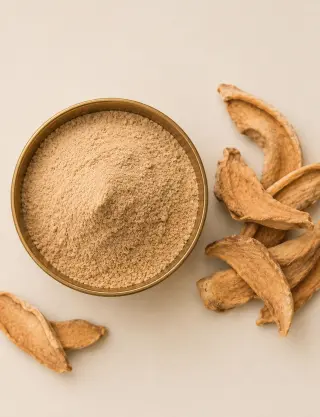
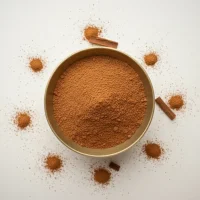
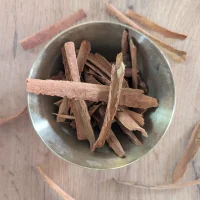
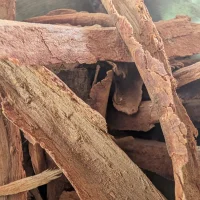
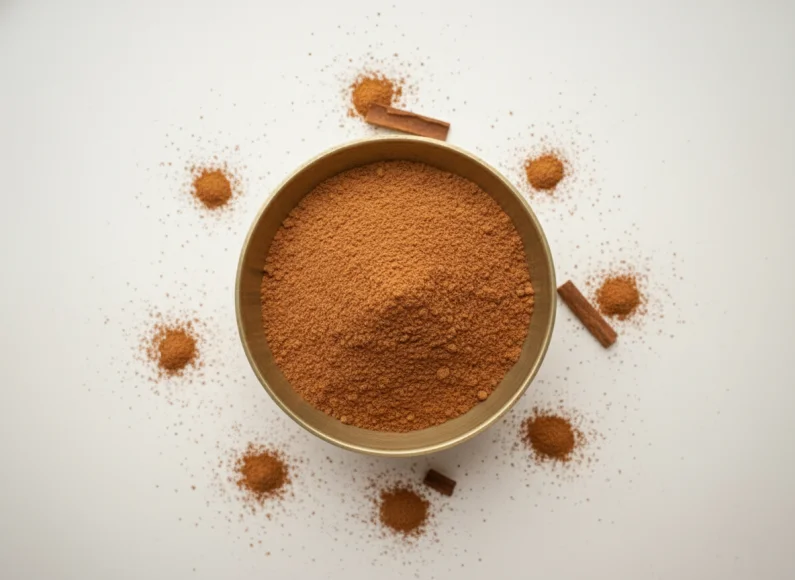
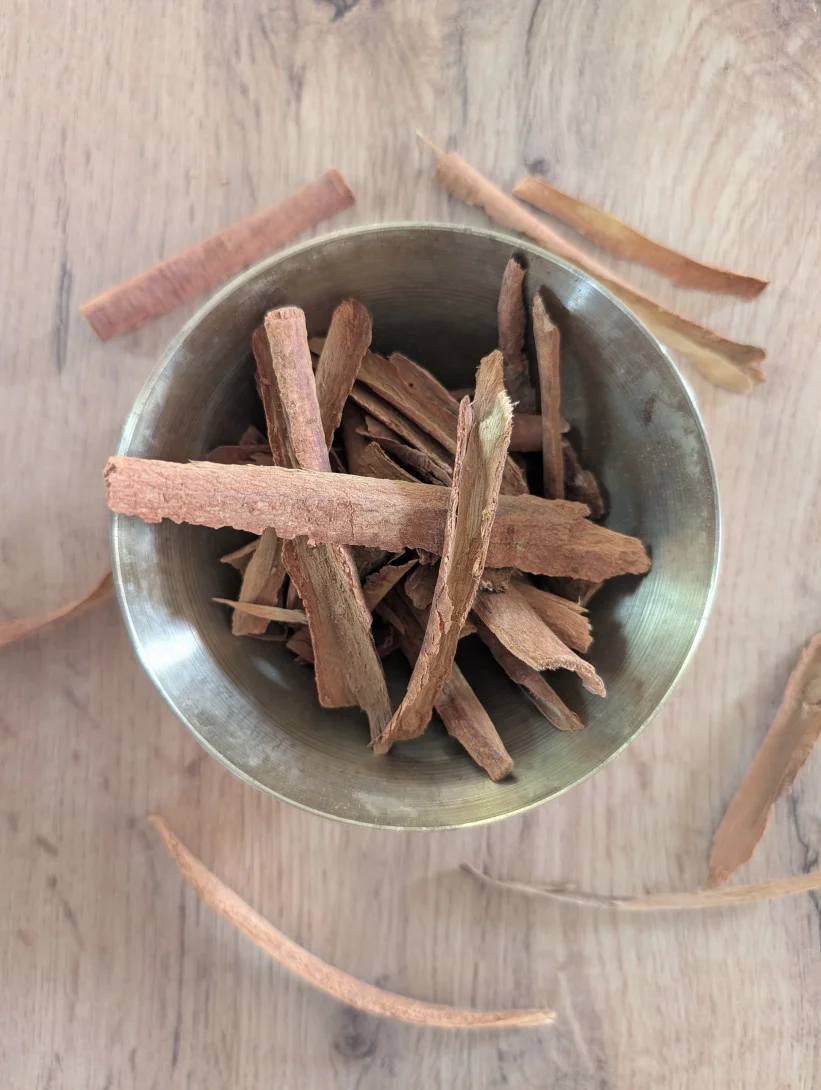
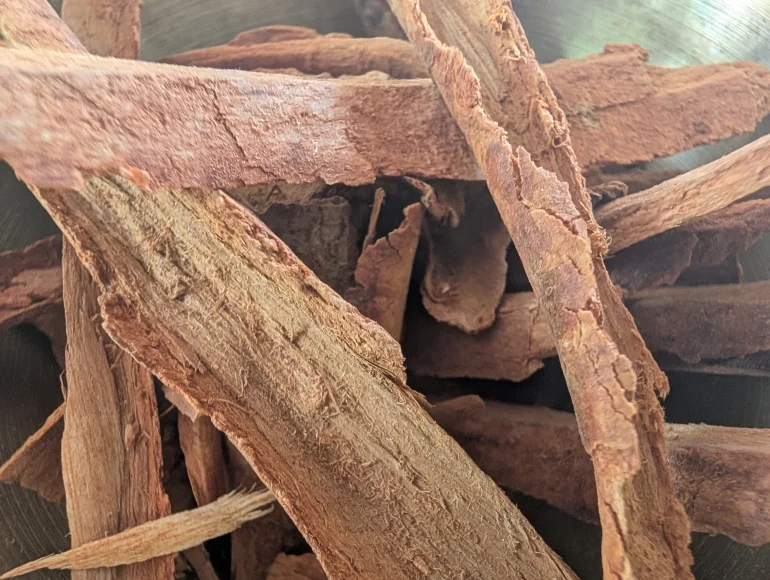
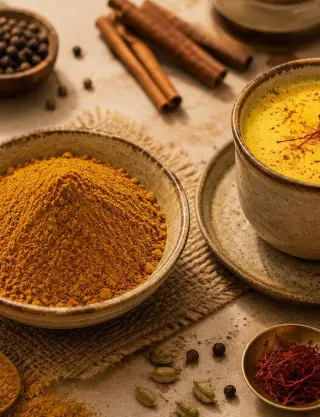
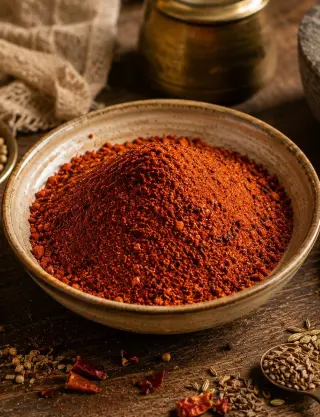
A cassia stick forms a thick hollow tube, with a single layer of bark rolled in on itself. It is hard and does not break easily. Ceylon cinnamon shows multiple thin layers rolled like a cigar and crumbles easily between the fingers. As a powder, cassia is a deep red-brown, while Ceylon is a lighter brown-beige.
Kerala cassia cinnamon has a powerful and warming aromatic profile, immediately recognisable. It is this flavour: warm, sweet, slightly piquant: that most French consumers spontaneously identify as 'cinnamon'. More intense and less subtle than Ceylon, it asserts itself in cooked preparations with a force that true cinnamon cannot match.
The dominant aromatic compound is trans-cinnamaldehyde, which accounts for 75 to 95% of the essential oil of the bark: a concentration significantly higher than that of Ceylon cinnamon (49.9 to 62.8%). This high level is what gives cassia its aromatic power and its ability to withstand prolonged cooking without losing its flavour.
Tasting notes
| Stage | Notes perceived |
|---|
| First olfactory impression | Warm, sweet, immediately recognisable: 'the' cinnamon of childhood memories |
| Heart notes | Woody, warm spice, slightly camphorous, hints of golden caramel |
| Base notes | Slightly bitter, astringent, notes of dry wood and resin |
| On the palate | Frank, persistent warmth, sweetness followed by a touch of bitterness on the finish |
| Through cooking | Remarkably heat-resistant: retains its power even after prolonged cooking |
| Freshly ground | Intense aromatic burst: fresh powder is incomparably richer than old powder |
Ideal aromatic pairings
| Family | Pairings |
|---|
| Warm spices | Clove, nutmeg, ginger, star anise: the gingerbread quartet |
| Indian spices | Cardamom, black pepper, turmeric, cumin: the base of Garam Masala |
| Fruits | Apple, pear, plum, cherry, orange: the pastry classics |
| Sugars | Honey, brown sugar, caramel, maple syrup: amplify the natural sweetness |
| Chocolate | Dark and milk chocolate: an age-old Mesoamerican pairing |
| Dairy | Cream, butter, whole milk: the fat rounds out the power |
Chef's tip
Ground cassia is more practical than Ceylon for baking: it disperses evenly through batters and mixtures, and its power withstands oven heat. For gingerbread, an apple cake or Christmas biscuits, cassia delivers the most flavourful result. Reserve Ceylon for no-bake preparations or finishing touches.
Cassia cinnamon powder is the baking spice par excellence in France and across much of the world. Its aromatic power and ability to withstand heat make it the ideal partner for cooked preparations: where Ceylon cinnamon, more delicate, would lose its nuances.
In French pastry
- Gingerbread: cassia is the dominant spice of traditional gingerbread: alongside clove, nutmeg and ginger
- Apple pie: a teaspoon in the filling, mixed with the apples: the absolute classic
- Apple compote: add at the end of cooking for a warm, enveloping fragrance
- Rice pudding: a generous pinch in the hot milk, or sprinkled on top
- Crêpes and waffles: stir directly into the batter, or sprinkle with sugar
- Christmas biscuits: speculoos, Alsatian bredele, cinnamon shortbread: cassia is essential
- Cinnamon rolls: cassia mixed with brown sugar and butter
In Indian cuisine
- Garam masala: cassia cinnamon is a central component of this northern Indian spice blend
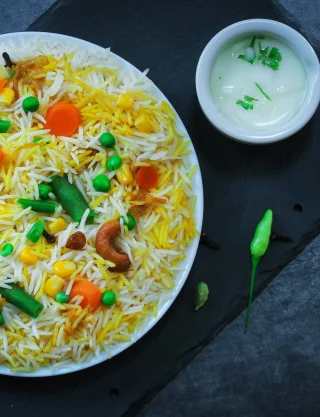
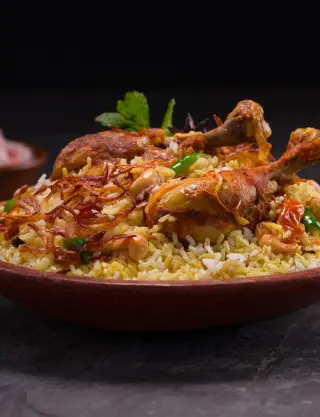
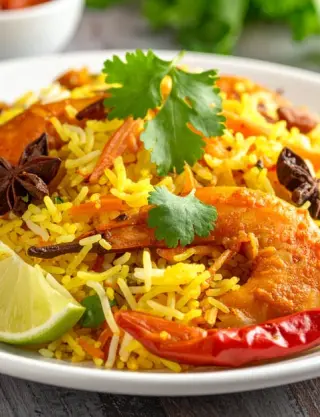
- Biryanis: pieces of bark are tucked between layers of rice to perfume the whole dish
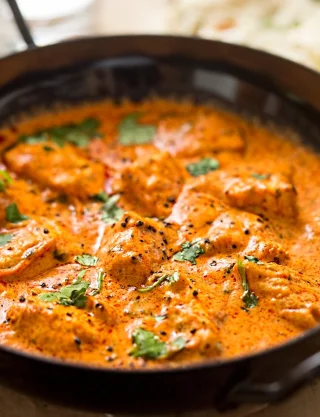
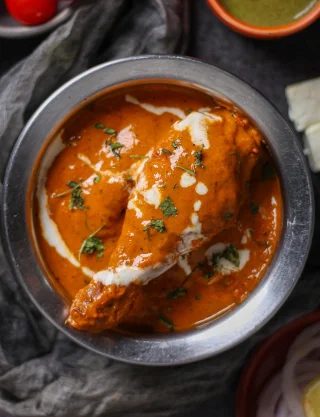
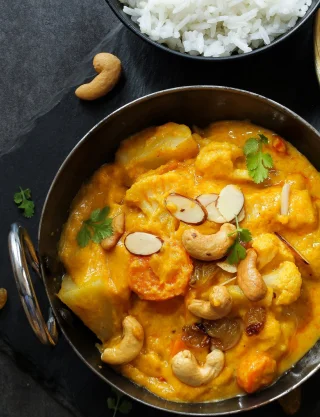
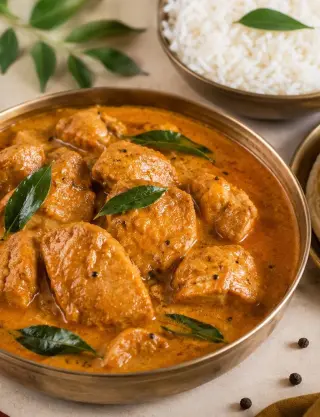
- Kerala curries: in meat curries (lamb, chicken) and rich coconut-cream kormas
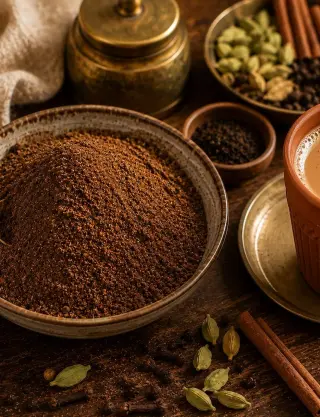
- Chai masala: an essential component of Indian spiced tea, alongside cardamom, ginger and clove
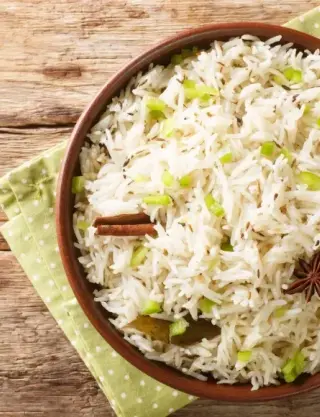
- Pulao and fragrant rice: a touch of powder in the cooking water of basmati rice
- Indian desserts: kheer (rice pudding), carrot halwa, gulab jamun
In international cuisine
- Mulled wine: cassia withstands boiling and perfumes the wine powerfully: it is the one traditionally used, not Ceylon
- Chinese five-spice (wǔ xiāng fěn): cassia, star anise, clove, fennel seed, Sichuan pepper
- American apple pie: cassia is the cinnamon of the United States: it is what gives American apple pie its flavour
- Hot chocolate: a pinch in hot milk with cocoa: an age-old pairing
- Vietnamese phở: Vietnamese cassia (C. loureiroi) perfumes the broth of this emblematic dish
- Moroccan cuisine: pastilla, prune tagines, royal couscous: cassia is the sweet spice par excellence of the Maghreb
- Swedish kanelbullar: the famous Scandinavian cinnamon buns use cassia exclusively
Recommended dosages
| Preparation | Dosage for 4 people |
|---|
| Cake / apple pie | 1 to 2 teaspoons |
| Fruit compote | 1/2 to 1 teaspoon |
| Rice pudding / cream | 1/4 to 1/2 teaspoon |
| Curry / biryani | 1/2 to 1 teaspoon |
| Chai masala (per cup) | 1/4 teaspoon |
| Mulled wine (1 litre) | 1 teaspoon |
| Gingerbread | 2 to 3 teaspoons |
Cassia cinnamon has numerous therapeutic properties documented by modern science, largely attributed to its high cinnamaldehyde content. It has been used for millennia in traditional Chinese medicine (ròu guì) and in Ayurveda (dalchini) for its warming and tonifying virtues.
The main active compounds are trans-cinnamaldehyde (75-95% of the essential oil: anti-inflammatory, antimicrobial), polyphenols of the proanthocyanidin type (blood-sugar-lowering effect), cinnamic acid (antioxidant) and coumarin (anticoagulant, but potentially hepatotoxic at high doses).
Documented properties
- Blood-sugar regulation: the most studied property. Several meta-analyses have shown that cassia cinnamon supplementation significantly reduces fasting blood glucose in type 2 diabetic patients. The mechanism involves increased insulin sensitivity and inhibition of alpha-glucosidase digestive enzymes
- Antimicrobial: cinnamaldehyde shows powerful bactericidal activity against E. coli, Salmonella, Staphylococcus aureus and Listeria monocytogenes. Cassia is being studied as a natural food preservative
- Anti-inflammatory: cinnamaldehyde inhibits the NF-κB and COX-2 pathways, reducing the production of pro-inflammatory cytokines (TNF-alpha, IL-6)
- Antioxidant: rich in polyphenols, cassia ranks among foods with the highest antioxidant capacity (high ORAC index)
- Cardiovascular: clinical studies suggest a reduction in total cholesterol, LDL and triglycerides
- Digestive: stimulates gastric juice secretion, reduces bloating and flatulence: a traditional use in Ayurveda and Chinese medicine
- Warming: in traditional Chinese medicine, cassia is classified as a 'hot' plant that warms the body, stimulates blood circulation and relieves cold-related joint pain
Coumarin: the essential precaution with cassia
Cassia contains significant levels of coumarin (2,650 to 7,017 mg/kg), a compound that is potentially hepatotoxic at high doses. The European Food Safety Authority (EFSA) has set a tolerable daily intake (TDI) of 0.1 mg per kg of body weight. For a 60 kg adult, this amounts to 6 mg of coumarin per day: roughly 1 to 2 teaspoons of ground cassia. For comparison, Ceylon cinnamon contains 250 to 40,000 times less coumarin and poses no such risk.
Recommendation: cassia is perfectly safe in normal culinary use. However, daily supplementation at high doses (more than 6 g per day) over a long period is not advised, particularly for people with liver disease or those taking anticoagulants.
Nutritional values (per 1 tablespoon / 8 g)
| Component | Content |
|---|
| Cinnamaldehyde | 75 to 95% of the essential oil |
| Essential oil | 1 to 4% of total weight |
| Coumarin | 2,650 to 7,017 mg/kg |
| Fibre | ~4.3 g |
| Calcium | ~80 mg (8% of RDI) |
| Iron | ~0.7 mg (4% of RDI) |
| Manganese | ~1.4 mg (60% of RDI) |
| Calories | ~19 kcal |
How to recognise good cassia cinnamon powder
- Colour: a deep, even red-brown: a dull or greyish colour indicates an old or poorly stored powder
- Aroma: powerful, warm and immediately recognisable when the pouch is opened: if the smell is faint, the powder has lost its essential oils
- Texture: fine and homogeneous powder, without lumps or coarse fibres
- Taste: warm, sweet, slightly bitter on the finish: a purely sweet flavour without complexity points to a low-quality cassia
- Stated origin: a serious supplier will indicate the species (C. cassia or C. verum) and the country of origin
Storage advice
- Keep in an airtight glass jar or an opaque resealable pouch, away from light and moisture
- Never store near a heat source (stove, oven, sunny window): heat degrades cinnamaldehyde
- Optimal shelf life: 6 months to 1 year as powder: ground cinnamon gradually loses its essential oils on contact with air
- For maximum freshness, prefer whole sticks and grind as needed (sticks keep for 2 to 3 years)
- Signs of decline: weakened aroma, faded colour, flat taste without warmth: the powder is still safe to use but will add little to your dishes
The freshness test trick
Pour a pinch of ground cinnamon into the palm of your hand and rub. If the fragrance is immediately intense and warming, the powder is fresh. If you have to bring your nose close to perceive the aroma, it is time to replace it.
What is the difference between Ceylon cinnamon and cassia cinnamon?
They are two distinct botanical species. Ceylon cinnamon (Cinnamomum verum) has a thin bark, a sweet and floral flavour, and contains very little coumarin. Cassia (Cinnamomum cassia) has a thick bark, a powerful and warm flavour, and contains significantly more coumarin. Both have their uses: cassia excels in baking and cooked dishes, Ceylon in delicate preparations and infusions.
Is cassia cinnamon dangerous for health?
In normal culinary use (1 to 2 teaspoons per day), cassia is perfectly safe. The risk concerns only daily high-dose supplementation over a long period, due to its coumarin content. EFSA recommends not exceeding 0.1 mg of coumarin per kg of body weight per day. For people consuming cinnamon daily in large quantities, Ceylon cinnamon is a risk-free alternative.
Why is 90% of the cinnamon sold in France actually cassia?
Cassia is more abundant, less expensive and has a more powerful flavour than Ceylon. French regulations allow the label 'cinnamon' for both species, which keeps the confusion alive. Most consumers know only the taste of cassia and identify it as 'the' cinnamon. True Ceylon cinnamon is a niche product, 3 to 5 times more expensive.
Can cassia cinnamon powder be used in chai?
Absolutely. Cassia is traditionally used in Indian chai masala. Its aromatic power perfectly withstands the boiling of milk and spices. Use about 1/4 teaspoon per cup, with cardamom, ginger and clove.
How can I tell whether my ground cinnamon is cassia or Ceylon?
Three clues: colour (cassia = deep red-brown, Ceylon = light brown-beige), taste (cassia = powerful and slightly bitter, Ceylon = sweet and floral), and price (Ceylon costs 3 to 5 times more). If the label simply says 'cinnamon' without specifying the species, it is very likely cassia.








 Appetizers