The Indian bay leaf is mentioned in the oldest Sanskrit texts under the name tamala patra (तमालपत्र), literally "dark leaf". The Charaka Samhita, the foundational treatise of Ayurvedic medicine compiled around the 2nd century BCE, already prescribes it for stimulating digestion and treating respiratory disorders.
In Graeco-Roman antiquity, malabathrum (a term derived from Sanskrit tamala patra via Tamil) referred to the aromatic leaves imported from India. Pliny the Elder mentions them in his Natural History (1st century CE) as one of the most precious commodities of the Eastern trade. Dioscorides, in his De Materia Medica, describes their medicinal and cosmetic uses. These leaves were so prized in Rome that they featured among the goods taxed at the port of Alexandria.
Malabathrum: an ancient treasure
The Roman poet Horace mentions malabathrum in his Odes as a luxury perfume. Wealthy Romans infused the leaves in oil to create scented ointments. The Periplus Maris Erythraei, a 1st-century navigation manual, lists malabathrum among the most lucrative exports from India to the Mediterranean world.
Over the centuries, tej patta became a foundational ingredient of Mughal cuisine. The cooks of the imperial court systematically incorporated it into biryanis, kormas and pulaos. It was during this period (between the 16th and 18th centuries) that the recipes for garam masala were codified, with tej patta holding a central place alongside cardamom, clove and cinnamon.
In Nepal, tej patta is far more than a simple condiment: it is a major export commodity. Nepal is today the world's largest producer of Indian bay leaves, with an annual harvest that sustains tens of thousands of families in the central and eastern hills of the country.
Did you know?
- The word malabathrum used by the Romans derives from Sanskrit tamala patra via Tamil, evidence of direct trade between South India and Rome from the 1st century onward
- Tej patta is often confused with European bay laurel (Laurus nobilis), but the two belong to different botanical families and share neither taste nor aroma
- In India, a tej patta leaf is sometimes placed in jars of rice or lentils to repel insects, a traditional practice that exploits its natural repellent properties
- Fresh leaves have almost no aroma; it is the drying process that concentrates and develops the essential oils
- Cinnamomum tamala can live over 100 years and reach 20 metres in height
- Tej patta is listed in the official Indian pharmacopoeia as a recognised medicinal plant
Tej patta across languages
| Language | Name |
|---|
| French | Laurier indien / Feuille de cannelier |
| Hindi | Tej Patta (तेज पत्ता) |
| Sanskrit | Tamala Patra (तमालपत्र) |
| Nepali | Tej Pat (तेजपात) |
| Bengali | Tej Pata (তেজ পাতা) |
| Tamil | Talishappattiri (தாளிசப்பத்திரி) |
| Malayalam | Karuva Ila (കറുവ ഇല) |
| English | Indian Bay Leaf / Tej Patta |
| German | Indisches Lorbeerblatt |
| Latin (ancient) | Malabathrum |
| Botanical Latin | Cinnamomum tamala (Buch.-Ham.) T.Nees & Eberm. |
The Hindi name tej patta literally means "pungent leaf" or "vivid leaf": tej (तेज) evoking strength and intensity, and patta (पत्ता) meaning leaf. The name refers to the leaf's characteristic aromatic warmth, inherited from its kinship with the cinnamon trees.
| Characteristic | Detail |
|---|
| Latin name | Cinnamomum tamala (Buch.-Ham.) T.Nees & Eberm. |
| Botanical family | Lauraceae, the cinnamon family |
| Local names | Tej Patta (Hindi) / Tamala Patra (Sanskrit) / Tej Pat (Nepali) |
| Part used | Dried leaves |
| Plant type | Evergreen tree, 10 to 20 m in height |
| Main aromatic compound | Eugenol (40-70%) and cinnamaldehyde |
| Harvest | October to December: mature leaves picked by hand |
| Drying | In the shade for 3 to 7 days to preserve colour and aroma |
Cinnamomum tamala thrives in the Himalayan foothills, at altitudes between 500 and 2,500 metres. It is a tree of humid subtropical forests, requiring well-drained, humus-rich soil and abundant rainfall.
Nepal is the world's leading producer of tej patta. The Cinnamomum tamala forests cover the central and eastern hills of the country, in the districts of Udayapur, Khotang, Bhojpur, Sindhuli and Palpa. The harvest represents an essential source of income for the rural communities of these regions.
Growing regions
- Nepal (central and eastern): world's leading producer: natural and semi-cultivated forests between 1,000 and 2,000 m altitude. Production estimated at 10,000 to 15,000 tonnes of dried leaves per year
- North-East India (Meghalaya, Sikkim, Arunachal Pradesh): ideal conditions in the Khasi Hills and mountain forests. Significant production, largely destined for the domestic market
- Uttarakhand (India): the Kumaon and Garhwal valleys: traditional harvesting in community forests
- Bhutan: modest but high-quality production in subtropical broadleaf forests
Beware of botanical confusion
The English "bay leaf" and the French laurier-sauce (Laurus nobilis) are plants entirely different from tej patta (Cinnamomum tamala). Laurus nobilis belongs to the Lauraceae family but to the genus Laurus, while tej patta belongs to the genus Cinnamomum, the cinnamon trees. Their aromatic profile, appearance and culinary uses are distinct. In an Indian recipe, European bay laurel cannot replace tej patta.
Botany
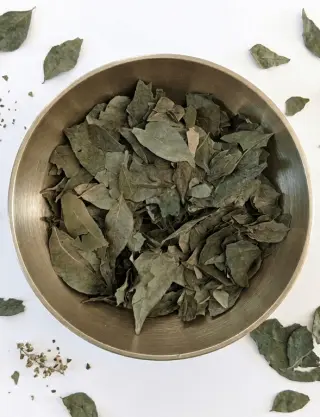
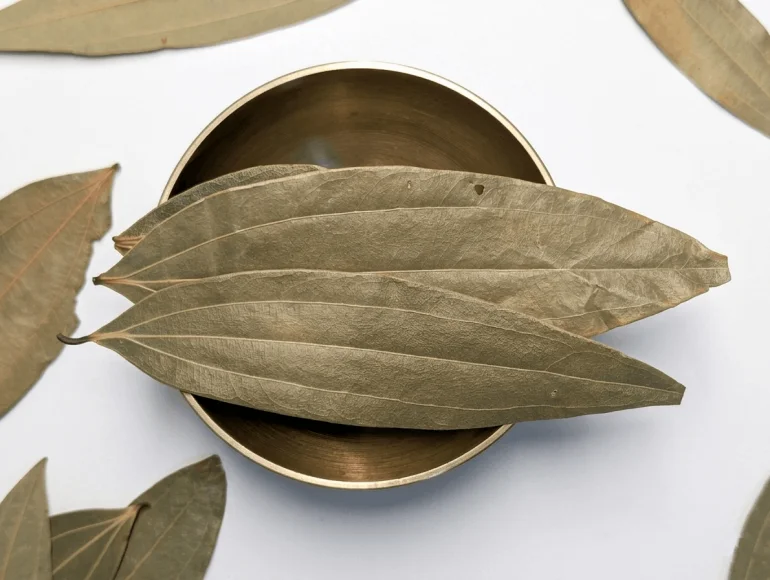
Cinnamomum tamala is an evergreen tree that can reach 20 metres in height. Its leaves are large (12 to 20 cm), oval-lanceolate, leathery, deep olive-green on the upper surface and paler beneath.
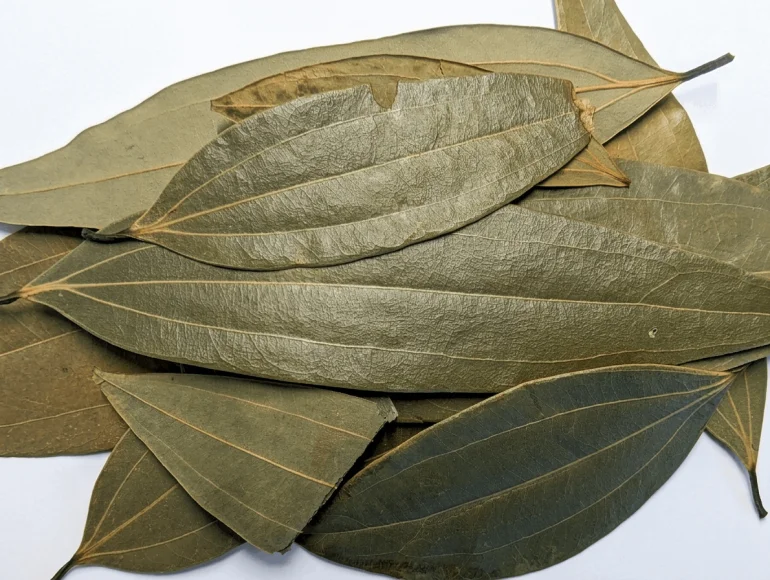
Identification is straightforward thanks to one distinctive trait: tej patta leaves display three parallel longitudinal veins, clearly visible, running from the base to the tip. European bay laurel, by comparison, has only a single central vein with lateral veins arranged in a herringbone pattern. This is the most reliable way to tell the two species apart.
| Criterion | Tej Patta (C. tamala) | European bay (L. nobilis) |
|---|
| Veins | 3 parallel longitudinal veins | 1 central vein, herringbone laterals |
| Leaf size | 12 to 20 cm, longer | 5 to 10 cm, shorter |
| Colour (dried) | Brown-olive, matte | Grey-green, slightly glossy |
| Aroma | Cinnamon, clove, sweet | Herbaceous, camphorous, minty |
| Aromatic family | Cinnamomum (cinnamon trees) | Laurus (laurels) |
| Origin | Himalayas (Nepal, North-East India) | Mediterranean |
The tree flowers between March and May, producing small yellowish-green blooms. The fruits are small oval drupes, black when ripe, sometimes used as a spice in certain regions of Nepal under the name tejphal.
Tej patta offers an aromatic profile radically different from that of European bay laurel. Where bay laurel is herbaceous and lightly camphorous, tej patta unfolds a warm and sweet palette dominated by notes of cinnamon, clove and nutmeg. It is an enveloping, woody and subtly sweet aroma.
This difference is explained by chemical composition: tej patta is rich in eugenol (the compound of clove) and cinnamaldehyde (the compound of cinnamon), whereas European bay laurel contains mainly cineole (eucalyptol).
| Aromatic note | Description |
|---|
| Top note | Spicy freshness, slightly peppery |
| Heart note | Sweet cinnamon, clove, nutmeg |
| Base note | Warm woody, lightly smoky, lingering sweetness |
| On the palate | Aromatic warmth without heat, light astringency |
The aroma develops during cooking
Unlike many spices that lose their aroma to heat, tej patta gradually releases its essential oils as it cooks. That is why it is added at the start of preparation, in hot oil or broth, and left to infuse throughout the cooking time. Remove it before serving: the leaf itself is tough and is not meant to be eaten.
Tej patta is a foundational ingredient of Indian cuisine. It features in virtually every curry, biryani, dal and fragrant rice preparation. Its role is that of a background aromatic: it never dominates a dish but lends it a characteristic depth and complexity.
In Indian cooking
- In the tadka (tempering): the leaf is dropped into hot oil or ghee at the very start of cooking, alongside cumin seeds, cardamom and cloves. It crackles and releases its fat-soluble aromas within seconds
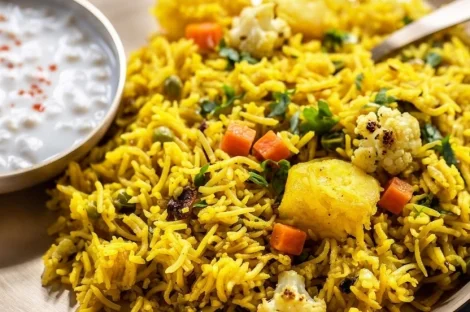
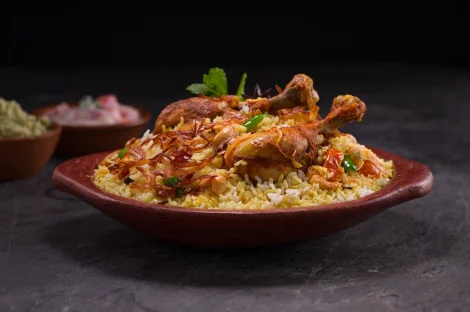
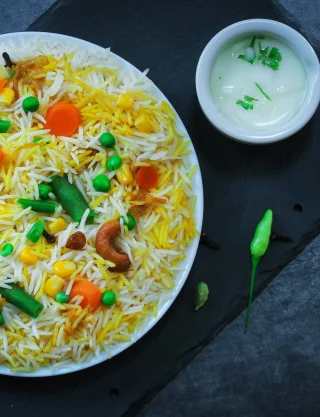
- In biryani: an indispensable ingredient: 2 to 3 leaves are added to the basmati cooking water and to the layer of spices between the rice and the meat
- In garam masala: an essential component of this iconic North Indian spice blend, alongside cinnamon, cardamom and clove
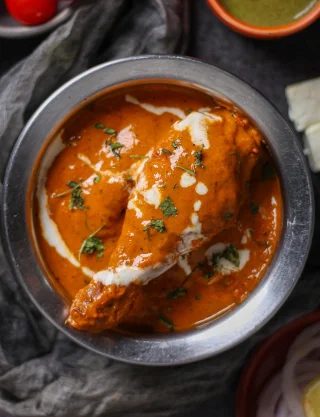
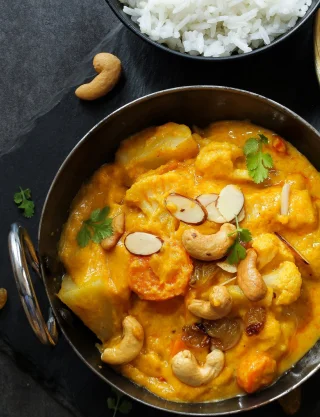
- In curries: present in kormas, rogan josh, nihari and most sauce-based curries
- In dals: perfumes lentils as they cook: dal makhani, dal tadka, chana dal
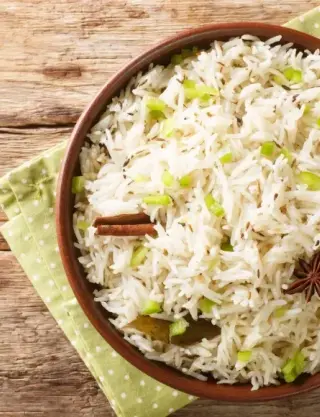
- In pulao and fragrant rice: added to the water with cardamom and clove for a subtly perfumed rice
- In chai masala: some family recipes include a piece of tej patta in the spice blend for tea
How to use
- Quantity: 1 to 3 leaves per dish is enough: tej patta is powerful, and an excess makes the dish bitter
- Always remove before serving: the leaf is tough and unpleasant on the palate. Its only role is to perfume the dish as it cooks
- Do not crumble: use the leaf whole or broken in half. Very small pieces are hard to remove and may be swallowed by accident
- Do not substitute European bay laurel: the aromatic profile is completely different. Bay laurel would bring camphorous and herbaceous notes that would distort an Indian recipe
The freshness test
Fold a leaf between your fingers: a quality leaf should remain supple without crumbling, and immediately release a warm cinnamon aroma. If the leaf is brittle and odourless, it is too old and will add nothing to the dish.
Beyond Indian cuisine
- Nepali cuisine: omnipresent in dals, meat curries and momo masala (the seasoning for Nepali dumplings)
- Pakistani cuisine: in nihari (a meat stew simmered overnight), haleem and the biryanis of Karachi
- Bangladeshi cuisine: in kormas and fish curries
- Infusions: as a digestive tisane with ginger and cardamom: a popular remedy after a hearty meal
Tej patta has held an important place in the Ayurvedic pharmacopoeia for over 2,000 years. The Charaka Samhita classifies it among plants that balance the kapha and vata doshas, and recommends it to stimulate the digestive fire (agni). Modern research has begun to validate several of these traditional uses.
Documented properties
- Digestive: stimulates the secretion of digestive enzymes and relieves bloating, gas and indigestion. In Ayurveda, an infusion of tej patta after a meal is a classic remedy
- Antidiabetic: several studies (Khan et al., 2009; Sharma et al., 2018) have shown that regular consumption of tej patta may contribute to lowering fasting blood glucose and improving insulin sensitivity. The polyphenols and flavonoids of the leaf are involved in this mechanism
- Anti-inflammatory: eugenol, the dominant compound, is a well-known anti-inflammatory that inhibits the production of pro-inflammatory mediators
- Antioxidant: rich in polyphenols, flavonoids and vitamins A and C, tej patta neutralises free radicals
- Antimicrobial: the essential oil of Cinnamomum tamala has shown activity against several pathogenic bacteria (E. coli, S. aureus) and certain fungi
- Respiratory: in traditional medicine, inhaling tej patta steam is used to clear the airways in cases of cold or nasal congestion
- Cardiovascular: preliminary studies suggest a beneficial effect on the lipid profile (reduction in total cholesterol and triglycerides)
Precautions for use
Never swallow the leaf whole: its rigid edges may irritate or injure the digestive tract. Always remove the leaves from the dish before serving. If you are on antidiabetic medication, consult your doctor before taking tej patta as a supplement, as it may potentiate the hypoglycaemic effect of these drugs.
Nutritional composition (per 100 g of dried leaves)
| Component | Content |
|---|
| Essential oil | 0.5 to 1.5% (eugenol, cinnamaldehyde, linalool) |
| Fibre | ~26 g |
| Calcium | ~834 mg |
| Iron | ~43 mg |
| Magnesium | ~120 mg |
| Vitamin A | ~6,185 IU |
| Vitamin C | ~46 mg |
| Calories | ~313 kcal |
How to recognise a good tej patta
- Veins: check for 3 parallel longitudinal veins running from the base: this is the signature of true Cinnamomum tamala. A single central vein indicates European bay laurel
- Colour: brown-olive to light brown, uniform. Yellowish or faded leaves are too old
- Suppleness: the leaf should remain slightly supple and bend without crumbling
- Aroma: when you crush the leaf, a warm cinnamon and clove aroma should release immediately. A herbaceous or camphorous scent points to European bay laurel
- Size: authentic leaves are large, 12 to 20 cm long, distinctly bigger than European bay
- Integrity: whole leaves or large pieces, with no dust or debris
Storage tips
- Store in an airtight glass jar or resealable pouch, away from light, heat and humidity
- Never store above the stove: heat and moisture degrade the essential oils
- Optimal shelf life: 1 year to 18 months under good storage conditions. Beyond that, the aroma weakens considerably
- Signs of degradation: faint or absent aroma when crumpled, pale colour, brittle leaf with no suppleness
- Freezing is possible: the leaves keep well in the freezer in an airtight pouch for up to 2 years, with minimal aroma loss
What is the difference between tej patta and European bay laurel?
They are two completely different species. Tej patta (Cinnamomum tamala) belongs to the cinnamon family and shows 3 parallel longitudinal veins, with an aroma of cinnamon and clove. European bay laurel (Laurus nobilis) has only one central vein, with a herbaceous, camphorous aroma. They are not interchangeable in cooking.
Can European bay laurel be used in place of tej patta in an Indian recipe?
No, it is not recommended. European bay laurel would bring camphorous and herbaceous notes that would distort the dish. If you do not have tej patta, it is better to omit it and add a small piece of cinnamon stick and a clove to partly compensate for its aroma.
Why does tej patta need to be removed before serving?
The tej patta leaf is stiff and tough, even after long cooking. It is not meant to be eaten and can irritate the digestive tract if swallowed. Its only role is to infuse its aromas into the dish as it cooks. Remove it as you would a cinnamon stick.
How do you recognise authentic tej patta?
Look at the veins: tej patta has 3 parallel longitudinal veins, clearly visible, running from base to tip. European bay laurel has only one central vein. Tej patta is also larger (12-20 cm), brown-olive in colour, and releases a cinnamon aroma when crushed.
How many leaves should be used per dish?
In general, 1 to 3 leaves are enough to perfume a dish for 4 to 6 people. Tej patta is powerful: in excess it can make the dish bitter. For a biryani, count 2 to 3 leaves. For a dal or curry, a single leaf is often enough.










 Gravy Dishes