Table Indienne
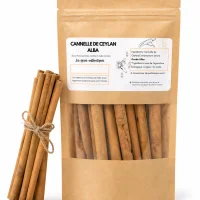
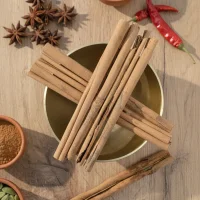
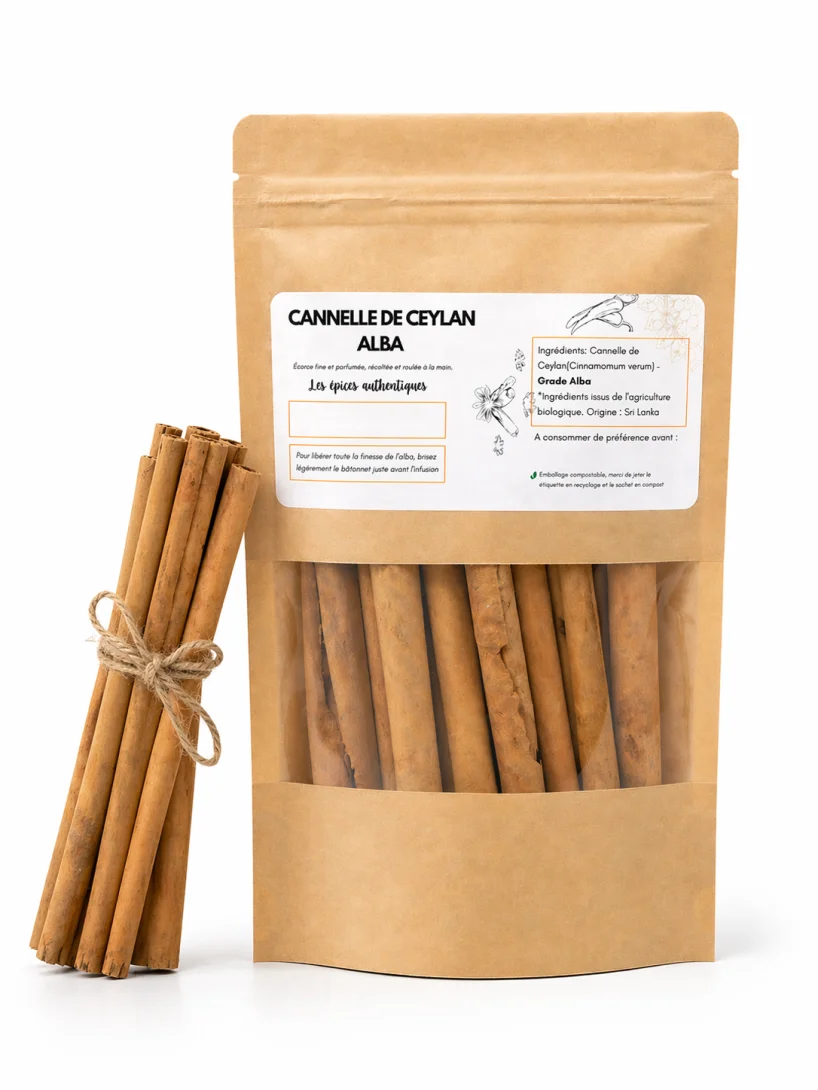
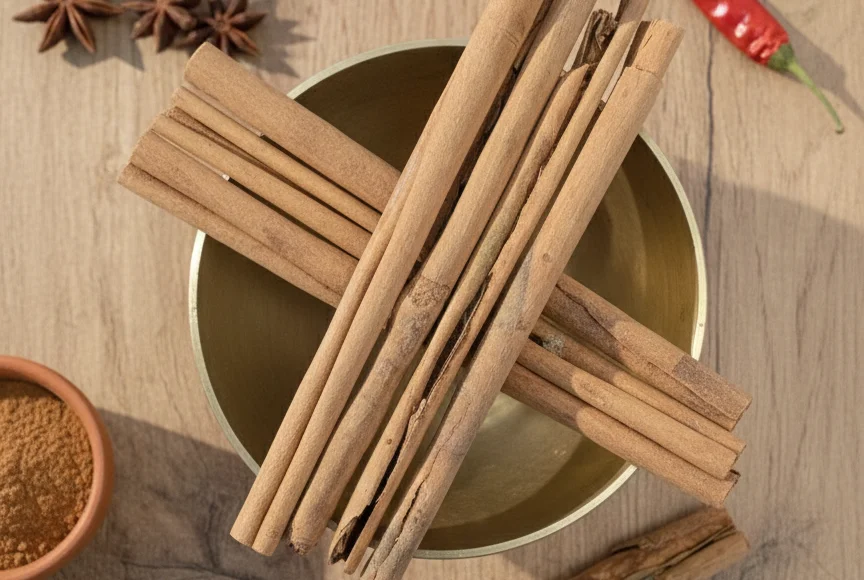
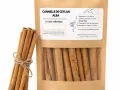
Discover our Ceylon cinnamon Alba grade, the finest grade of true cinnamon (Cinnamomum verum), grown in Sri Lanka. Delicate and gently sweet aroma, paper-thin golden quills to enhance your pastries, beverages and sweet-savoury dishes.
Ready for shipping, delivery time 2-5 business days
Delivery from €3.99 at Mondial Relay pickup points. Free shipping from €45.
Free spice samples with every order.
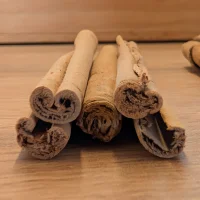
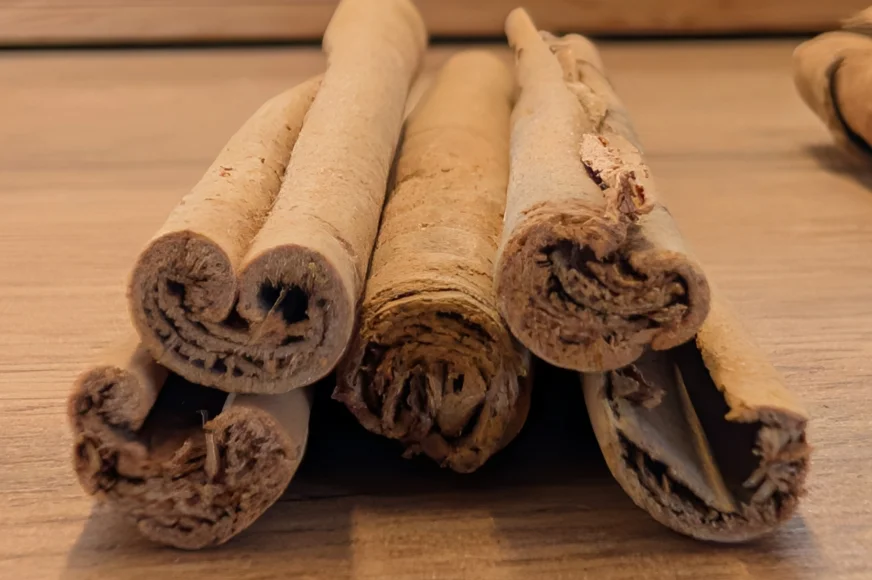
Ceylon cinnamon Alba grade represents the absolute excellence of true cinnamon (Cinnamomum verum). Produced exclusively in Sri Lanka, the original home of cinnamon, the Alba grade is the finest of all grades: its quills have a diameter of less than 6mm and are formed from near-transparent layers of bark of exceptional delicacy. This cinnamon is radically different from cassia cinnamon (sold in supermarkets) due to its very low coumarin content, making it completely safe for daily consumption.
Alba grade is the premium grade of Ceylon cinnamon. Its ultra-thin quills break and powder easily, instantly releasing their floral and gently sweet aroma. The coumarin content is up to 250 times lower than that of cassia cinnamon — a recognised public health concern that makes Ceylon cinnamon the essential choice for regular use. Alba grade also offers the silkiest texture and the most nuanced aromatic profile.
We source our spices exclusively from certified organic producers in Sri Lanka, guaranteeing authentic true cinnamon, natural, with no additives or preservatives.
To preserve all its aromas, store your cinnamon quills in a dry place, away from light and humidity, in their original airtight packaging.
Very low coumarin content, safe for daily use
Helps regulate blood sugar naturally
Anti-inflammatory and antioxidant properties
Improves digestion and soothes nausea
Promotes cardiovascular health
Natural antibacterial and antifungal properties
Supports brain health and memory
Strengthens the immune system
Nutritional declaration per 100g
| Nutritional component | Per 100g |
|---|---|
| Energy | 1 035 kJ / 247 kcal |
| Fat | ~ 1,2 g |
| of which saturated fat | ~ 350 mg |
| Carbohydrates | ~ 80,6 g |
| of which sugars | ~ 2,2 g |
| Dietary fiber | ~ 53,1 g |
| Proteins | ~ 4 g |
| Salt | ~ 40 mg |
| Supplier certified organic | Yes |
| Pesticides free | Yes |
| Origin | Sri Lanka |
| Quality | Alba (Premium Grade) |
| Type | Whole quills |
| Taste profile | Floral, soft and slightly sweet aroma with notes of vanilla and clove. Far more delicate and nuanced than cassia cinnamon. |
True cinnamon is one of the oldest and most coveted spices in human history. For millennia it has been at the heart of trade routes, colonial wars and imperial strategies — a spice so precious that some historians place it among the direct causes of the great European explorations of the 15th and 16th centuries.
Its earliest documented traces go back to ancient Egypt, around 2,000 BCE. The Egyptians used it in their embalming preparations and ritual offerings. It is mentioned in the Hebrew Bible (Exodus 30:23, Proverbs 7:17), in the oldest Sanskrit Ayurvedic texts, and in Greek accounts from the 7th century BCE — Sappho already evokes cassia in her poems.
Cinnamon is one of the few spices mentioned by name in the Bible. In Exodus (30:23), God commands Moses to use cinnamon (kinemon in Hebrew) to prepare the holy anointing oil. In Proverbs (7:17), it perfumes the bed of the seductress. The Egyptians had been importing it for at least 2,000 years BCE — by what routes remained a mystery, for Arab merchants jealously guarded the secret of its origin to keep prices high.
The Greeks and Romans knew cinnamon but were unaware of its exact provenance. Arab traders told them that it was guarded by giant birds that built their nests with its branches. This absurd fable, reported in earnest by Herodotus, illustrates how far intermediaries went to protect their trade circuits.
When Vasco da Gama landed at Calicut in 1498 and discovered that cinnamon grew abundantly along the Malabar Coast, it triggered a commercial revolution. The Portuguese quickly took control of Sri Lanka and established the first organised colonial monopoly on a spice. In 1638, the Dutch wrested Sri Lanka from the Portuguese. A dazzled Dutch captain wrote: the shores of the island are covered with it, and when the wind blows seaward, the scent of cinnamon can be felt eight leagues offshore.
In 1767, Lord Brown of the British East India Company founded the Anjarakandy plantation in the Kannur district of Kerala. It is one of the largest cinnamon plantations in Asia, still in operation today. Its creation sparked the first large-scale spice war in India: the local king Pazhassi Raja and the East India Company fought several wars for control of this estate. In order to register this colonial property, the British established the first land registry office of the Indian subcontinent — an administrative system that would later spread across the whole of India.
The British took control of Sri Lanka from the Dutch in 1796, consolidating their dominance over the global cinnamon trade. At the same time, however, cultivation spread to Jamaica, Brazil, the Caribbean and Southeast Asia, progressively breaking the monopoly.
Today, Sri Lanka produces around 80 to 90% of the world output of Cinnamomum verum. India — and Kerala in particular — produces the rest, and the quality of the cinnamon from the Western Ghats is considered by many connoisseurs to be equal to, or even superior to, the Ceylonese.
| Language | Name |
|---|---|
| French | Cannelle vraie / Cannelle de Ceylan |
| Hindi / Urdu | Dalchini (दालचीनी) |
| Malayalam (Kerala) | Karuva patta (കറുവ പട്ട) |
| Tamil | Lavangapattai (இலவங்கப்பட்டை) |
| Sanskrit | Tvak / Darusita |
| English | True Cinnamon / Ceylon Cinnamon |
| Arabic | Qirfa (قرفة) |
| Portuguese | Canela do Ceilão |
| Sinhala (Sri Lanka) | Kurundu |
| Botanical Latin | Cinnamomum verum J. Presl (1825) |
The etymology of the word "cinnamon" comes from the Old French canel (12th century), derived from medieval Latin canella — a diminutive of canna (tube, reed), referring to the cylindrical shape of the rolled sticks. That same Latin canna also gave "canon", "canal" and "channel" in English. The scientific name Cinnamomum comes from the Greek kinnamomon, borrowed from the Phoenician qinnamon — a root also found in biblical Hebrew.

| Characteristic | Detail |
|---|---|
| Latin name | Cinnamomum verum J. Presl (syn. C. zeylanicum Blume) |
| Botanical family | Lauraceae — same family as bay laurel, avocado and camphor |
| Local names | Karuva patta (Malayalam) / Dalchini (Hindi) |
| Part used | Dried inner bark (rolled into quills) |
| Quality grades | Alba (the finest) · C5 Special · Mexican (M5, M4) · Hamburg (H1, H2) · Quillings |
| Cinnamaldehyde content | 49.9 to 62.8% of the essential oil of the bark |
| Coumarin | Trace amounts: 0.017 to 0.18 mg/kg (vs 2,650 to 7,017 mg/kg for cassia) |
| Harvest | Wet season preferred — the bark peels away more easily |
| Drying | In the shade, then in complete darkness to preserve the essential oils |
Cinnamomum verum is one of the rare spices whose natural range includes both Sri Lanka and South India. The tree is indigenous — native, growing in the wild — to the humid forests of the Western Ghats, in particular in Kerala. This common origin explains why Kerala cinnamon and Ceylon cinnamon share the same botanical name and a very similar aromatic profile.
The two are botanically identical (Cinnamomum verum). In Sri Lanka, semi-industrial production uses brass tools to produce ultra-regular sticks. In Kerala, harvesting is artisanal with traditional knives, yielding sticks of less perfect shape but an aromatic richness judged by many connoisseurs to be equal to — or even superior to — the Ceylonese.
| Producing region | Share and characteristics |
|---|---|
| Sri Lanka (Ceylon) | 80 to 90% of world C. verum production — semi-industrial production, very regular sticks |
| India — Kerala | ~10% of world production — wild cinnamon trees in the Ghats — artisanal production, premium quality |
| India — Karnataka | Low volume — ancient tradition — C. citriodorum (Malabar cinnamon) also cultivated |
| Madagascar | Growing production — C. verum — decent quality — exported to Europe |
| Seychelles | C. verum has become invasive — limited volume |
Cinnamomum verum is an evergreen tree of the Lauraceae family. In the wild, it reaches 10 to 15 metres; in plantations, it is pruned to 2-3 metres to make harvesting easier. The first harvest takes place after 3 years, and the tree can produce for 40 to 50 years.
Making cinnamon quills is a manual craft that remains fundamentally non-mechanisable for the finest grades. The branches are cut, the outer bark is scraped away, then the inner bark — extremely thin (0.5 to 1 mm) — is peeled off, rolled into multiple layers and slowly dried in the shade. As it dries, the bark curls naturally into a spiral, forming the characteristic multi-layered quill.
Look at the cross-section of the stick. True cinnamon shows multiple fine layers rolled together, like a layered cigar — it is friable and can be ground easily. Cassia is a thick, hard bark forming a hollow or semi-solid tube. The colour confirms it: light beige-brown for the real thing, deep red-brown for cassia.
True cinnamon develops an aromatic profile of a delicacy and complexity that bears no resemblance to the pungent power of cassia. It is precisely this subtlety that earns it its status as a noble spice.
The main aromatic compound is trans-cinnamaldehyde (49.9 to 62.8% of the essential oil of the bark), accompanied by eugenol (10-15%), linalool (3-5%) and beta-caryophyllene (2-3%). Cassia contains up to 95% cinnamaldehyde but almost no eugenol or linalool — which explains its one-dimensional profile.
| Tasting note | Description |
|---|---|
| First olfactory impression | Sweet, warm, lightly floral — a sophisticated fragrance, closer to jasmine than to candy |
| Heart notes | Complex sweet cinnamon, floral nuances (eugenol), pale citrus, distant vanilla |
| Base | Delicate spicy warmth, imperceptible white pepper, gentle vegetal sap |
| On the palate | Pleasant, non-aggressive warmth, lightly astringent, long, sweet aromatic finish |
| In a hot infusion | Rounded and complex — the gentle warmth diffuses gradually |
| Freshly ground | A floral-spicy aromatic explosion — the most expressive form |
| Criterion | True cinnamon (C. verum) | Cassia (C. cassia) |
|---|---|---|
| General profile | Sweet, floral, complex | Intense, pungent, one-dimensional |
| Stick colour | Light brown, golden beige | Deep red-brown, mahogany |
| Stick structure | Multiple fine layers, friable | Thick, hard bark, hollow tube |
| Cinnamaldehyde | 50 to 63% | Up to 95% |
| Coumarin | 0.017 to 0.18 mg/kg | 2,650 to 7,017 mg/kg |
True cinnamon is the spice of preparations where subtlety comes first. Its most delicate aromatic compounds (linalool, eugenol) evaporate easily with heat. Chefs add it at the end of cooking, in cold infusions, or in preparations without cooking. It is the spice of custards, ganaches, infusions and perfumes.
True cinnamon calls for a different approach from cassia in the kitchen. Its delicacy is a quality, not a weakness — provided it is used in preparations that bring this subtlety to the fore.
True cinnamon is one of the most scientifically studied spices. Hundreds of clinical and preclinical studies have been published on its properties, particularly since the discovery of its antidiabetic potential in the 1990s and 2000s. Its decisive advantage over cassia is the near-total absence of coumarin, which alone makes it truly safe for daily use.
The main active compounds are trans-cinnamaldehyde (anti-inflammatory), eugenol (antibacterial, analgesic), linalool (anxiolytic), proanthocyanidins and catechins (antidiabetic), and dimeric and tetrameric procyanidins (documented insulin-like activity).
| Criterion | True cinnamon (C. verum) | Cassia (C. cassia) |
|---|---|---|
| Coumarin | 0.017 to 0.18 mg/kg | 2,650 to 7,017 mg/kg |
| Difference factor | 10,000 to 40,000 times less in true cinnamon | |
| Tolerable daily intake (EFSA) | 0.1 mg/kg of body weight | |
| 1 teaspoon (~2.6 g) | Well below the threshold | 6.9 to 18 mg of coumarin — exceeds the limit for an adult |
| Daily use | Safe and recommended | Documented hepatotoxic risk |
True cinnamon is safe at usual culinary doses. Concentrated supplements (capsules, extracts), however, should be used with care: avoid doses above 2 g per day in supplementation. Cinnamon can potentiate the effects of blood-sugar-lowering and anticoagulant medications. Not recommended at medicinal doses for pregnant women. The essential oil of the bark is caustic to the skin — never apply it pure.
| Grade | Description and use |
|---|---|
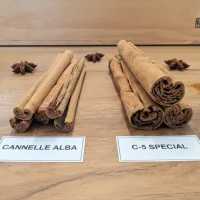
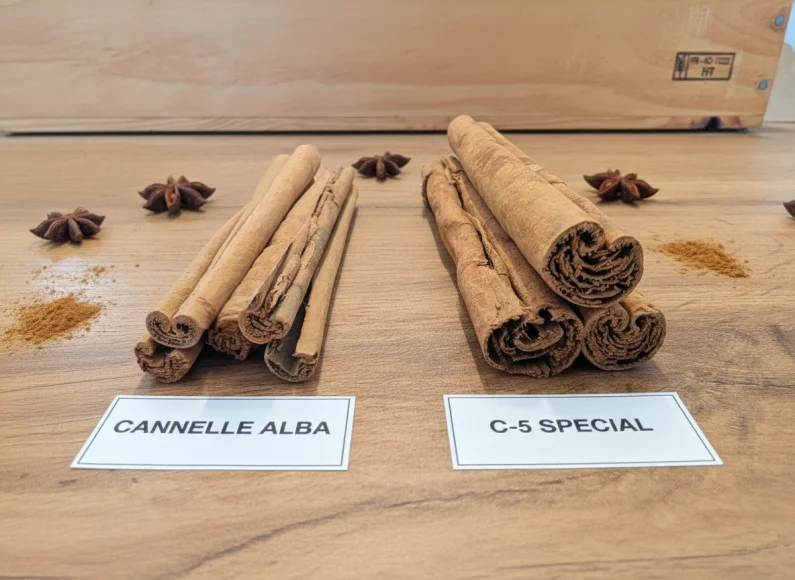
| Alba | Very fine diameter (< 6 mm) — palest colour — reserved for premium markets — the most aromatic |
| Continental / C5 Special | Very high quality — diameter 6-12 mm — destined for high-end European markets |
| Mexican (M5, M4) | Widespread commercial standard — diameter 18-23 mm — golden-brown colour |
| Hamburg (H1, H2) | Standard quality — diameter 21-23 mm — common export |
| Quillings | Bark fragments < 106 mm — used for grinding and essential oil |
The visual test is infallible: look at the cross-section of the stick. True cinnamon (C. verum) has multiple fine layers rolled together, like the pages of a rolled-up book — it is friable and breaks easily. Cassia has a thick, hard bark forming an almost solid tube. The colour confirms it: light beige-brown for the real thing, deep red-brown for cassia. If you are buying powder, insist on the botanical name Cinnamomum verum on the label.
The intense, pungent flavour that most people associate with cinnamon is in fact the profile of cassia — a different species with up to 95% cinnamaldehyde. True cinnamon contains only 50 to 63% cinnamaldehyde but is enriched with eugenol, linalool and other compounds that give it a floral, sweet and complex profile. After a few uses you will perceive the greater subtlety of true cinnamon.
The difference is major and scientifically documented. Cassia contains between 2,650 and 7,017 mg/kg of coumarin — a hepatotoxic compound whose daily tolerated dose, set by the EFSA, is 0.1 mg/kg of body weight. A single teaspoon of cassia can exceed this limit. True cinnamon contains between 0.017 and 0.18 mg/kg of coumarin — 10,000 to 40,000 times less. For daily use, true cinnamon is the only safe option.
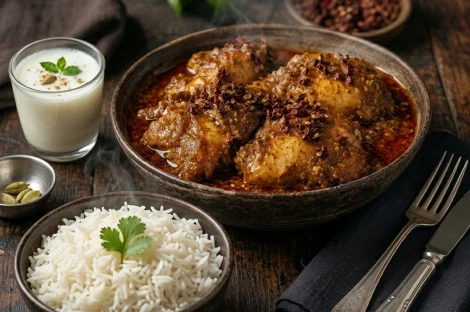
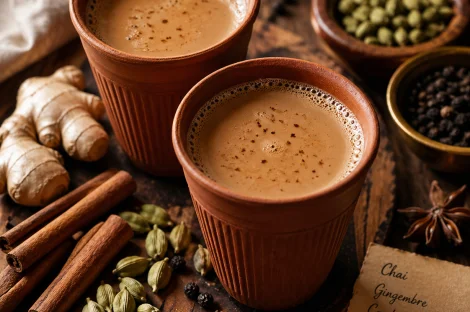
Yes for most recipes, but the results will differ. True cinnamon excels in fine desserts, infusions, chai, custards and drinks. For robust dishes such as heavily spiced biryanis or intense gingerbreads, cassia gives a result closer to what people are used to. In everyday French cooking and quality pastry, true cinnamon is superior.
They are botanically identical — both are Cinnamomum verum. The difference lies in the harvesting methods: in Sri Lanka, semi-industrial production with brass tools yields regular sticks. In Kerala, the harvest is artisanal, done by the farmers themselves, giving sticks of less perfect shape but an aromatic richness considered by many connoisseurs to be equal or even superior. The Anjarakandy plantation (Kannur, 1767) is among the largest and oldest in Asia.
For top-end gastronomic use (fine desserts, chocolate work), choose the Alba or C5 Special grade — the finest and most aromatic. For premium everyday cooking, Mexican M5 or M4 offers excellent value for money. To grind your own powder, Quillings are ideal and more economical.
True cinnamon is one of the oldest and most coveted spices in human history. For millennia it has been at the heart of trade routes, colonial wars and imperial strategies — a spice so precious that some historians place it among the direct causes of the great European explorations of the 15th and 16th centuries.
Its earliest documented traces go back to ancient Egypt, around 2,000 BCE. The Egyptians used it in their embalming preparations and ritual offerings. It is mentioned in the Hebrew Bible (Exodus 30:23, Proverbs 7:17), in the oldest Sanskrit Ayurvedic texts, and in Greek accounts from the 7th century BCE — Sappho already evokes cassia in her poems.
Cinnamon is one of the few spices mentioned by name in the Bible. In Exodus (30:23), God commands Moses to use cinnamon (kinemon in Hebrew) to prepare the holy anointing oil. In Proverbs (7:17), it perfumes the bed of the seductress. The Egyptians had been importing it for at least 2,000 years BCE — by what routes remained a mystery, for Arab merchants jealously guarded the secret of its origin to keep prices high.
The Greeks and Romans knew cinnamon but were unaware of its exact provenance. Arab traders told them that it was guarded by giant birds that built their nests with its branches. This absurd fable, reported in earnest by Herodotus, illustrates how far intermediaries went to protect their trade circuits.
When Vasco da Gama landed at Calicut in 1498 and discovered that cinnamon grew abundantly along the Malabar Coast, it triggered a commercial revolution. The Portuguese quickly took control of Sri Lanka and established the first organised colonial monopoly on a spice. In 1638, the Dutch wrested Sri Lanka from the Portuguese. A dazzled Dutch captain wrote: the shores of the island are covered with it, and when the wind blows seaward, the scent of cinnamon can be felt eight leagues offshore.
In 1767, Lord Brown of the British East India Company founded the Anjarakandy plantation in the Kannur district of Kerala. It is one of the largest cinnamon plantations in Asia, still in operation today. Its creation sparked the first large-scale spice war in India: the local king Pazhassi Raja and the East India Company fought several wars for control of this estate. In order to register this colonial property, the British established the first land registry office of the Indian subcontinent — an administrative system that would later spread across the whole of India.
The British took control of Sri Lanka from the Dutch in 1796, consolidating their dominance over the global cinnamon trade. At the same time, however, cultivation spread to Jamaica, Brazil, the Caribbean and Southeast Asia, progressively breaking the monopoly.
Today, Sri Lanka produces around 80 to 90% of the world output of Cinnamomum verum. India — and Kerala in particular — produces the rest, and the quality of the cinnamon from the Western Ghats is considered by many connoisseurs to be equal to, or even superior to, the Ceylonese.
| Language | Name |
|---|---|
| French | Cannelle vraie / Cannelle de Ceylan |
| Hindi / Urdu | Dalchini (दालचीनी) |
| Malayalam (Kerala) | Karuva patta (കറുവ പട്ട) |
| Tamil | Lavangapattai (இலவங்கப்பட்டை) |
| Sanskrit | Tvak / Darusita |
| English | True Cinnamon / Ceylon Cinnamon |
| Arabic | Qirfa (قرفة) |
| Portuguese | Canela do Ceilão |
| Sinhala (Sri Lanka) | Kurundu |
| Botanical Latin | Cinnamomum verum J. Presl (1825) |
The etymology of the word "cinnamon" comes from the Old French canel (12th century), derived from medieval Latin canella — a diminutive of canna (tube, reed), referring to the cylindrical shape of the rolled sticks. That same Latin canna also gave "canon", "canal" and "channel" in English. The scientific name Cinnamomum comes from the Greek kinnamomon, borrowed from the Phoenician qinnamon — a root also found in biblical Hebrew.
| Characteristic | Detail |
|---|---|
| Latin name | Cinnamomum verum J. Presl (syn. C. zeylanicum Blume) |
| Botanical family | Lauraceae — same family as bay laurel, avocado and camphor |
| Local names | Karuva patta (Malayalam) / Dalchini (Hindi) |
| Part used | Dried inner bark (rolled into quills) |
| Quality grades | Alba (the finest) · C5 Special · Mexican (M5, M4) · Hamburg (H1, H2) · Quillings |
| Cinnamaldehyde content | 49.9 to 62.8% of the essential oil of the bark |
| Coumarin | Trace amounts: 0.017 to 0.18 mg/kg (vs 2,650 to 7,017 mg/kg for cassia) |
| Harvest | Wet season preferred — the bark peels away more easily |
| Drying | In the shade, then in complete darkness to preserve the essential oils |
Cinnamomum verum is one of the rare spices whose natural range includes both Sri Lanka and South India. The tree is indigenous — native, growing in the wild — to the humid forests of the Western Ghats, in particular in Kerala. This common origin explains why Kerala cinnamon and Ceylon cinnamon share the same botanical name and a very similar aromatic profile.
The two are botanically identical (Cinnamomum verum). In Sri Lanka, semi-industrial production uses brass tools to produce ultra-regular sticks. In Kerala, harvesting is artisanal with traditional knives, yielding sticks of less perfect shape but an aromatic richness judged by many connoisseurs to be equal to — or even superior to — the Ceylonese.
| Producing region | Share and characteristics |
|---|---|
| Sri Lanka (Ceylon) | 80 to 90% of world C. verum production — semi-industrial production, very regular sticks |
| India — Kerala | ~10% of world production — wild cinnamon trees in the Ghats — artisanal production, premium quality |
| India — Karnataka | Low volume — ancient tradition — C. citriodorum (Malabar cinnamon) also cultivated |
| Madagascar | Growing production — C. verum — decent quality — exported to Europe |
| Seychelles | C. verum has become invasive — limited volume |
Cinnamomum verum is an evergreen tree of the Lauraceae family. In the wild, it reaches 10 to 15 metres; in plantations, it is pruned to 2-3 metres to make harvesting easier. The first harvest takes place after 3 years, and the tree can produce for 40 to 50 years.
Making cinnamon quills is a manual craft that remains fundamentally non-mechanisable for the finest grades. The branches are cut, the outer bark is scraped away, then the inner bark — extremely thin (0.5 to 1 mm) — is peeled off, rolled into multiple layers and slowly dried in the shade. As it dries, the bark curls naturally into a spiral, forming the characteristic multi-layered quill.
Look at the cross-section of the stick. True cinnamon shows multiple fine layers rolled together, like a layered cigar — it is friable and can be ground easily. Cassia is a thick, hard bark forming a hollow or semi-solid tube. The colour confirms it: light beige-brown for the real thing, deep red-brown for cassia.
True cinnamon develops an aromatic profile of a delicacy and complexity that bears no resemblance to the pungent power of cassia. It is precisely this subtlety that earns it its status as a noble spice.
The main aromatic compound is trans-cinnamaldehyde (49.9 to 62.8% of the essential oil of the bark), accompanied by eugenol (10-15%), linalool (3-5%) and beta-caryophyllene (2-3%). Cassia contains up to 95% cinnamaldehyde but almost no eugenol or linalool — which explains its one-dimensional profile.
| Tasting note | Description |
|---|---|
| First olfactory impression | Sweet, warm, lightly floral — a sophisticated fragrance, closer to jasmine than to candy |
| Heart notes | Complex sweet cinnamon, floral nuances (eugenol), pale citrus, distant vanilla |
| Base | Delicate spicy warmth, imperceptible white pepper, gentle vegetal sap |
| On the palate | Pleasant, non-aggressive warmth, lightly astringent, long, sweet aromatic finish |
| In a hot infusion | Rounded and complex — the gentle warmth diffuses gradually |
| Freshly ground | A floral-spicy aromatic explosion — the most expressive form |
| Criterion | True cinnamon (C. verum) | Cassia (C. cassia) |
|---|---|---|
| General profile | Sweet, floral, complex | Intense, pungent, one-dimensional |
| Stick colour | Light brown, golden beige | Deep red-brown, mahogany |
| Stick structure | Multiple fine layers, friable | Thick, hard bark, hollow tube |
| Cinnamaldehyde | 50 to 63% | Up to 95% |
| Coumarin | 0.017 to 0.18 mg/kg | 2,650 to 7,017 mg/kg |
True cinnamon is the spice of preparations where subtlety comes first. Its most delicate aromatic compounds (linalool, eugenol) evaporate easily with heat. Chefs add it at the end of cooking, in cold infusions, or in preparations without cooking. It is the spice of custards, ganaches, infusions and perfumes.
True cinnamon calls for a different approach from cassia in the kitchen. Its delicacy is a quality, not a weakness — provided it is used in preparations that bring this subtlety to the fore.
True cinnamon is one of the most scientifically studied spices. Hundreds of clinical and preclinical studies have been published on its properties, particularly since the discovery of its antidiabetic potential in the 1990s and 2000s. Its decisive advantage over cassia is the near-total absence of coumarin, which alone makes it truly safe for daily use.
The main active compounds are trans-cinnamaldehyde (anti-inflammatory), eugenol (antibacterial, analgesic), linalool (anxiolytic), proanthocyanidins and catechins (antidiabetic), and dimeric and tetrameric procyanidins (documented insulin-like activity).
| Criterion | True cinnamon (C. verum) | Cassia (C. cassia) |
|---|---|---|
| Coumarin | 0.017 to 0.18 mg/kg | 2,650 to 7,017 mg/kg |
| Difference factor | 10,000 to 40,000 times less in true cinnamon | |
| Tolerable daily intake (EFSA) | 0.1 mg/kg of body weight | |
| 1 teaspoon (~2.6 g) | Well below the threshold | 6.9 to 18 mg of coumarin — exceeds the limit for an adult |
| Daily use | Safe and recommended | Documented hepatotoxic risk |
True cinnamon is safe at usual culinary doses. Concentrated supplements (capsules, extracts), however, should be used with care: avoid doses above 2 g per day in supplementation. Cinnamon can potentiate the effects of blood-sugar-lowering and anticoagulant medications. Not recommended at medicinal doses for pregnant women. The essential oil of the bark is caustic to the skin — never apply it pure.
| Grade | Description and use |
|---|---|
| Alba | Very fine diameter (< 6 mm) — palest colour — reserved for premium markets — the most aromatic |
| Continental / C5 Special | Very high quality — diameter 6-12 mm — destined for high-end European markets |
| Mexican (M5, M4) | Widespread commercial standard — diameter 18-23 mm — golden-brown colour |
| Hamburg (H1, H2) | Standard quality — diameter 21-23 mm — common export |
| Quillings | Bark fragments < 106 mm — used for grinding and essential oil |
The visual test is infallible: look at the cross-section of the stick. True cinnamon (C. verum) has multiple fine layers rolled together, like the pages of a rolled-up book — it is friable and breaks easily. Cassia has a thick, hard bark forming an almost solid tube. The colour confirms it: light beige-brown for the real thing, deep red-brown for cassia. If you are buying powder, insist on the botanical name Cinnamomum verum on the label.
The intense, pungent flavour that most people associate with cinnamon is in fact the profile of cassia — a different species with up to 95% cinnamaldehyde. True cinnamon contains only 50 to 63% cinnamaldehyde but is enriched with eugenol, linalool and other compounds that give it a floral, sweet and complex profile. After a few uses you will perceive the greater subtlety of true cinnamon.
The difference is major and scientifically documented. Cassia contains between 2,650 and 7,017 mg/kg of coumarin — a hepatotoxic compound whose daily tolerated dose, set by the EFSA, is 0.1 mg/kg of body weight. A single teaspoon of cassia can exceed this limit. True cinnamon contains between 0.017 and 0.18 mg/kg of coumarin — 10,000 to 40,000 times less. For daily use, true cinnamon is the only safe option.
Yes for most recipes, but the results will differ. True cinnamon excels in fine desserts, infusions, chai, custards and drinks. For robust dishes such as heavily spiced biryanis or intense gingerbreads, cassia gives a result closer to what people are used to. In everyday French cooking and quality pastry, true cinnamon is superior.
They are botanically identical — both are Cinnamomum verum. The difference lies in the harvesting methods: in Sri Lanka, semi-industrial production with brass tools yields regular sticks. In Kerala, the harvest is artisanal, done by the farmers themselves, giving sticks of less perfect shape but an aromatic richness considered by many connoisseurs to be equal or even superior. The Anjarakandy plantation (Kannur, 1767) is among the largest and oldest in Asia.
For top-end gastronomic use (fine desserts, chocolate work), choose the Alba or C5 Special grade — the finest and most aromatic. For premium everyday cooking, Mexican M5 or M4 offers excellent value for money. To grind your own powder, Quillings are ideal and more economical.
Nos épices sont importées directement d'Inde et conditionnées à la demande pour garantir une fraîcheur optimale. Contrairement aux épices vendues en grande surface qui peuvent rester des mois sur les étagères, nous veillons à ce que chaque épice conserve toute sa saveur et son arôme.
Chaque épice provient de régions spécifiques en Inde réputées pour leur savoir-faire. Nous travaillons directement avec des producteurs locaux qui cultivent leurs épices de manière traditionnelle et biologique, sans pesticides ni produits chimiques.
Pour révéler tous les arômes, nous recommandons de faire légèrement griller les épices entières à sec dans une poêle avant de les moudre. Conservez-les dans un endroit sec et à l'abri de la lumière pour préserver leur fraîcheur le plus longtemps possible.
Les épices entières sont bien meilleures que les épices moulues
Consultez notre article de blog pour découvrir pourquoi les épices entières conservent mieux leurs arômes.
Thank you! Your question has been sent. Mihika will answer soon and you will receive an email.
Other products you might like