Green cardamom is a spice whose human history spans more than four millennia. Native to the shaded forests of the Western Ghats in southern India, it has crossed civilisations, empires and continents without ever losing its status as an exceptional spice.
The earliest documented traces of its use go back to the Vedic period, around the 30th century BCE. The Sanskrit text Charaka Samhita, foundational to Ayurvedic medicine, cites it abundantly under the name ela for its digestive and purifying virtues. Dravidian merchants integrated it into trade with the ports of the Persian Gulf and the Red Sea from the first millennium BCE.
The cardamom of the pharaohs and the Roman emperors
The ancient Egyptians used cardamom in the making of perfumes and funerary ointments. Capsule fragments have been found in tombs of the 18th Dynasty. In ancient Greece, Theophrastus mentions it in his Historia Plantarum (4th century BCE). In Rome, Pliny the Elder cites it in his Natural History as a banquet digestive. Emperor Nero is said to have burned an entire year's production to perfume the streets of Rome at the funeral of his wife Poppaea: an act of absurd luxury that says everything about the value placed on this spice.
In the Middle Ages, Arab merchants held the monopoly on the cardamom trade to Europe. Vasco da Gama's arrival at Calicut in 1498 transformed that trade radically: by opening the direct maritime route, the Portuguese bypassed the Arab middlemen and seized control of the spice trade. Cardamom became a major economic justification for the colonisation of Kerala.
The most surprising episode of modern history is the rise of Guatemala as the world's leading producer by volume. In 1914, a German planter named Oscar Majus Kloeffer introduced cultivation in the high-altitude forests of Alta Verapaz. A century later, Guatemala produces about 70% of the world's cardamom, almost all of it exported to the Arab Gulf countries.
Volume vs quality: Guatemala and Kerala
Keralan cardamom, grown in its original terroir, develops an aromatic complexity and a cineole concentration superior to the Guatemalan variety. The markets of the Persian Gulf systematically pay a premium for Indian cardamom. Volume does not mean quality: Kerala remains the global reference despite lower volumes.
Did you know?
- Green cardamom is the 3rd most expensive spice in the world, after saffron (1st) and vanilla (2nd)
- Kerala is home to the world's largest cardamom market in Kumily (Idukki district), the global benchmark for prices
- The Njallani variety, developed by a farmer who only studied up to the equivalent of fifth grade, today occupies 88.7% of the cardamom acreage in Idukki district
- Sweden is the second-largest cardamom consumer per capita after India, about 60 g per person per year, mainly in traditional pastries
- The etymology of Elettaria comes from the Tamil elettari, ‘‘cardamom seed''; even in its scientific nomenclature, the plant carries its South Indian imprint
- The Njallani monoculture in Idukki district has contributed to a temperature rise of 0.3°C every ten years since 1978, documented by the Cardamom Research Station of Pampadumpara (2022 study)
- The seeds contain 383 mg of calcium per 100 g, higher than whole milk per gram
- Emperor Nero is said to have burned an entire year's production of cardamom to perfume the streets of Rome during a funeral
Green cardamom across languages
| Language | Name |
|---|
| French | Cardamome verte · Cardamome aromatique · Cardamome de Malabar |
| Hindi / Urdu | Choti Elaichi (छोटी इलायची) · Hari Elaichi |
| Sanskrit | Ela · Sukshmela · Truti |
| Tamil | Elakkai |
| Malayalam (Kerala) | Elam · Elathari (seed) |
| Kannada | Elakki |
| Gujarati | Elchi |
| Arabic | Hel · Habahan |
| English | Green Cardamom · True Cardamom |
| Swedish / Norwegian | Kardemumma |
| German | Grüner Kardamom |
| Botanical Latin | Elettaria cardamomum (L.) Maton |
The etymological story is a journey across civilisations. The Latin name Elettaria comes from the Tamil elettari (‘‘cardamom seed''), attesting that even in its modern scientific nomenclature, the plant carries the imprint of its South Indian Dravidian origin. The specific name cardamomum is Greek, and has come down through time since Theophrastus (4th century BCE) without changing a syllable.
| Characteristic | Detail |
|---|
| Botanical name | Elettaria cardamomum (L.) Maton |
| Family | Zingiberaceae, same family as ginger and turmeric |
| Local names | Choti Elaichi (Hindi) · Elakkai (Tamil) · Elam (Malayalam) |
| Part used | Whole dried green capsule and its aromatic black seeds |
| Global ranking | 3rd most expensive spice in the world, after saffron (1st) and vanilla (2nd) |
| Natural varieties | Malabar · Mysore · Vazhuka (natural hybrid) |
| Commercial cultivars | Njallani (Green Gold) · Pallakudi · ICRI-1 · ICRI-2 · IISR Vijetha |
| Essential-oil content | 4 to 10% depending on the cultivar, 1,8-cineole dominant (up to 50%) |
| Harvest | Manual, every 40–45 days, 8–9 harvests per plant per year |
| Benchmark market | Kumily, Idukki, Kerala, the world's largest cardamom market |
The region of original production carries a name that says it all: the Cardamom Hills. This chain of green hills forms the southern part of the Western Ghats, in the districts of Idukki and Wayanad in Kerala. Kumily, in Idukki district, is home to the largest cardamom auction market in the world.
The terroir that makes the difference
- Optimal altitude between 600 and 1,200 m according to the ICAR (Indian Council of Agricultural Research)
- Rainfall of 1,500 to 4,000 mm per year, well distributed; distribution matters more than total volume
- Optimal temperature of 18 to 23°C for flowering; growing range: 10 to 35°C
- Partial shade required: cardamom is a sciophyte plant, intolerant of direct sunlight
- Loamy soil, well-drained, rich in humus, slightly acidic (pH 4.6 to 6.5)
| Producing region | Share and characteristics |
|---|
| Guatemala (Alta Verapaz) | ~70% of global volume · Large pods · Good but less complex aroma |
| India: Kerala (Idukki, Wayanad) | 15–20% global · Qualitative reference · 3 natural varieties + improved cultivars |
| India: Karnataka (Coorg, Hassan) | ~5% global · Mainly the prostrate-panicle Malabar variety |
| Sri Lanka | ~5% global · Traditional production · Delicate aroma |
| Tanzania / Madagascar | Emerging production · Variable quality · Price-competitive |
Botany
Green cardamom (Elettaria cardamomum) is a perennial herbaceous plant with a creeping rhizome, belonging to the Zingiberaceae family. Leafy pseudo-stems rise up to 4 m from a network of underground rhizomes, while the flowers and fruits appear directly from the base; a feature called cauliflory.
- Pseudo-stems: 2 to 4 m tall, vivid green, formed of interlocking leaf sheaths
- Flowers: white to lilac or pale violet, on 30- to 60-cm spikes, creeping from the rhizome along the ground
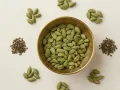
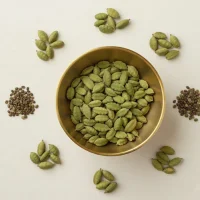
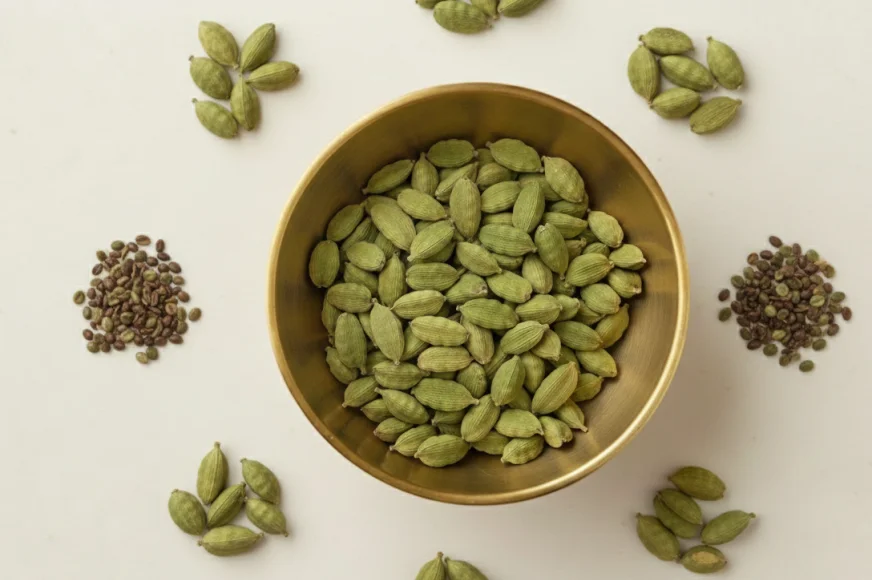
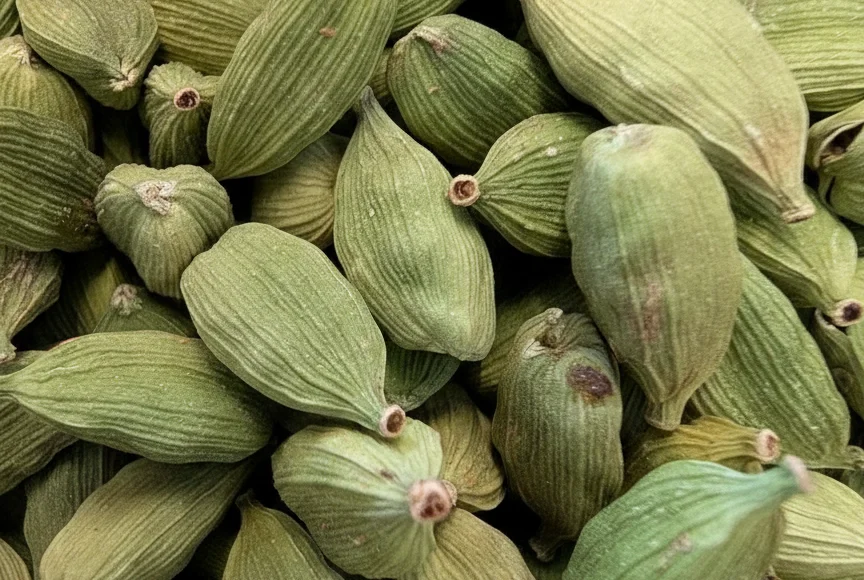
- Capsules: oval-trigonous, ribbed, pale green at maturity, 1 to 2 cm; containing 15 to 20 seeds
- Seeds: 3 to 4 mm, angular, black-brown; maximum concentration of essential oils
- Productive cycle: first harvests after 3 years; peak production between 5 and 10 years; life up to 20 years
- Pollination: cross-pollinated, mainly by Apis cerana; hand pollination increases yields by 25 to 30%
The scissor-harvest of the Adivasi women
In Kerala, each capsule is detached individually from its stem with small special scissors, every 40–45 days, 8 to 9 passes per plant per year. An experienced harvester gathers about 8 kg per day. This entirely manual, non-mechanisable character largely explains why cardamom is the third most expensive spice in the world. Women from the Adivasi tribal communities of Idukki and Wayanad are the main harvesters; a skill passed down from mother to daughter for generations.
The varieties of green cardamom in India
The varietal diversity of green cardamom in India is considerable, and little known to the general public. There are three natural botanical varieties (Malabar, Mysore, Vazhuka), to which are added several improved cultivars.
The three natural botanical varieties
| Variety | Panicle | Characteristics |
|---|
| Malabar (Nadan) | Prostrate, creeping along the ground | Native variety of Kerala · Small oval pods · Rich, warm aroma · Good resistance to pests |
| Mysore | Erect, vertical | Native of Karnataka · Larger pods · Higher cineole and limonene content, more aromatic · Very sensitive to thrips |
| Vazhuka | Semi-erect | Natural Malabar × Mysore hybrid · Compact vivid-green pods · Higher dry-weight yield than either parent · Preferred cultivar in Kerala |
Njallani, Green Gold: the agricultural revolution
Njallani was selected by the farmer Sebastian Joseph of Idukki, who only studied up to the equivalent of fifth grade. With his son Rejimon, he isolated exceptional plants through controlled cross-pollination. The result: 120 to 160 capsules per plant compared with 30–35 for ordinary varieties. Njallani today occupies 88.7% of the cardamom acreage in Idukki district (source: National Innovation Foundation India). Its weak point: more sensitive to pests and drought than the indigenous varieties, and its dominance has reduced genetic biodiversity.
The threat of monoculture
Since the 1990s, Njallani has progressively eliminated almost all other varieties from commercial plantations. Older varieties such as Pallakudi, Kanipparamban, Elam Rani and Mysore Vazhuka have nearly disappeared. This genetic homogenisation increases vulnerability to disease and contributes to the erosion of terroir; a concern documented by the Cardamom Research Station of Pampadumpara.
Institutional research cultivars
| Cultivar | Origin and characteristics |
|---|
| ICRI-1 (Malabar) | Released by the Spice Board (ICRI) · Abundant flowering · Extra-large dark-green globular pods · Yield 656 kg/ha |
| ICRI-2 (Mysore) | Released by ICRI · Performs well in irrigated conditions · Suited to high altitudes · Oblong parrot-green pods |
| PV-1 | Released by CRS Pampadumpara, KAU · Suited to Idukki forest reserves · Yield 982 kg/ha |
| IISR Vijetha | Released by IISR Kozhikode · High yields · Large, bold capsules |
| IISR Avinash | Released by IISR · Recent variety · Increased resistance to fungal diseases |
Green cardamom has one of the most complex and seductive aromatic profiles in the spice world. Its balance between freshness and warmth, between floral and spicy, between citrusy and resinous explains its universal use in cuisines as different as Indian, Scandinavian, Arabic and French.
The dominant aromatic compound is 1,8-cineole (eucalyptol), which represents up to 50% of the total essential oils. It is accompanied by alpha-terpineol (floral notes), limonene (citrus), linalool (lavender), borneol (warm camphor) and terpinen-4-ol (slightly peppery). The Mysore variety is renowned for its higher cineole and limonene content, making it more aromatic than the Malabar.
Tasting notes
| Phase | Perceived notes |
|---|
| First olfactory impression | Intense freshness, camphor-citrus, slightly floral |
| Heart notes | Eucalyptus, soft mint, citrus zest (lime, bergamot), white blossom |
| Base notes | Soft spicy warmth, faint hint of pine resin |
| On the palate (bitten seed) | Explosive freshness, light camphoraceous bite, then a long, pleasant warmth |
| In hot cooking | Soft, rounded warmth that integrates harmoniously |
| In cold drinks | Freshness is amplified, one of the best uses of the spice |
Chef's tip
Lightly crush the pod with the flat of a knife to open it without breaking it, then add it whole to your preparation. The seeds release their aroma gradually. To grind, remove the black seeds, dry-toast them for 30 seconds, let them cool, then pass through a mill.
Green cardamom is one of the most versatile spices in the world, equally at home in a piping-hot chai or a crème brûlée, in a biryani or a Swedish pastry. Its unique aromatic profile allows it to elevate both sweet and savoury preparations.
In Indian cuisine
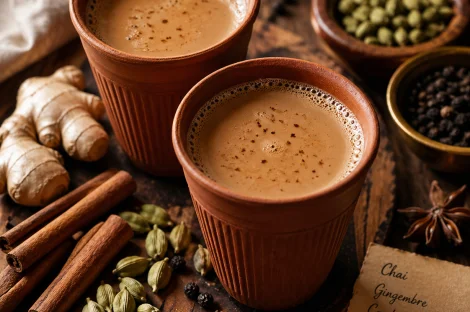
- In masala chai: 2–3 lightly crushed pods in hot milk, inseparable from an authentic chai
- In garam masala: a floral, fresh component that balances pepper, cloves and cinnamon
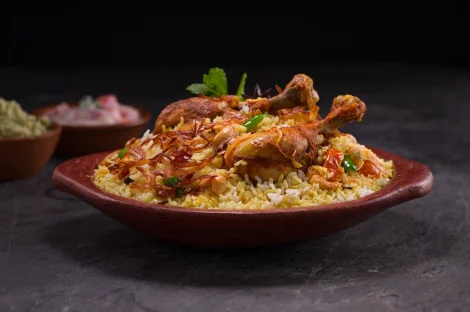
- In biryanis: whole pods infused in hot ghee to perfume the rice
- In kheer and rice puddings: a few ground seeds, a classic pairing with rose and saffron
- In mithai (sweets): gulab jamun, barfi, ladoo, a central aroma of Indian sweets
- As a digestive: a few seeds chewed after the meal, an Indian and Arab tradition
In French cuisine: perfect pairings
- Crème brûlée with cardamom: infuse 4–5 crushed pods in the warm cream, for a spectacular result
- Apple or pear tart: a pinch of ground cardamom in the filling
- Chocolate mousse: a pinch brings an unexpected floral and fresh dimension
- Roast lamb: ½ teaspoon ground in the marinade, a classic pairing
- Revisited rice pudding: infuse a pod in the milk from the very start
- Flavoured butter: blend with lemon and honey for pancakes or toast
In Scandinavian baking
- Kanelbullar: the Swedish cardamom and cinnamon buns, a Nordic classic
- Cardamom coffee: third-wave coffee shops now feature cardamom coffee on their menus
In Ayurvedic medicine, cardamom carries the title of spice of joy, associated with balancing the three doshas. Modern science has largely validated these ancient properties.
Scientifically documented properties
- Digestive and carminative: stimulates the production of gastric acid and bile, reduces intestinal spasms; properties validated in the Journal of Ethnopharmacology
- Anti-inflammatory: a randomised controlled trial (Journal of Science and Food Agriculture, 2017) showed significant improvement in inflammatory markers in pre-diabetic women supplemented with cardamom
- Cardiovascular: a clinical study (Indian Journal of Biochemistry and Biophysics, 2009) documented a significant reduction in blood pressure in patients consuming 1.5 g of powder per day for 12 weeks
- Oral and dental: 1,8-cineole destroys the biofilms of Streptococcus mutans and inhibits periodontal pathogens; chewing the seeds freshens breath more effectively than mint
- Anti-nausea: validated in several studies, including for post-chemotherapy nausea
- Antimicrobial: efficacy demonstrated against Salmonella, E. coli and Candida albicans
Nutritional values (per 100 g)
| Component | Content / role |
|---|
| Essential oil | 4 to 10%, dominant cineole (>50%), alpha-terpineol, limonene, linalool |
| Calcium | 383 mg, higher than whole milk per gram |
| Magnesium | 229 mg, >55% of recommended daily intake |
| Iron | 13.97 mg, close to 100% of RDI per tablespoon |
| Dietary fibre | 28 g, excellent digestive contribution |
Precautions of use
Cardamom is generally well tolerated at culinary doses. In case of gallstones, consult a doctor before significant consumption, as it stimulates the production of bile. Concentrated essential-oil supplements of cardamom are not recommended for pregnant women without medical advice.
Quality criteria
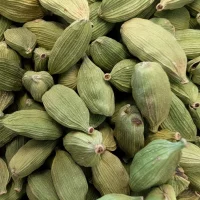
- Colour: vivid green to dark green pods; yellowed pods have lost their essential oils
- Size: premium pods measure 1 to 1.5 cm; small pods under 8 mm contain less aroma
- Aroma: on opening, the fragrance should be immediately intense and fresh
- Full seeds: a quality pod contains 15 to 20 plump, black seeds
- Kerala (Idukki) origin, the global benchmark market
- Avoid the powder: up to 40% of commercial powders contain undeclared additives according to quality-control studies
Storage tips
- As whole pods, in an airtight glass jar, away from light and moisture
- Shelf life: 18 to 24 months as whole pods; 6 months maximum once ground
- To grind: remove the seeds, dry-toast for 30 seconds, let them cool, then grind
- Empty pods can flavour sugar, tea or a broth; do not throw them away
What is the difference between the Malabar, Mysore and Vazhuka varieties?
These are the three natural botanical varieties of Elettaria cardamomum cultivated in India. Malabar has a prostrate panicle (creeping along the ground) and small oval pods with a rich, warm aroma. Mysore has an erect panicle (vertical) and larger pods, known for its higher cineole and limonene content, making it more aromatic. Vazhuka is a natural hybrid of the two with a semi-erect panicle, compact vivid-green pods and a higher yield. Vazhuka is the genetic basis of the Njallani cultivar.
What makes the Njallani cultivar so special?
Njallani was selected by the Idukki farmer Sebastian Joseph through controlled cross-pollination. It produces 120 to 160 capsules per plant versus 30–35 for ordinary varieties, can be harvested all year if irrigated, and requires 40% less shade. It now occupies 88.7% of the cardamom acreage in Idukki district. Its weak point: more sensitive to pests and drought, and its dominance has reduced genetic biodiversity.
How do you choose between whole pods and ground cardamom?
Always prefer whole pods. The powder loses up to 60% of its aromatic compounds within 6 months of grinding. Up to 40% of commercial powders contain undeclared additives. Buy green pods and grind them at the moment of use. Empty pods can flavour sugar or tea.
Is Indian green cardamom better than Guatemalan?
Both are botanically the same species, but the terroir creates real aromatic differences. Keralan cardamom develops a more complex and more persistent aroma thanks to higher altitudes and greater thermal variation. The Guatemalan is softer and more herbaceous, excellent in pastry, less remarkable in curries. The markets of the Persian Gulf systematically pay a premium for cardamom from Kerala.
What is Pallakudi and why does it matter?
Pallakudi is a hybrid variety developed by the Spice Board of India that played a pivotal role, the first improved cultivar to replace the original wild variety, before being supplanted by Njallani. Now rare, it is preserved by a few activist farmers in the Nedumkandam Panchayat of Idukki. It stands out for a creamy, gentle profile, ideal for desserts. Its preservation is a biodiversity issue.
How do you use cardamom in a homemade chai?
Lightly crush 2–3 pods with the flat of a knife to open them without breaking them. Add to hot milk together with the black tea, a cinnamon stick and a little fresh ginger. Let infuse for 3–4 minutes. Cardamom is the inseparable ingredient of authentic chai; it is what gives it that floral and fresh aromatic signature.
Why is green cardamom so expensive?
Green cardamom is the 3rd most expensive spice in the world, after saffron and vanilla. Its price is explained by an entirely manual harvest: each capsule is detached individually with scissors, every 40–45 days. An experienced harvester only collects about 8 kg per day. This process cannot be mechanised, which keeps production costs high.








 Drinks