A spice that changed the history of the world
Nutmeg (Myristica fragrans) is native to the Banda Islands, a volcanic archipelago at the heart of the Moluccas (Indonesia), the sole production site in the world for centuries. Its value was so extraordinary (worth its weight in gold in medieval Europe) that it became the engine of European colonisation in Southeast Asia.
Arabs controlled the nutmeg trade until the 15th century, selling it to Venice via jealously guarded caravan routes. In 1512, the Portuguese were the first Europeans to reach the Moluccas. But it was the Dutch East India Company (VOC) that, in the 17th century, seized an absolute monopoly on world production by massacring much of the population of the Banda Islands and installing a forced plantation system. This monopoly triggered the Anglo-Dutch War of 1667 and the Treaty of Breda, by which the Dutch received Suriname in exchange for the island of Manhattan, considered at the time a bad deal for the English, so precious was nutmeg.
The French Revolution ended the Dutch monopoly: Pierre Poivre, governor of Mauritius, clandestinely introduced nutmeg and clove plants to French islands in the Indian Ocean. Nutmeg began to be cultivated in Grenada (Caribbean), Zanzibar, and Kerala, diversifying production outside the Moluccas for the first time.
In Ayurveda, nutmeg (Jatiphala) has been used for over 2,000 years to treat digestive disorders, as a local anaesthetic (toothache), a mild sedative, and an aphrodisiac. Avicenna's Canon of Medicine (1025) details its medicinal properties. Medieval European medicine prescribed it against plague, infections, and as a general tonic.
Kerala terroir: nutmeg's second homeland
While the Banda Islands remain the ancestral birthplace, Kerala has become one of the great nutmeg production terroirs. The humid tropical climate of the Western Ghats (annual rainfall of 3,000 mm, temperatures between 20°C and 30°C, altitude 300 to 1,000 metres) creates optimal conditions for Myristica fragrans.
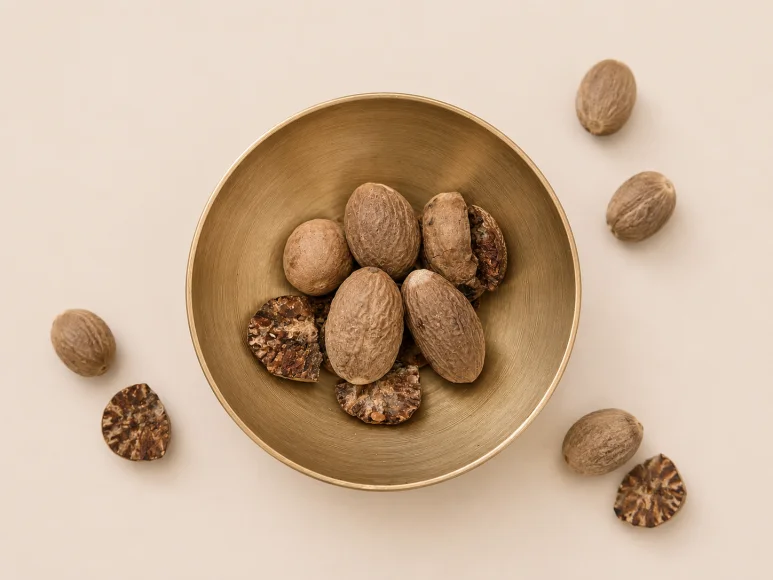
Nutmeg is the dried kernel of the fruit of this evergreen tree, which can live over 100 years and reach 20 metres in height. The fruit looks externally like a peach or apricot: at maturity, it opens to reveal a scarlet network of threads, the mace (aril), which envelops the dark-brown kernel. Nutmeg proper is this kernel, sun-dried for 6 to 8 weeks until its shell cracks and separates easily. Mace, dried separately, is a spice in its own right with a profile slightly more delicate than nutmeg.
Kerala nutmeg plantations are often interplanted with pepper, cardamom and ginger, a traditional agroforestry practice that preserves biodiversity and limits pesticide use. Trees are harvested 2 to 3 times per year; a mature tree produces between 1,500 and 2,000 nutmegs per year.
Flavour profile: warm, woody, complex
Nutmeg has one of the most complex aromatic profiles in the plant kingdom: more than 100 volatile compounds have been identified. The principal ones are:
- Myristicin (30-40% of the essential oil): responsible for the warm, slightly camphorated note, and psychoactive properties at very high doses
- Elemicin and safrole: floral and slightly anise-like notes
- α-pinene, β-pinene and sabinene: fresh, woody, resinous notes
- Eugenol: clove note, responsible for the gentle heat
- Geraniol and linalool: softer floral notes in the background
The result is a warm, woody, lightly sweet aroma with a peppery touch and reminiscences of clove and cinnamon. The intensity is deceptive: nutmeg is subtle when correctly dosed, but its absence is immediately noticeable in a béchamel or gratin dauphinois.
Freshly grated nutmeg is radically different from commercial powder: more vibrant, more floral, more complex. Ground nutmeg loses the majority of its volatile compounds through oxidation in the 6 to 8 weeks after milling.
Culinary uses around the world
Classic French cuisine
- Béchamel: nutmeg is the obligatory final seasoning, a pinch freshly grated at the last moment transforms an ordinary béchamel
- Gratins: gratin dauphinois, cauliflower gratin, lasagne, nutmeg is the discreet aromatic signature that unifies flavours
- Potatoes: mashed potatoes (nutmeg is traditional here), gratin, pommes dauphine
- Spinach: creamed spinach is a classic pairing with nutmeg, particularly in Alsatian cuisine
- Quiches and savoury tarts: in the egg custard filling, a pinch of nutmeg rounds out the flavours
Indian cuisine
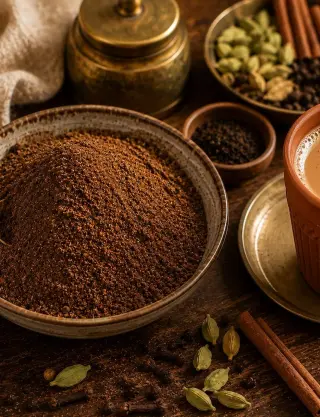
- Garam masala: nutmeg is one of the base spices of this emblematic blend, it provides warmth and depth
- Biryani: a whole nutmeg (or fragment) in the rice during cooking for a delicate aroma
- Chai masala: a few shavings of fresh nutmeg in the chai milk
- Koftas and braised meats: a pinch in lamb meatballs or meat sauces
Pastry and desserts
- American pumpkin pie (one of the pumpkin spice blend spices)
- Crème brûlée and custard
- Speculoos and Christmas biscuits (Dutch and Belgian cuisine)
- Eggnog: freshly grated nutmeg on the surface is its visual and flavour signature
- Fruit compotes and apple crumbles
Middle Eastern and North African cuisine
- Ras el hanout: nutmeg is one of the 30+ spices in the great Moroccan blend
- Tagines: lamb, chicken or vegetable tagines with a touch of nutmeg for warmth
- Kefta and kafta: Middle Eastern meatballs often incorporate nutmeg
Recognised properties and health benefits
Nutmeg has been used in traditional medicine for millennia. Modern research has begun to validate several of these properties:
- Digestive: essential oils stimulate digestive enzyme secretion and reduce intestinal spasms. Traditionally used against flatulence, nausea and mild diarrhoea.
- Anti-inflammatory: myristicin and elemicin exert documented anti-inflammatory activity by inhibiting pro-inflammatory mediator production (COX-2).
- Neuroprotective: preliminary studies suggest myristicin can inhibit accumulation of amyloid plaques associated with Alzheimer's disease. At low doses it is associated with improved cognitive performance.
- Antibacterial: eugenol and other phenylpropanoids show antibacterial activity against E. coli, Staphylococcus aureus and Salmonella in vitro.
- Antioxidant: phenolic compounds (ellagic acid, catechins, phytosterols) neutralise free radicals and reduce oxidative stress.
- Mild sedative: traditionally used in warm evening milk to promote sleep. Studies in rodents confirm an anxiolytic effect at low doses.
- Hepatoprotective: animal studies indicate nutmeg extracts reduce markers of toxin-induced liver damage.
- Local analgesic: eugenol (also present in clove) is used in dentistry. Traditionally, a fragment of nutmeg applied to a painful tooth relieved the pain.
Safety note: at normal culinary doses (under 1g per day), nutmeg is perfectly safe. High doses (over 5–10g in a single intake) can cause adverse effects due to myristicin. Restrict it to cooking in reasonable quantities.
Optimal storage for whole nutmeg
Whole nutmeg is one of the best-keeping spices in its intact form. Here is why and how:
- Shelf life: a whole nutmeg, well stored, maintains its aroma intact for 3 to 5 years. Once grated or ground, the aroma degrades within 6 to 8 weeks.
- Ideal container: airtight metal tin (such as Table Indienne's), glass jar with airtight lid, or resealable pouch, the key is air-tightness.
- Conditions: away from direct light, away from heat sources (not next to the hob), in a dry environment. Normal kitchen room temperature is perfectly suitable.
- No refrigerator: refrigerator moisture can encourage mould growth. Whole spices keep better at room temperature.
- How to use: grate directly from the whole nutmeg on a dedicated nutmeg grater or the fine side of your cheese grater. The ideal quantity is a pinch to 1/4 teaspoon for 4 people. Replace the lid immediately to preserve remaining aromas.
What is the difference between whole nutmeg and ground nutmeg powder?
Whole nutmeg preserves all its essential oils until the moment of use, whereas ground nutmeg loses up to 70% of its aromatic compounds in the 6 to 8 weeks after milling through oxidation. The whole nut is used with a small grater (dedicated nutmeg grater or the fine face of a cheese grater) and releases a radically more vibrant, floral and complex aroma. A whole nutmeg lasts 3 to 5 years versus 2 to 3 months of real freshness for ground nutmeg.
How much nutmeg should I use in a béchamel sauce?
For a classic béchamel (500ml milk), grate the equivalent of a small pinch: about 1/8 teaspoon (approximately 0.25g). Nutmeg is a spice of subtlety: it should be perceived as a warm, deep note, never as a dominant aroma. Always add it at the end of cooking, off the heat or just before removing the pan, to preserve the volatile compounds.
What is mace and how is it related to nutmeg?
Mace is the aril (a network of scarlet to orange filaments) that envelops the kernel of the nutmeg inside the Myristica fragrans fruit. It is essentially the seed coat or envelope of the kernel. Mace is dried separately and is a spice in its own right, used notably in European sausages, pâtés and charcuterie. Its profile is slightly softer and more floral than nutmeg itself, with less heat and more citrusy notes.
Can you eat too much nutmeg? Is it dangerous?
At normal culinary doses (up to 1g per intake, approximately 1/4 teaspoon), nutmeg is perfectly safe. It is only at high doses of 5 to 15g in a single intake that myristicin can cause adverse effects: nausea, dizziness, confusion, tachycardia. These doses correspond to 1 to 3 whole nutmegs consumed at once, which never happens in normal cooking. Used in béchamel, desserts or chai, the quantities are tiny and absolutely risk-free.
How do I grate nutmeg without a special grater?
A dedicated nutmeg grater is ideal (fine-toothed grid), but the finest face of your standard cheese grater works perfectly. A microplane also works well. Hold the whole nutmeg firmly between thumb and forefinger and gently rub it on the grater in circular motions, the nut is hard but grates easily. Avoid grating down to your fingers: stop when the fragment becomes too small to hold comfortably. A 2mm grating gives approximately 1/4 teaspoon of fresh nutmeg.









 Gravy Dishes