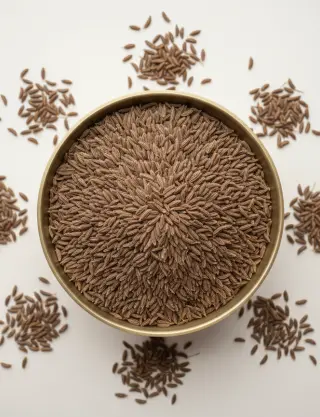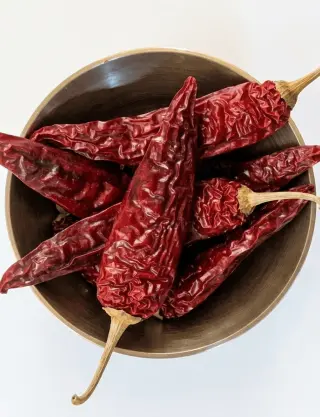




Mace (Javitri)
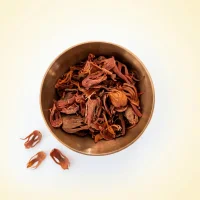
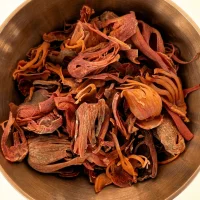
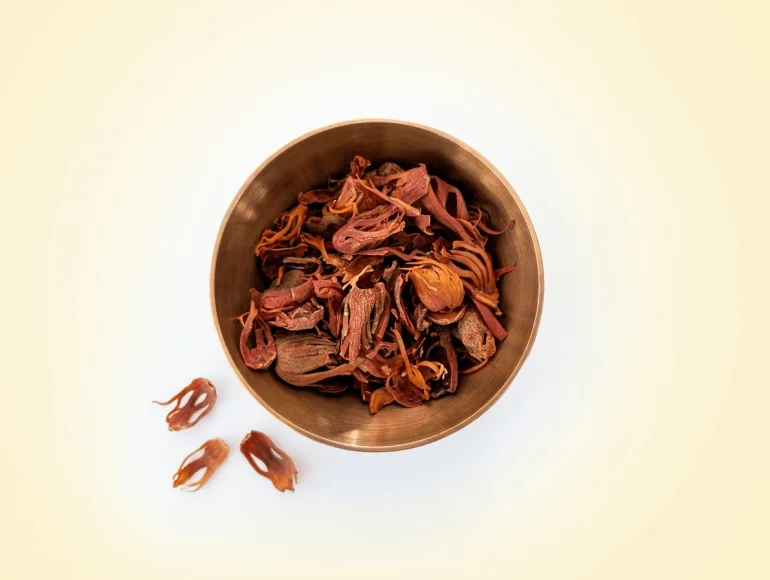
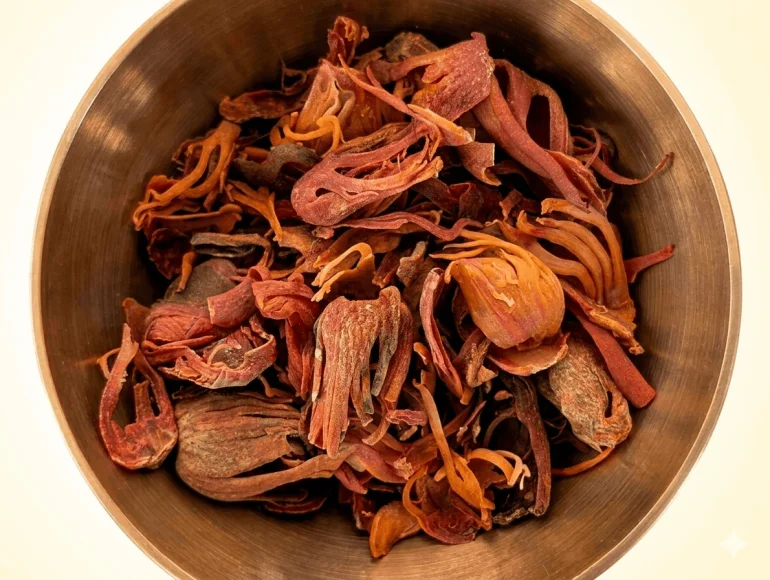
Discover our mace (Javitri) whole blades, harvested in the plantations of Kerala, India. Delicate nutmeg-like flavour, subtle, floral and slightly sweet to refine your biryanis and desserts.
Ready for shipping, delivery time 3-21 business days
Delivery from €4.80 at Mondial Relay pickup points.
Free spice samples with every order.



-
Mace (Javitri): the floral elegance of Mughal cuisine
Mace, known as Javitri in India, is the aril that covers the nutmeg. Harvested by hand in the plantations of Kerala, it offers a more delicate and floral flavour than nutmeg itself, with warm, slightly sweet notes that bring refined elegance to dishes. Long reserved for Mughal haute cuisine and royal biryanis, Javitri is now accessible to all lovers of authentic Indian cooking.
Why choose whole mace blades?
Whole mace blades are the most aromatic and authentic form: they can be used whole in slow-cooked dishes to infuse a delicate flavour, or freshly ground at the moment of use for maximum intensity. Unlike mace powder which quickly loses its aromas, whole blades keep well and maintain their complex flavour profile. A tiny amount is enough to generously perfume an entire dish.
Culinary uses:
- Biryanis and pulaos for floral aromatic elegance
- Desserts and pastries for a warm, sweet note
- Hot drinks and chai for a subtle, fragrant touch
- Creamy sauces for refined aromatic sophistication
- Spice blends (garam masala) for floral and warm complexity
Origin and quality:
We source our spices from smallholder farms in India that grow them without pesticides, to guarantee you a natural product of premium quality.
Storage:
To preserve all its delicate aromas, store your mace in a dry place, away from light and humidity, in its airtight packaging.
-
Improves digestion and soothes nausea
Natural analgesic properties
Anti-inflammatory properties
Supports oral health
Boosts blood circulation
Strengthens bone health
Protects the liver
Promotes healthy, glowing skin
-
Nutritional declaration per 100g
Nutritional component Per 100g Energy 1 890 kJ / 452 kcal Fat ~ 32,4 g of which saturated fat ~ 9,5 g Carbohydrates ~ 50,5 g of which sugars ~ 2 g Dietary fiber ~ 20,2 g Proteins ~ 6,7 g Salt ~ 80 mg -
Directly selected smallholder producers Yes Pesticides free Yes Spice level Low Origin Kerala, India Quality Premium Type Whole blades Taste profile Delicate, warm flavor with nutmeg notes, slightly more subtle and floral than whole nutmeg.
Kits using this spice
Discover our kits with recipes to learn how to use this spice

Chicken Korma
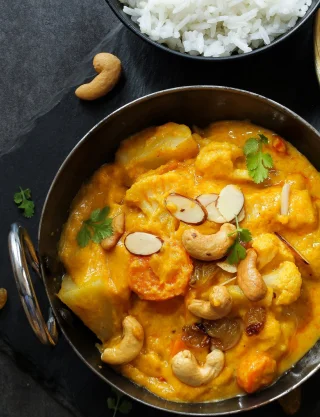
Vegetable korma
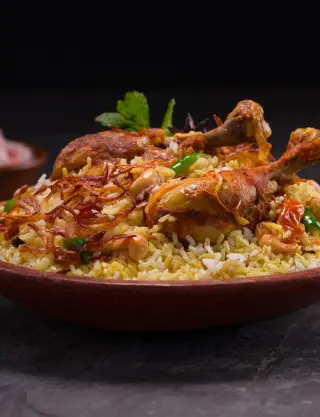
Chicken Biryani
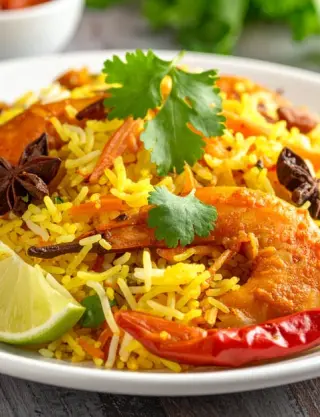
Shrimp Biryani
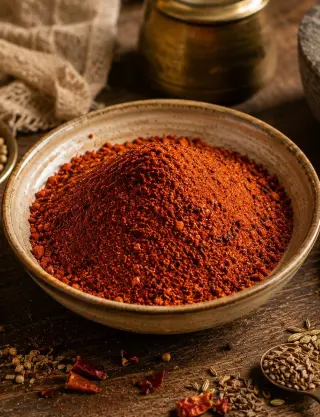
Learn more
Mace and nutmeg are the two spices that come from the same fruit of the nutmeg tree (Myristica fragrans), a tree native to the Banda Islands, a tiny volcanic archipelago in the eastern Moluccas, in Indonesia. For millennia, these ten small islands were the only place in the world where the nutmeg tree grew, and mace, even rarer than nutmeg, was regarded as an exceptional spice.
Arab and Indian merchants knew of mace long before Europeans did. Sanskrit texts mention jatiphala (nutmeg) and javitri (mace) in Ayurvedic treatises dating back to the 1st century CE. Mace was particularly prized in Unani medicine and in the cuisine of the royal courts of the Indian subcontinent.
The island traded for Manhattan
In 1667, the Treaty of Breda ended the Second Anglo-Dutch War. The English ceded the island of Run (the last nutmeg island they controlled in the Bandas) to the Dutch, in exchange for New Amsterdam, a small colony on the east coast of America... which became New York. At the time, a handful of mace was worth more than a plot of land in Manhattan. This exchange illustrates the extraordinary value the spices of the Moluccas represented.
In the 16th century, the Portuguese were the first Europeans to reach the Moluccas (1512). But it was the Dutch of the VOC (Vereenigde Oostindische Compagnie) who established a ruthless monopoly on the mace and nutmeg trade. In 1621, Governor Jan Pieterszoon Coen massacred and deported nearly the entire indigenous population of the Banda Islands to secure total control over production. The plantations were redistributed to Dutch colonists called perkeniers.
To maintain artificially high prices, the VOC regularly burned surplus stocks of mace and nutmeg in Amsterdam. Smugglers who tried to sneak nutmeg seedlings out of the Moluccas risked the death penalty. This monopoly was only broken in 1770, when the Frenchman Pierre Poivre managed to smuggle nutmeg trees out and transplant them to Mauritius and Réunion.
In India, mace has held a central place in Mughlai cuisine since the 16th century. The Mughal emperors (Akbar, Jahangir, Shah Jahan) used it in their ceremonial biryanis and qormas. Lucknowi (Awadhi) cuisine, the direct heir of this tradition, remains the world's largest consumer of mace today. Kerala became a major producer of nutmeg and mace from the 19th century onwards, although Indonesia and Grenada remain the world's largest producers.
Did you know?
- Mace is one of the most expensive spices in the world by weight: it takes about 400 nutmegs to obtain 1 kg of dried mace
- The Dutch traded Manhattan for a nutmeg island (Run) in 1667, such was the value of mace and nutmeg
- The VOC burned its surplus stocks in Amsterdam to keep prices high
- Mace is bright red when freshly harvested, then turns orange as it dries; Grenadian mace stays more orange, Moluccan mace darker red
- Elizabeth I of England loved mace: it featured in almost every recipe of the Tudor court
- The nutmeg tree is dioecious: there are male and female trees, and only the females bear fruit
- A single nutmeg tree can produce for 60 to 80 years
- Pierre Poivre, who broke the Dutch monopoly, bore a fitting surname ('Poivre' means 'pepper' in French), and he is also said to have inspired the tongue-twister 'Peter Piper picked a peck of pickled peppers'
Mace across languages
| Language | Name |
|---|---|
| French | Macis / Fleur de muscade |
| Hindi | Javitri (जावित्री) |
| Malayalam (Kerala) | Jathipathri (ജാതിപത്രി) |
| Sanskrit | Jatikosha (जातिकोश) |
| Tamil | Jathipathiri (ஜாதிபத்திரி) |
| English | Mace |
| Dutch | Foelie |
| German | Muskatblüte |
| Indonesian | Bunga pala |
| Arabic | Basbasah (بسباسة) |
| Botanical Latin | Myristica fragrans Houtt. |
The word 'mace' comes from the Latin macir, borrowed from the Greek maker, which originally referred to the aromatic bark of an Indian tree. The Hindi term javitri derives from the Sanskrit jatikosha, meaning 'envelope of the jati (nutmeg tree)'. In Dutch, foelie is a word of Malay origin, testifying to the antiquity of the spice trade between the Moluccas and the Malay world. The English term mace should not be confused with the medieval weapon of the same name: the two words have entirely separate etymologies.
| Characteristic | Detail |
|---|---|
| Latin name | Myristica fragrans Houtt. |
| Botanical family | Myristicaceae |
| Local names | Javitri (Hindi) / Jathipathri (Malayalam) |
| Part used | Aril (fleshy envelope surrounding the nutmeg seed) |
| Original origin | Banda Islands, Moluccas (Indonesia) |
| Main producers | Indonesia, Grenada, India (Kerala, Karnataka), Sri Lanka |
| Harvest | Year-round with two peaks (June–August and November–March) |
| Yield | ~1 kg of mace per 100 kg of fresh fruit |
| Drying | Naturally in the sun (10 to 14 days) |
The nutmeg tree (Myristica fragrans) is a tropical evergreen of the Myristicaceae family, native to the Banda Islands of the Moluccas. It thrives in a hot and humid equatorial climate, between 20 degrees north and south of the equator, at altitudes ranging from sea level up to about 700 metres.
The fruit of the nutmeg tree resembles a golden-yellow apricot. When ripe, it splits open in two to reveal a striking spectacle: a brown nut (the future nutmeg) enveloped by a network of bright scarlet, fleshy filaments: this is the mace, also called 'nutmeg flower'. It is not a flower in the botanical sense, but an aril, a fleshy outgrowth of the funicle (the point where the seed attaches to the fruit).
Kerala: an adopted terroir
Although native to the Moluccas, the nutmeg tree has acclimatized remarkably well to Kerala. The districts of Ernakulam, Thrissur, Kottayam and Kozhikode offer conditions close to its original habitat: constant heat (25–30°C), high humidity (80%+), soil rich in organic matter and natural shading from coconut and areca palms.
- Soil: lateritic, rich in humus, well-drained; the nutmeg tree fears waterlogging
- Rainfall: 2,000 to 3,500 mm/year, ideally spread over 8 to 9 months
- Shade: essential during the first years, then gradual tolerance to sunlight
- Patience: the nutmeg tree only fruits from 7 to 9 years onwards, and reaches full production only at 15–20 years
- Longevity: a tree can produce for 60 to 80 years
Harvesting mace
Harvesting mace requires skilled labour and extreme care. When the ripe fruit splits open naturally on the tree, the pickers must collect the fruit before it falls to the ground. The aril is then delicately detached from the nut by hand, a gesture that requires dexterity so as not to tear the 'blades' of mace.
Fresh mace, of a bright scarlet red, is spread on racks and slowly dried in the sun for 10 to 14 days. As it dries, it loses its vivid colour and takes on an orange tint (Moluccas, Kerala) or yellow-orange (Grenada). Mace loses about 70% of its weight during drying, which partly explains its high price.
| Origin | Characteristics of the mace |
|---|---|
| Banda Islands (Indonesia) | Deep red-orange, intense and resinous aroma, historically the most prized |
| Kerala (India) | Bright orange, warm and soft aroma, excellent value for money |
| Grenada (Caribbean) | Pale yellow-orange, milder and sweeter aroma, widely exported |
| Sri Lanka | Orange, intermediate aromatic profile |
Botany
The nutmeg tree is dioecious: there are separate male and female trees. Only the female trees produce fruit, but pollination requires the presence of male trees nearby (one male for 8 to 10 females). The sex of the tree can only be determined at the first flowering, after 5 to 7 years of growth, a vagary that complicates plantation management.
The fruit of the nutmeg tree is one of a kind: it produces two distinct spices from the same fruit. Nutmeg is the kernel (the seed) of the fruit, while mace is the aril that surrounds it. The two spices share some aromatic compounds but offer markedly different taste profiles: mace being more subtle, more refined and more complex.
Whole mace or ground mace?
Whole mace (in 'blades' or 'flowers') keeps far longer than ground mace and releases its aroma gradually during cooking. For slow-cooked dishes, biryanis and infusions, prefer whole blades. For pastries and spice blends, ground mace is more practical.
Mace offers an aromatic profile that is more subtle, more delicate and more complex than nutmeg. Where nutmeg is round, warm and woody, mace is lighter, more floral and endowed with an elegance that chefs sometimes compare to a cross between cinnamon, pepper and a touch of rose.
| Dimension | Aromatic profile |
|---|---|
| Top notes | Pine, resin, slightly camphoraceous; a fresh and penetrating brightness |
| Heart notes | Soft cinnamon, fine pepper, floral nuance (rose, geranium) |
| Base notes | Warm woody, hazelnut, slightly musky |
| Heat | Moderate, enveloping; less pungent than nutmeg |
| Length on the palate | Persistent, with a slightly bitter and resinous finish |
Mace vs. Nutmeg
| Criterion | Mace | Nutmeg |
|---|---|---|
| Intensity | More subtle, more delicate | More intense, more rounded |
| Dominant notes | Floral, resinous, peppery | Woody, warm, sweet |
| Colour imparted | Saffron-like tint (yellow-orange) | No colouring |
| Preferred use | Delicate dishes, fine sauces, biryanis | Pastries, mashed potatoes, béchamel |
| Price | 2 to 3 times more expensive | More affordable |
Chef's tip
Mace quickly loses its aroma during prolonged cooking. In slow-cooked dishes, add it in the last 20 minutes. For biryanis, place the mace blades in the dum (steam cooking) rather than in the initial tadka. In pastry, mace pairs magnificently with stone fruits (apricot, peach, cherry) and milk-based desserts.
Mace is a spice of refinement, used in the most sophisticated cuisines of the world. In India, it is the emblematic spice of Mughlai and Lucknowi cooking. In Europe, it is a secret ingredient of French haute cuisine and traditional charcuterie.
In Indian cuisine
- Lucknowi (Awadhi) biryani: mace is the signature spice of Lucknow biryani: it perfumes the rice without colouring it excessively and lends an incomparable finesse
- Mughlai qorma: mace blades are infused in ghee with cardamom and cloves to create the aromatic base of royal qormas
- Nihari: this slow-cooked overnight meat stew counts mace among its fundamental spices
- Premium garam masala: in refined blends, mace replaces or complements nutmeg
- Ras malai and kheer: a pinch of mace in milk-based desserts brings a subtle complexity
- Chai masala: some older recipes include mace for a distinctive floral note
In French and European cuisine
- Classic béchamel: mace is the traditional seasoning of béchamel in French haute cuisine, more elegant than grated nutmeg
- Mornay sauce: mace brings a delicate note that elevates melted gruyère
- Quenelles and terrines: a classic ingredient of Lyonnaise charcuterie
- Soups and veloutés: cream of cauliflower, pumpkin velouté, lobster bisque
- Charcuterie: mortadella, boudin blanc, Strasbourg sausage: mace features in many traditional recipes
- Pastry: fruit cakes, English puddings, Dutch biscuits (speculaas)
- Mulled wine and punch: a blade of mace in mulled wine adds a unique floral dimension
Pairings and dosage
| Pairing | Tip |
|---|---|
| Cardamom + mace | The classic pairing of Mughlai cooking, floral elegance |
| Saffron + mace | The royal duo of ceremonial biryanis, to be dosed sparingly |
| Cinnamon + mace | For desserts and sweet-and-savoury dishes |
| White pepper + mace | In white sauces and fish dishes |
| Rose + mace | In Mughlai desserts: kheer, firni, halwa |
Dosage
Mace is powerful: a single blade is enough to perfume a dish for 4 to 6 people. As a powder, start with 1/4 teaspoon. Mace is not interchangeable with nutmeg in equal quantity: use about half the quantity of nutmeg called for in a recipe if you substitute it with mace.
Mace shares many of its bioactive compounds with nutmeg, but in different proportions. Ayurvedic medicine considers it more 'sattvic' (pure and balancing) than nutmeg, and has used it for centuries for its digestive, anti-inflammatory and tonic properties.
Key active compounds
- Myristicin: a phenylpropanoid compound with anti-inflammatory and neuroprotective properties. It is also the compound responsible for psychoactive effects at very high doses
- Elemicin and safrole: aromatic compounds with antioxidant properties
- Eugenol: a natural antiseptic and analgesic (also present in cloves)
- Macelignan: a compound specific to mace, studied for its hepatoprotective properties
Documented properties
- Digestive: stimulates the secretion of gastric juices, relieves nausea, bloating and flatulence; a traditional use in Ayurveda
- Anti-inflammatory: myristicin and macelignan inhibit inflammation mediators
- Antioxidant: rich in phenolic compounds that neutralize free radicals
- Antibacterial: activity demonstrated against several bacterial strains, notably E. coli and Staphylococcus aureus
- Oral health: the eugenol in mace is a traditional dental analgesic
- Blood circulation: in traditional medicine, mace is reputed to stimulate circulation and warm the body
- Skin health: used in Unani medicine in preparations for complexion and against acne
Precautions of use for myristicin
Mace contains myristicin, a compound which, when consumed in very large quantities (several grams), can cause undesirable psychoactive effects: nausea, dizziness, palpitations and hallucinations. These effects never occur at normal culinary doses (a few blades or a pinch of powder). Do not exceed 1 teaspoon of ground mace per day. Not recommended in large quantities for pregnant women. If you are on medication, consult your doctor.
Nutritional values (per 1 teaspoon / 2 g)
| Component | Content |
|---|---|
| Essential oils | 10 to 15% (myristicin, elemicin, eugenol, safrole) |
| Lipids | ~25% (mace butter, rich in myristic acid) |
| Fibre | ~0.4 g |
| Vitamins | A, B1, B2, C |
| Minerals | Iron, calcium, copper, magnesium, manganese |
| Calories | ~10 kcal |
How to recognize good mace
- Colour: bright orange to red-orange for whole mace; a dull, brownish or faded colour indicates an old or poorly dried product
- Suppleness: the blades should be slightly supple and brittle, not completely rigid or limp
- Aroma: intense, warm and complex fragrance to the nose: notes of cinnamon, pine and flower should be perceptible. Mace without smell is dead mace
- Integrity: whole blades (unbroken) preserve their aromas better and are of higher quality
- Origin mentioned: a serious supplier indicates the country of origin (Indonesia, India, Grenada)
Storage tips
- Store the whole blades in an airtight glass jar, away from light, heat and moisture
- Do not store near the stove or any heat source; essential oils evaporate
- Optimal shelf life: 2 to 3 years for whole blades; 6 months maximum as powder
- For fresh powder: grind the blades in a mortar or spice mill just before use
- Sign of degradation: faded colour, weakened aroma, absence of floral and resinous notes
Storage trick
Wrap the mace blades in aluminium foil before placing them in the jar. The foil absorbs excess moisture and protects against light, thereby extending the aromatic shelf life by several months.
What is the difference between mace and nutmeg?
Mace and nutmeg come from the same fruit of the nutmeg tree (Myristica fragrans). Nutmeg is the seed (the kernel) of the fruit, while mace is the aril, the lacy red fleshy envelope that surrounds the nut. Mace is more subtle, more floral and more refined than nutmeg, with resinous and peppery notes. It is also 2 to 3 times more expensive, since a single fruit produces very little mace.
Can mace be replaced with nutmeg in a recipe?
Yes, but the result will be different. Nutmeg is more intense and sweeter. If a recipe calls for mace, use half the quantity of nutmeg. The reverse is also true: to replace nutmeg with mace, double the quantity. In biryanis and Mughlai qormas, mace brings an irreplaceable finesse that nutmeg alone cannot reproduce.
Is mace harmful to health?
At normal culinary doses (one blade or a pinch of powder per dish), mace is perfectly safe. The myristicin it contains only becomes a problem at very high doses (several grams in a single intake), which is far beyond usual culinary use. Pregnant women are nevertheless advised against consuming it in large quantities.
How do you use whole mace in cooking?
Mace blades are used like bay leaves: add them whole to slow-cooked dishes, sauces or broths, and remove them before serving. For biryanis, slip 2 to 3 blades into the layers of rice. To infuse milk or cream, gently heat with a mace blade for 10 minutes then remove it.
Why is mace so expensive?
Mace is rare by nature: a single nutmeg fruit yields only a few grams of fresh mace, and this loses 70% of its weight during drying. It takes about 400 nutmegs to obtain 1 kg of dried mace. The harvest is manual and delicate, since the aril must be detached without being torn. Finally, the nutmeg tree only begins to produce after 7 to 9 years of growth.
-
Mace and nutmeg are the two spices that come from the same fruit of the nutmeg tree (Myristica fragrans), a tree native to the Banda Islands, a tiny volcanic archipelago in the eastern Moluccas, in Indonesia. For millennia, these ten small islands were the only place in the world where the nutmeg tree grew, and mace, even rarer than nutmeg, was regarded as an exceptional spice.
Arab and Indian merchants knew of mace long before Europeans did. Sanskrit texts mention jatiphala (nutmeg) and javitri (mace) in Ayurvedic treatises dating back to the 1st century CE. Mace was particularly prized in Unani medicine and in the cuisine of the royal courts of the Indian subcontinent.
The island traded for Manhattan
In 1667, the Treaty of Breda ended the Second Anglo-Dutch War. The English ceded the island of Run (the last nutmeg island they controlled in the Bandas) to the Dutch, in exchange for New Amsterdam, a small colony on the east coast of America... which became New York. At the time, a handful of mace was worth more than a plot of land in Manhattan. This exchange illustrates the extraordinary value the spices of the Moluccas represented.
In the 16th century, the Portuguese were the first Europeans to reach the Moluccas (1512). But it was the Dutch of the VOC (Vereenigde Oostindische Compagnie) who established a ruthless monopoly on the mace and nutmeg trade. In 1621, Governor Jan Pieterszoon Coen massacred and deported nearly the entire indigenous population of the Banda Islands to secure total control over production. The plantations were redistributed to Dutch colonists called perkeniers.
To maintain artificially high prices, the VOC regularly burned surplus stocks of mace and nutmeg in Amsterdam. Smugglers who tried to sneak nutmeg seedlings out of the Moluccas risked the death penalty. This monopoly was only broken in 1770, when the Frenchman Pierre Poivre managed to smuggle nutmeg trees out and transplant them to Mauritius and Réunion.
In India, mace has held a central place in Mughlai cuisine since the 16th century. The Mughal emperors (Akbar, Jahangir, Shah Jahan) used it in their ceremonial biryanis and qormas. Lucknowi (Awadhi) cuisine, the direct heir of this tradition, remains the world's largest consumer of mace today. Kerala became a major producer of nutmeg and mace from the 19th century onwards, although Indonesia and Grenada remain the world's largest producers.
Did you know?
- Mace is one of the most expensive spices in the world by weight: it takes about 400 nutmegs to obtain 1 kg of dried mace
- The Dutch traded Manhattan for a nutmeg island (Run) in 1667, such was the value of mace and nutmeg
- The VOC burned its surplus stocks in Amsterdam to keep prices high
- Mace is bright red when freshly harvested, then turns orange as it dries; Grenadian mace stays more orange, Moluccan mace darker red
- Elizabeth I of England loved mace: it featured in almost every recipe of the Tudor court
- The nutmeg tree is dioecious: there are male and female trees, and only the females bear fruit
- A single nutmeg tree can produce for 60 to 80 years
- Pierre Poivre, who broke the Dutch monopoly, bore a fitting surname ('Poivre' means 'pepper' in French), and he is also said to have inspired the tongue-twister 'Peter Piper picked a peck of pickled peppers'
Mace across languages
Language Name French Macis / Fleur de muscade Hindi Javitri (जावित्री) Malayalam (Kerala) Jathipathri (ജാതിപത്രി) Sanskrit Jatikosha (जातिकोश) Tamil Jathipathiri (ஜாதிபத்திரி) English Mace Dutch Foelie German Muskatblüte Indonesian Bunga pala Arabic Basbasah (بسباسة) Botanical Latin Myristica fragrans Houtt. The word 'mace' comes from the Latin macir, borrowed from the Greek maker, which originally referred to the aromatic bark of an Indian tree. The Hindi term javitri derives from the Sanskrit jatikosha, meaning 'envelope of the jati (nutmeg tree)'. In Dutch, foelie is a word of Malay origin, testifying to the antiquity of the spice trade between the Moluccas and the Malay world. The English term mace should not be confused with the medieval weapon of the same name: the two words have entirely separate etymologies.
-
Characteristic Detail Latin name Myristica fragrans Houtt. Botanical family Myristicaceae Local names Javitri (Hindi) / Jathipathri (Malayalam) Part used Aril (fleshy envelope surrounding the nutmeg seed) Original origin Banda Islands, Moluccas (Indonesia) Main producers Indonesia, Grenada, India (Kerala, Karnataka), Sri Lanka Harvest Year-round with two peaks (June–August and November–March) Yield ~1 kg of mace per 100 kg of fresh fruit Drying Naturally in the sun (10 to 14 days) The nutmeg tree (Myristica fragrans) is a tropical evergreen of the Myristicaceae family, native to the Banda Islands of the Moluccas. It thrives in a hot and humid equatorial climate, between 20 degrees north and south of the equator, at altitudes ranging from sea level up to about 700 metres.
The fruit of the nutmeg tree resembles a golden-yellow apricot. When ripe, it splits open in two to reveal a striking spectacle: a brown nut (the future nutmeg) enveloped by a network of bright scarlet, fleshy filaments: this is the mace, also called 'nutmeg flower'. It is not a flower in the botanical sense, but an aril, a fleshy outgrowth of the funicle (the point where the seed attaches to the fruit).
Kerala: an adopted terroir
Although native to the Moluccas, the nutmeg tree has acclimatized remarkably well to Kerala. The districts of Ernakulam, Thrissur, Kottayam and Kozhikode offer conditions close to its original habitat: constant heat (25–30°C), high humidity (80%+), soil rich in organic matter and natural shading from coconut and areca palms.
- Soil: lateritic, rich in humus, well-drained; the nutmeg tree fears waterlogging
- Rainfall: 2,000 to 3,500 mm/year, ideally spread over 8 to 9 months
- Shade: essential during the first years, then gradual tolerance to sunlight
- Patience: the nutmeg tree only fruits from 7 to 9 years onwards, and reaches full production only at 15–20 years
- Longevity: a tree can produce for 60 to 80 years
Harvesting mace
Harvesting mace requires skilled labour and extreme care. When the ripe fruit splits open naturally on the tree, the pickers must collect the fruit before it falls to the ground. The aril is then delicately detached from the nut by hand, a gesture that requires dexterity so as not to tear the 'blades' of mace.
Fresh mace, of a bright scarlet red, is spread on racks and slowly dried in the sun for 10 to 14 days. As it dries, it loses its vivid colour and takes on an orange tint (Moluccas, Kerala) or yellow-orange (Grenada). Mace loses about 70% of its weight during drying, which partly explains its high price.
Origin Characteristics of the mace Banda Islands (Indonesia) Deep red-orange, intense and resinous aroma, historically the most prized Kerala (India) Bright orange, warm and soft aroma, excellent value for money Grenada (Caribbean) Pale yellow-orange, milder and sweeter aroma, widely exported Sri Lanka Orange, intermediate aromatic profile Botany
The nutmeg tree is dioecious: there are separate male and female trees. Only the female trees produce fruit, but pollination requires the presence of male trees nearby (one male for 8 to 10 females). The sex of the tree can only be determined at the first flowering, after 5 to 7 years of growth, a vagary that complicates plantation management.
The fruit of the nutmeg tree is one of a kind: it produces two distinct spices from the same fruit. Nutmeg is the kernel (the seed) of the fruit, while mace is the aril that surrounds it. The two spices share some aromatic compounds but offer markedly different taste profiles: mace being more subtle, more refined and more complex.
Whole mace or ground mace?
Whole mace (in 'blades' or 'flowers') keeps far longer than ground mace and releases its aroma gradually during cooking. For slow-cooked dishes, biryanis and infusions, prefer whole blades. For pastries and spice blends, ground mace is more practical.
-
Mace offers an aromatic profile that is more subtle, more delicate and more complex than nutmeg. Where nutmeg is round, warm and woody, mace is lighter, more floral and endowed with an elegance that chefs sometimes compare to a cross between cinnamon, pepper and a touch of rose.
Dimension Aromatic profile Top notes Pine, resin, slightly camphoraceous; a fresh and penetrating brightness Heart notes Soft cinnamon, fine pepper, floral nuance (rose, geranium) Base notes Warm woody, hazelnut, slightly musky Heat Moderate, enveloping; less pungent than nutmeg Length on the palate Persistent, with a slightly bitter and resinous finish Mace vs. Nutmeg
Criterion Mace Nutmeg Intensity More subtle, more delicate More intense, more rounded Dominant notes Floral, resinous, peppery Woody, warm, sweet Colour imparted Saffron-like tint (yellow-orange) No colouring Preferred use Delicate dishes, fine sauces, biryanis Pastries, mashed potatoes, béchamel Price 2 to 3 times more expensive More affordable Chef's tip
Mace quickly loses its aroma during prolonged cooking. In slow-cooked dishes, add it in the last 20 minutes. For biryanis, place the mace blades in the dum (steam cooking) rather than in the initial tadka. In pastry, mace pairs magnificently with stone fruits (apricot, peach, cherry) and milk-based desserts.
-
Mace is a spice of refinement, used in the most sophisticated cuisines of the world. In India, it is the emblematic spice of Mughlai and Lucknowi cooking. In Europe, it is a secret ingredient of French haute cuisine and traditional charcuterie.
In Indian cuisine
- Lucknowi (Awadhi) biryani: mace is the signature spice of Lucknow biryani: it perfumes the rice without colouring it excessively and lends an incomparable finesse
- Mughlai qorma: mace blades are infused in ghee with cardamom and cloves to create the aromatic base of royal qormas
- Nihari: this slow-cooked overnight meat stew counts mace among its fundamental spices
- Premium garam masala: in refined blends, mace replaces or complements nutmeg
- Ras malai and kheer: a pinch of mace in milk-based desserts brings a subtle complexity
- Chai masala: some older recipes include mace for a distinctive floral note
In French and European cuisine
- Classic béchamel: mace is the traditional seasoning of béchamel in French haute cuisine, more elegant than grated nutmeg
- Mornay sauce: mace brings a delicate note that elevates melted gruyère
- Quenelles and terrines: a classic ingredient of Lyonnaise charcuterie
- Soups and veloutés: cream of cauliflower, pumpkin velouté, lobster bisque
- Charcuterie: mortadella, boudin blanc, Strasbourg sausage: mace features in many traditional recipes
- Pastry: fruit cakes, English puddings, Dutch biscuits (speculaas)
- Mulled wine and punch: a blade of mace in mulled wine adds a unique floral dimension
Pairings and dosage
Pairing Tip Cardamom + mace The classic pairing of Mughlai cooking, floral elegance Saffron + mace The royal duo of ceremonial biryanis, to be dosed sparingly Cinnamon + mace For desserts and sweet-and-savoury dishes White pepper + mace In white sauces and fish dishes Rose + mace In Mughlai desserts: kheer, firni, halwa Dosage
Mace is powerful: a single blade is enough to perfume a dish for 4 to 6 people. As a powder, start with 1/4 teaspoon. Mace is not interchangeable with nutmeg in equal quantity: use about half the quantity of nutmeg called for in a recipe if you substitute it with mace.
-
Mace shares many of its bioactive compounds with nutmeg, but in different proportions. Ayurvedic medicine considers it more 'sattvic' (pure and balancing) than nutmeg, and has used it for centuries for its digestive, anti-inflammatory and tonic properties.
Key active compounds
- Myristicin: a phenylpropanoid compound with anti-inflammatory and neuroprotective properties. It is also the compound responsible for psychoactive effects at very high doses
- Elemicin and safrole: aromatic compounds with antioxidant properties
- Eugenol: a natural antiseptic and analgesic (also present in cloves)
- Macelignan: a compound specific to mace, studied for its hepatoprotective properties
Documented properties
- Digestive: stimulates the secretion of gastric juices, relieves nausea, bloating and flatulence; a traditional use in Ayurveda
- Anti-inflammatory: myristicin and macelignan inhibit inflammation mediators
- Antioxidant: rich in phenolic compounds that neutralize free radicals
- Antibacterial: activity demonstrated against several bacterial strains, notably E. coli and Staphylococcus aureus
- Oral health: the eugenol in mace is a traditional dental analgesic
- Blood circulation: in traditional medicine, mace is reputed to stimulate circulation and warm the body
- Skin health: used in Unani medicine in preparations for complexion and against acne
Precautions of use for myristicin
Mace contains myristicin, a compound which, when consumed in very large quantities (several grams), can cause undesirable psychoactive effects: nausea, dizziness, palpitations and hallucinations. These effects never occur at normal culinary doses (a few blades or a pinch of powder). Do not exceed 1 teaspoon of ground mace per day. Not recommended in large quantities for pregnant women. If you are on medication, consult your doctor.
Nutritional values (per 1 teaspoon / 2 g)
Component Content Essential oils 10 to 15% (myristicin, elemicin, eugenol, safrole) Lipids ~25% (mace butter, rich in myristic acid) Fibre ~0.4 g Vitamins A, B1, B2, C Minerals Iron, calcium, copper, magnesium, manganese Calories ~10 kcal -
How to recognize good mace
- Colour: bright orange to red-orange for whole mace; a dull, brownish or faded colour indicates an old or poorly dried product
- Suppleness: the blades should be slightly supple and brittle, not completely rigid or limp
- Aroma: intense, warm and complex fragrance to the nose: notes of cinnamon, pine and flower should be perceptible. Mace without smell is dead mace
- Integrity: whole blades (unbroken) preserve their aromas better and are of higher quality
- Origin mentioned: a serious supplier indicates the country of origin (Indonesia, India, Grenada)
Storage tips
- Store the whole blades in an airtight glass jar, away from light, heat and moisture
- Do not store near the stove or any heat source; essential oils evaporate
- Optimal shelf life: 2 to 3 years for whole blades; 6 months maximum as powder
- For fresh powder: grind the blades in a mortar or spice mill just before use
- Sign of degradation: faded colour, weakened aroma, absence of floral and resinous notes
Storage trick
Wrap the mace blades in aluminium foil before placing them in the jar. The foil absorbs excess moisture and protects against light, thereby extending the aromatic shelf life by several months.
-
What is the difference between mace and nutmeg?
Mace and nutmeg come from the same fruit of the nutmeg tree (Myristica fragrans). Nutmeg is the seed (the kernel) of the fruit, while mace is the aril, the lacy red fleshy envelope that surrounds the nut. Mace is more subtle, more floral and more refined than nutmeg, with resinous and peppery notes. It is also 2 to 3 times more expensive, since a single fruit produces very little mace.
Can mace be replaced with nutmeg in a recipe?
Yes, but the result will be different. Nutmeg is more intense and sweeter. If a recipe calls for mace, use half the quantity of nutmeg. The reverse is also true: to replace nutmeg with mace, double the quantity. In biryanis and Mughlai qormas, mace brings an irreplaceable finesse that nutmeg alone cannot reproduce.
Is mace harmful to health?
At normal culinary doses (one blade or a pinch of powder per dish), mace is perfectly safe. The myristicin it contains only becomes a problem at very high doses (several grams in a single intake), which is far beyond usual culinary use. Pregnant women are nevertheless advised against consuming it in large quantities.
How do you use whole mace in cooking?
Mace blades are used like bay leaves: add them whole to slow-cooked dishes, sauces or broths, and remove them before serving. For biryanis, slip 2 to 3 blades into the layers of rice. To infuse milk or cream, gently heat with a mace blade for 10 minutes then remove it.
Why is mace so expensive?
Mace is rare by nature: a single nutmeg fruit yields only a few grams of fresh mace, and this loses 70% of its weight during drying. It takes about 400 nutmegs to obtain 1 kg of dried mace. The harvest is manual and delicate, since the aril must be detached without being torn. Finally, the nutmeg tree only begins to produce after 7 to 9 years of growth.
Pourquoi choisir Mace (Javitri) de La Table Indienne ?

Fraîcheur et qualité exceptionnelles
Nos épices sont importées directement d'Inde et conditionnées à la demande pour garantir une fraîcheur optimale. Contrairement aux épices vendues en grande surface qui peuvent rester des mois sur les étagères, nous veillons à ce que chaque épice conserve toute sa saveur et son arôme.
Authenticité et traçabilité
Chaque épice provient de régions spécifiques en Inde réputées pour leur savoir-faire. Nous travaillons directement avec des producteurs locaux qui cultivent leurs épices de manière traditionnelle, sans pesticides ni produits chimiques.
Comment bien utiliser cette épice ?
Pour révéler tous les arômes, nous recommandons de faire légèrement griller les épices entières à sec dans une poêle avant de les moudre. Conservez-les dans un endroit sec et à l'abri de la lumière pour préserver leur fraîcheur le plus longtemps possible.

Le saviez-vous ?
Les épices entières sont bien meilleures que les épices moulues
Consultez notre article de blog pour découvrir pourquoi les épices entières conservent mieux leurs arômes.
Questions & Answers
Thank you! Your question has been sent. Mihika will answer soon and you will receive an email.
Mace (Javitri)
Discover also
Other products you might like