Tea is today India's most consumed drink after water, but its commercial history there is surprisingly recent. In 1823, Scottish explorer Robert Bruce discovered wild tea plants in the upper Brahmaputra valley, in Assam, whose leaves the local Singpho people were already brewing. Bruce negotiated with local chiefs to obtain leaf and seed samples, but died the following year before having them properly authenticated.
His brother, Charles Alexander Bruce, picked up the thread. In the early 1830s he sent samples to the botanical gardens in Calcutta, where the plant was finally identified as a distinct tea variety, now called Camellia sinensis var. assamica, different from the Chinese tea plant the British had relied on until then. A first consignment of Assam tea was auctioned in London on 10 January 1839, causing immediate excitement: the British East India Company, keen to break China's monopoly on tea, saw a strategic opportunity. The Assam Company was founded that same year to take over the experimental plantations.
A tea meant for export, reinvented by the workers
For a long time, the Indian population treated tea more as a medicinal plant than an everyday drink: almost the entire output of the colonial plantations was shipped to the United Kingdom. It was the plantation labourers of Assam, unable to afford the delicate porcelain and refined brewing methods of the British colonists, who invented a new way to prepare it: they boiled the leftover dust and fannings of tea (the lowest grades, unsellable for export) vigorously with spices drawn from Ayurvedic tradition, milk and sugar. Chai masala was born, worlds away from the delicate tea the British were shipping home.
The CTC process, catalyst of everyday chai
The industrial turning point came in the 1930s with the invention of the CTC process (Crush, Tear, Curl), which breaks tea leaves into small particles that brew quickly into a strong liquor, able to stand up to milk, sugar and spices without losing character. Its mechanisation in the 1960s made tea far more affordable, and chai masala then exploded across India, carried after 1947 independence by a new, familiar figure: the chai wallah, the street vendor recognisable by his steaming pot and his signature move of pouring tea from one container to another to cool and froth it.
Did you know?
The black tea in this blend is no neutral base: it's the CTC process itself, designed to produce a robust liquor, that made it possible to add generous amounts of milk, sugar and spices without the tea disappearing, unlike whole-leaf tea, far too delicate for that kind of treatment.
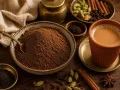
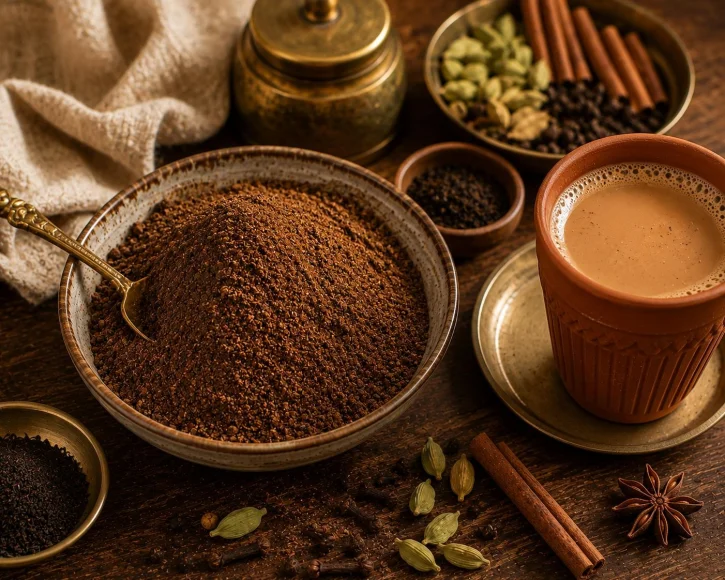
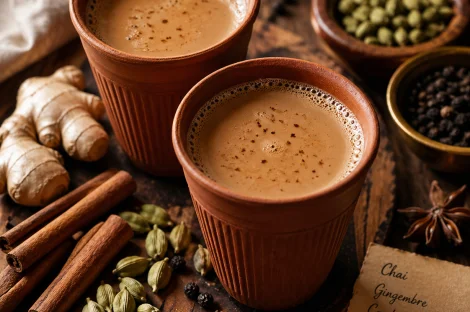
Rather than a single spice grown in one specific region, this blend pairs a robust black tea with six spices chosen for their warm, mildly spicy register, in the tradition of chai masala served across India.
| Ingredient | Role in the blend |
|---|
| Black CTC tea | Robust base, able to stand up to milk and spices without losing character |
| Ginger | Warm spiciness, the most recognisable note of chai |
| Cardamom | Fresh, floral scent, the aromatic signature of Indian chai |
| Cinnamon | Warm, slightly woody sweetness |
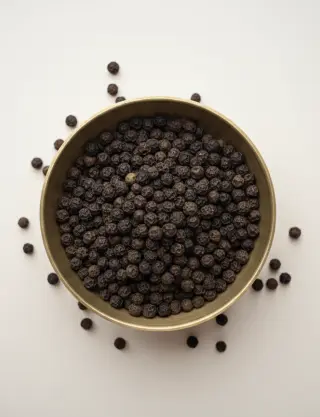
| Black pepper | Subtle warmth on the finish |
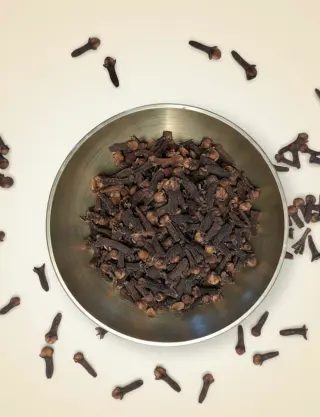
| Cloves | Powerful, slightly medicinal note, to be dosed carefully |
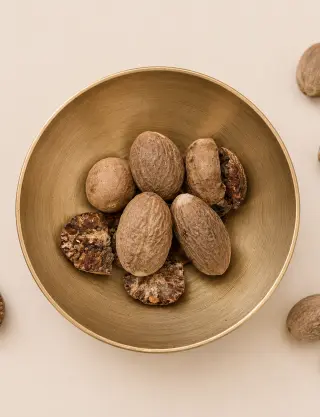
| Nutmeg | Woody roundness that closes the blend |
A two-region geography
The tea in this blend comes from Assam, in north-east India, a humid tropical region with alluvial soil particularly suited to the tea plant. The spices, on the other hand, mostly come from southern India (Kerala cardamom, pepper, cinnamon) and the west (Gujarat ginger among others), a marriage of two botanical Indias that only the chai tradition brings together in a single cup.
Not ONE recipe, but thousands
There is no single, fixed chai masala recipe: every family, every street stall has its own, with different proportions and sometimes different spices (fennel, saffron, or more or less generous black pepper depending on region and household). Our blend uses the six spices most commonly associated with chai in the northern Indian tradition.
This blend is robust and warming, carried by the tannic strength of black CTC tea. Ginger usually leads on the palate with its recognisable kick, followed by cardamom's floral freshness, the spice many Indians consider chai's most characteristic note. Cinnamon and nutmeg bring a sweet, woody roundness in the background, while cloves, more powerful, need to stay subtle so as not to dominate the blend.
Once brewed with milk and sugar the traditional way, the blend loses some of its tannic astringency and gains a creamy body: it's this milky version, not plain tea, that defines chai in the Indian imagination.
Just how much ginger and sugar goes in varies hugely from family to family and remains a lively topic of debate in India: some households prefer a very sweet, mildly spiced chai, others a 'kadak' chai, strong on tea and generous with freshly grated ginger on top of the dry blend. Neither is more authentic than the other, just regional and family habit.
The traditional method (doodh patti)
- Bring about 250 ml of water and 250 ml of whole milk to the boil with a teaspoon of the blend
- Boil for 3 to 5 minutes over medium heat, until the mixture turns a deep amber colour
- Add sugar to taste, strain and serve immediately, very hot
Regional variations
- Kadak chai: a stronger version, with more tea and a longer brewing time, popular in western India
- Chai without milk (kaadha): the blend brewed in water only, closer to a spiced herbal tea, sometimes drunk for a cold
- Western-style chai latte: the blend brewed then blended with hot frothed milk, an adaptation popularised by coffee chains
Other uses
- As a base for a tiramisu or a spiced custard, by steeping the blend in the milk or cream
- A pinch in cookie or cake batter for a chai note
- As iced tea cubes in summer, brewed strong then chilled
Street-side pairings
In India, chai is rarely drunk alone. At the chai wallah's stall, it's traditionally paired with plain biscuits (Parle-G being the country's most iconic brand), samosas, pakoras (fried vegetable fritters), or spiced savoury crackers like khari. This sweet-savoury-spiced pairing, taken in small amounts several times a day rather than in one big sitting, shapes a large part of urban Indian eating habits.
Did you know?
The word 'chai' simply means 'tea' in Hindi, itself derived from the Chinese word 'cha'. That name travelled overland: carried west along the Silk Road and across the Mongol Empire, it then reached India via the Mughal Empire's trade routes, well before the British developed large-scale tea cultivation there. Ordering a 'chai tea' at a Western café is therefore, literally, ordering a 'tea tea' - a redundancy that has become common through unfamiliarity with the word's origin.
This blend pairs black tea's theine with the traditionally digestive and warming properties of several Indian spices, though no health claim can be made for the drink as a whole.
What the ingredients are traditionally used for
- Black tea : a source of theine (chemically close to caffeine) and theaflavins, antioxidant compounds formed as tea leaves oxidise
- Ginger : long used to aid digestion and soothe mild nausea
- Cardamom : traditionally paired in Ayurvedic medicine with a fresh-breath effect and digestive support
- Cloves : contain eugenol, a compound with well-documented antiseptic properties, historically used in dentistry
- Cinnamon : traditionally used for its warming properties in both Ayurvedic and Chinese medicine
- Nutmeg : used in small amounts in traditional Ayurvedic medicine for its calming properties, particularly in the evening
How much caffeine is in a cup?
A cup of chai masala brewed the Indian way (tea boiled for several minutes with water and milk) generally contains less theine than a filter coffee, but more than a tea simply steeped for a few minutes, due to the extended contact time between hot water and the CTC tea leaves, whose small particle size favours fast, substantial extraction in the first place.
Precautions
This blend contains theine and isn't recommended in large amounts for people sensitive to caffeine, children, or in the evening for anyone prone to sleep trouble. Pregnant women should limit their daily theine intake and ask a healthcare professional for advice. Consumed in normal amounts, the blend is well tolerated by most adults.
Quality markers
- Colour : even dark brown for the tea, with visible flecks of whole or crushed spices
- Smell : a clear warm, spiced, slightly woody aroma as soon as you open the pack, with no stale note
Storage tips
- Keep in an airtight, opaque container, away from light, moisture and strong odours (tea easily absorbs surrounding smells)
- Shelf life: about 12 to 18 months under good conditions
- Avoid storing the pack near strongly scented items (coffee, potent spices) that could alter its aroma
Does Chai Masala contain caffeine?
Yes, it contains theine (chemically close to caffeine) from the black tea. The amount varies with brewing time and the proportion of tea used, generally less than a coffee but enough that sensitive people should avoid it late in the day.
Can I make a caffeine-free Chai Masala?
Our blend contains real black tea, so it does contain theine. For a caffeine-free version, you can steep just the spices in water or milk, without the tea - the result is closer to a spiced herbal tea than a classic chai.
What's the difference between chai and chai tea?
None, really: 'chai' simply means 'tea' in Hindi. The phrase 'chai tea', common in the West, is therefore redundant, a bit like saying 'tea tea'.
Can I use plant-based milk for this chai?
Yes, oat, almond or soy milk all work, with oat milk generally preferred since it holds up better to boiling without splitting. The result will be slightly less creamy than with whole cow's milk.
Why is chai brewed by boiling, unlike Western tea?
The Indian method (doodh patti) boils the tea directly with the milk and water, which extracts more tannins and colour than a simple steep. It's precisely to withstand this extended boiling that CTC tea, more robust than whole-leaf tea, was favoured from the start.
How much of each spice should I use if I make my own blend?
Ginger and cardamom usually lead, followed by a moderate amount of cinnamon. Cloves, very powerful, should stay a minor player: too much can give the whole brew a medicinal taste.
What do people eat with Chai Masala in India?
Traditionally plain biscuits, samosas or pakoras (fried vegetable fritters), taken in small amounts several times a day rather than in one big sitting. The contrast between sweet-spiced chai and salty-fried snacks is a much-loved pairing in India.










 Drinks