



















-15 %
€2.55
€3.00
€51.00/kg
 Table Indienne
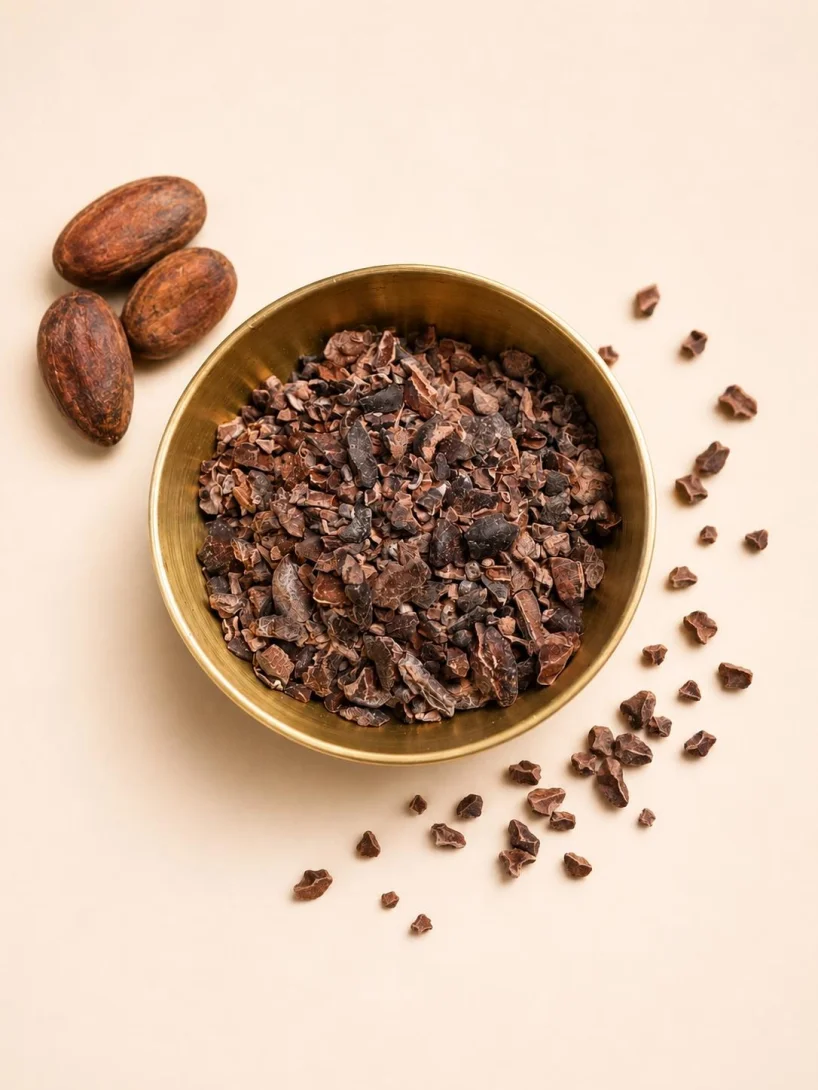
Unlike cocoa powder, obtained by pressing and finely grinding the beans, our roasted cacao nibs are simply pieces of Indian cocoa beans, hulled and crushed after roasting. They keep all the crunchy texture and the frank bitterness of the raw bean, with no further processing. Grown in South India, this little-known cocoa offers a raw, authentic alternative to cacao nibs usually imported from South America or Africa.
Cacao nibs keep a crunchy texture that powder simply cannot offer: they bring crunch rather than just fragrance. Their pronounced bitterness and subtle fruity notes make them a prime ingredient for anyone looking for raw cocoa, with no sugar or processing, to use as is as a topping or to fold into savoury preparations where their texture makes all the difference.
Our nibs are already shelled and crushed, ready to use. For shelling at home, our roasted cocoa beans keep their kernel inside the shell until use, and the shell infuses very well in hot milk. For drinks and baking, see our pure cocoa powder.
Our cacao nibs come from beans grown in South India, roasted then crushed to reveal their full character.
To preserve all their crunch and aroma, store your cacao nibs in a dry place, away from light and moisture, in their airtight packaging.
Rich in antioxidants (flavonoids)
Excellent source of fibre
Natural source of magnesium and iron
Boosts mood thanks to theobromine
Supports cardiovascular health
Provides a feeling of satiety
Gently boosts energy, caffeine-free
Contributes to normal nervous system function
| Directly selected smallholder producers | No |
| Vegetarian | Yes |
| Origin | Kerala, Tamil Nadu and Andhra Pradesh, India |
| Quality | Premium |
| Type | Roasted nibs |
| Taste profile | Bitter, crunchy and intensely roasted, with subtle fruity notes and a touch of acidity. |
| Possible traces of allergens | May contain traces of tree nuts and milk (packaged in a facility handling these allergens). |
| Composition | 100% roasted, crushed cacao bean nibs, no sugar or additives. |
Discover our roasted cacao nibs, Indian cocoa beans crushed after roasting. Bitter, crunchy and intensely aromatic for your toppings, granola and original savoury recipes.
By purchasing this product, you add €0.08 to your loyalty account, redeemable as a discount on your next order!
From €40.00 in your basket: a free spice gift of your choice, 3 to pick from.
Ready for shipping, delivery time 3-7 business days
Delivery from €4.80 at Mondial Relay pickup points. Free pickup-point delivery from €65.00 (up to 1 kg). *



India is not among the big cocoa-producing countries, and yet the cacao tree has been present there for over two centuries. It was introduced in 1798 by the British East India Company at Courtallam, in the Tirunelveli district of today’s Tamil Nadu, before reaching the Western Ghats, the Malabar plain (Kerala) and Mysore (Karnataka). For a long time the crop remained marginal.
The real boom is much more recent. Between 1930 and 1935, Criollo-type cacao trees, the traditionally most prized variety, were tested at the Kallar and Burliar fruit stations in the Nilgiris. In 1964, a few Malaysian Forastero and Trinitario clones were imported, and trials of mixed cropping with areca nut and coconut began in several research centres. In 1965, the chocolate maker Cadbury India set up a research and demonstration unit in Kerala, at Chundale, and it went on to help spread the crop to Karnataka, Andhra Pradesh and Tamil Nadu.
Research became organised: the CPCRI, India’s central plantation crops research institute, launched systematic work in 1969, and the Kerala Agricultural University (KAU) joined in 1979, with Cadbury India’s support from 1987. From the early 1970s, commercial plantations were set up under coconut palms in Tamil Nadu and Andhra Pradesh, with about 50% shade and irrigation. A Karnataka grower sums it up: the cacao tree does well in the shade of tall trees such as areca, and the head of KAU’s cocoa research centre calls it a “less effort, more income” crop.
Until recently, India imported about 70% of the cocoa it needed. In 2020-2021, Andhra Pradesh was the leading producing state (10,903 tonnes), ahead of Kerala (9,647 tonnes). In 2024, a poor harvest in West Africa, linked to ageing trees, diseases, erratic rain and a heat wave, pushed world prices from about 2,500 dollars a tonne to 10,000 dollars in May, and many Indian farmers took an interest.
Did you know?
During the Covid-19 pandemic, Cadbury India and the Campco cooperative trained Indian farmers in the drying, fermenting and roasting of beans, three steps that decide the final taste of a cacao nib. It is one of the links that is often forgotten: a good cocoa is made as much after the harvest as in the plantation.
| Characteristic | Detail |
|---|---|
| Latin name | Theobroma cacao L. |
| Botanical family | Malvaceae |
| Types | Criollo, Forastero and Trinitario (a hybrid of the two) |
| Part used | The bean, the seed inside the pod |
| Origin of our cocoa | Kerala, Tamil Nadu and Andhra Pradesh, in southern India |
| Ingredient | 100% roasted and crushed cocoa bean nibs |
The pod measures about 17 to 20 cm and holds 30 to 50 seeds embedded in a sweet pulp. It grows directly on the trunk and the large branches, not at the tips of the twigs. The cacao tree takes about five years to produce, and a 400 g pod yields only 35 to 40 g of dried beans.
Nibs are therefore the raw bean, with no other processing. Ground, they give the cocoa mass; pressed, this gives cocoa butter and, after grinding the press cake, powder. Our pure cocoa powder is the next step on from them.
Cacao nibs are bitter, crunchy and intensely roasted, with slight fruity notes and a hint of acidity. Unlike the powder, from which some of the cocoa butter has been removed, nibs contain all the bean’s natural fat: they are rounder in the mouth.
Where the powder flavours, nibs bring crunch. Their frank bitterness goes very well with sweetness (honey, dates, fruit), with salt and with spices. A tablespoon is generally enough for a bowl of yogurt or a portion of granola.
Precautions and allergens
This product may contain traces of tree nuts and milk: it is packed in a workshop that handles these allergens. Nibs are hard and small: for young children, it is best to grind them. Like all cocoa, they contain theobromine and a little caffeine, and are toxic to dogs and cats.
They are pieces of cocoa bean that have been roasted, shelled and crushed. It is the bean in its rawest form: no sugar, no additives, no further processing.
The powder is made by pressing the cocoa paste to remove part of the butter, then grinding the remaining cake. Nibs keep the whole bean: they are crunchy, richer in fat and add more texture than flavour.
As they are, as a topping on yogurt or granola, mixed into cookie dough, infused in hot milk or even in a savoury dish. Their bitterness goes well with sweetness and spices.
Yes. The cacao tree has been grown in India since its introduction in 1798 and commercial cultivation has mainly developed since the 1970s, in Kerala, Tamil Nadu, Andhra Pradesh and Karnataka, often under coconut palms.
Yes, a little, along with theobromine, a close relative. Sensitive people may wish to moderate their consumption, especially in the evening.
They may contain traces of tree nuts and milk, as they are packed in a workshop that handles these allergens. Please mention any allergies when you place your order.
Thank you! Your question has been sent. Mihika will answer soon and you will receive an email.
Roasted Cacao Nibs
Other products you might like
€2.55
€3.00
€51.00/kg

€3.00 €40.00/kg

€3.50 €46.67/kg
€5.50 €5.50/kg