

Roasted Cocoa Beans
Discover our roasted cocoa beans, whole, in their shell, grown in agroforestry in South India. In the shade of other spices and plants, with no forest cut down for them, to nibble, crush or grind for your desserts and savoury recipes.
Ready for shipping, delivery time 3-7 business days
Delivery from €4.80 at Mondial Relay pickup points.


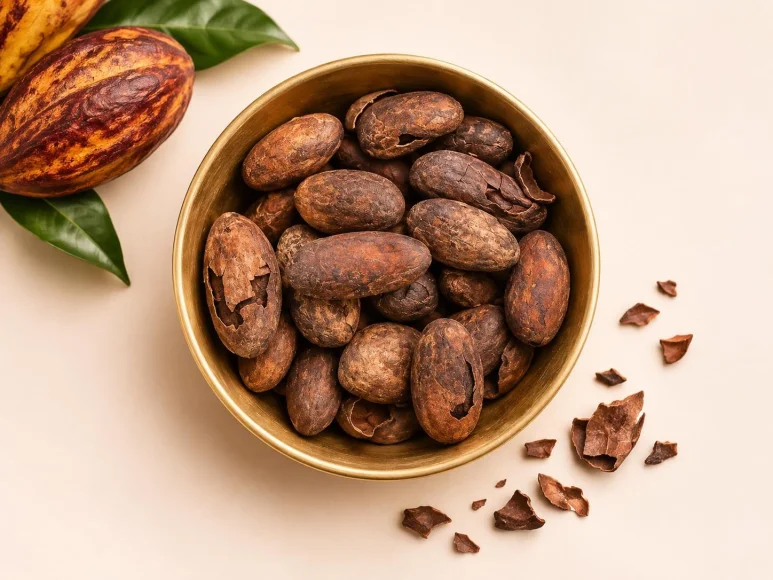
Roasted cocoa beans: cocoa in its raw form
Before it becomes chocolate or powder, cocoa is a bean. Ours are whole Indian cocoa beans, in their shell, roasted to bring out their aroma: a frank bitterness, dark chocolate notes, a fruity touch and a hint of acidity. No sugar, no additives, no further processing: the bean just as it is, and it's up to you what to do with it. The shell comes off easily with your fingertips, and it infuses very well in hot milk.
Cocoa that grows alongside other plants: agroforestry
In South India, the cocoa tree is not grown on vast plantations that take the place of the forest. It is grown in agroforestry: planted in the shade of other crops, among other spices and plants that share the same soil.
Producing cocoa here does not mean clearing forest: the trees find their place on land that is already cultivated, under the canopy of other plants. It is a different story from the cocoa that has pushed back forests elsewhere in the world, and it is why these beans earn their place in our selection of South Indian spices.
Culinary uses:
- Nibbled once shelled, for lovers of pure, bitter cocoa
- Crushed in a mortar as a topping on yoghurt, porridge or fruit salads
- Ground finely to flavour a spiced hot chocolate
- Folded into cookie or brownie dough for extra crunch
- In a reinvented mole or a spicy curry-style sauce
- Shell infused in hot milk, for a light chocolatey drink
Beans, nibs or powder?
The whole bean is shelled at home and keeps its kernel inside its shell until use. Our cacao nibs are already shelled and crushed, ready to scatter over yoghurt. Our pure cocoa powder dissolves into a drink or a bake.
Origin and quality:
Our cocoa beans are grown in South India, in agroforestry, then roasted. They contain nothing but cocoa.
Storage:
Keep your cocoa beans in a dry place, away from light and moisture, in their tightly resealed packaging.
| Directly selected smallholder producers | No |
| Vegetarian | Yes |
| Origin | South India |
| Quality | Premium |
| Type | Whole roasted beans |
| Taste profile | Bitter and intensely roasted, with dark chocolate notes, subtle fruity touches and a hint of acidity. |
| Possible traces of allergens | May contain traces of tree nuts and milk (packaged in a facility handling these allergens). |
| Composition | 100% whole roasted cocoa beans, in their shell, no sugar or additives. |
Learn more
Before it was a flavour, the cocoa bean was money. Among the Aztecs in the 16th century it served as currency: in Tlaxcala, a price list dated 1545 sets a good turkey hen at 100 beans. It was a currency with one particular feature: you could also drink it.
Theobroma, food of the gods
The cocoa tree owes its scientific name to a Swedish botanist. In 1753, in his Species Plantarum, Carl Linnaeus named it Theobroma cacao, from the Greek theos (god) and brōma (food): the "food of the gods". The name stuck, and it is hardly an exaggeration for a seed that has served as currency, offering and prestige drink.
When arecanut growers took up chocolate
The arrival of the cocoa tree in India in the 18th century is told in our guide to cacao nibs. A less familiar story is that of CAMPCO. This co-operative was founded on 11 July 1973 in Mangalore, in Karnataka, by Varanashi Subraya Bhat, for arecanut growers, after a marketing crisis in arecanut in 1970-1971. Its full name says it all: Central Arecanut and Cocoa Marketing and Processing Co-operative.
Cocoa entered its story by accident. In the early 1980s world cocoa prices collapsed and Cadbury, the region's big buyer, stopped buying from planters without warning. The co-operative then started buying the fresh beans itself. On 1 September 1986 it opened a chocolate factory in Puttur: arecanut growers were now making chocolate, and they are cited today among the country's largest makers.
Did you know?
The cocoa tree and the areca palm get along well: the first needs shade, the second provides it. In the gardens of Karnataka and Kerala the two grow side by side, one beneath the other.
| Characteristic | Detail |
|---|---|
| Latin name | Theobroma cacao L. |
| Botanical family | Malvaceae |
| Part used | The bean: a kernel wrapped in a thin shell |
| Origin of our beans | South India, grown in agroforestry |
| Ingredient | 100% whole roasted cocoa beans, in their shell |
Agroforestry: cocoa in the shade of palms
The cocoa tree is a shade tree: it needs roughly 40 to 50% shade to grow well. In South India it is therefore not planted in large open fields. It is grown mostly as an intercrop, in coconut and arecanut gardens, and also under oil palms and rubber trees. According to a study cited by Indian researchers, more than two thirds of the country's cocoa grows under coconut palms and about a fifth under arecanut. Under an areca palm, 30 to 50% of the light passes through the foliage, which is enough for cocoa.
Researchers at CPCRI, India's plantation crops institute, go further: they test multi-storey gardens. At Arsikere, in Karnataka, coconut palms, cocoa trees, lime trees and moringa (the "drumsticks" of Indian cooking) share the same plot, and other trials combine cocoa, banana, lime and moringa under coconut palms. One garden thus yields coconuts, beans, limes and pods.
In this model the cocoa tree takes its place in an already cultivated garden, on the middle storey: it does not replace a forest. That is the difference with regions where cocoa growing has pushed back the forest. To be honest about it: this is not a label or a certification, it is simply how cocoa is most often grown in this region.
Nationally it is a modest but growing crop: official 2025-2026 estimates give roughly 117,000 hectares of cocoa trees for some 34,000 tonnes of dried beans, with Andhra Pradesh in the lead, followed by Kerala. These are orders of magnitude, which vary by year and source.
One bean, two materials
A cocoa bean has two very different parts. The kernel, also called the nib, is rich in fat (cocoa butter): it is what gives the chocolate flavour. The shell, the thin skin around it, makes up roughly 10 to 20% of the bean's weight and is mostly fibre. Roasting loosens it from the kernel, which makes shelling easy at home.
The kernel of our beans is bitter, crunchy and deeply roasted, with dark chocolate notes, subtle fruity touches and a hint of acidity. Nothing sweet here: this is raw cocoa, which asks to be paired or tamed.
Two flavours in one bean
The shell has its own character. Dry and fibrous between the teeth, it is not for chewing, but it flavours very well: infused, it gives a light, woody, gentle chocolate drink, far less powerful than the kernel. The shell protects the kernel until the moment you crack it, one more reason to keep the bean whole until you use it.
Shelling at home
- As the beans are roasted, the shell comes away easily: press and fold the bean between your fingers, then peel the shell off in pieces
- For a larger batch, crack them roughly with a rolling pin in a bag, then winnow: slowly pour the mix from one bowl into another in front of a fan (or a hairdryer on cool air). The air carries off the light shells, and the pieces of kernel fall back into the bowl
- Do not throw the shells away: they can be infused (see below)
Nibble, crush, grind
- Nibble the kernel as it is, for lovers of pure, bitter cocoa
- Crush it in a mortar and scatter it over yoghurt, porridge or fruit salad
- Grind it finely (coffee grinder or mortar) to flavour a hot chocolate or a cake batter
- Fold it into cookie or brownie dough for bitterness and crunch
Infusing the shell and the beans
The shell is prepared like a herbal tea. In water at about 95 °C, allow 8 to 10 minutes for a light chocolatey infusion (one tasting guide suggests 2.5 g of shells for a 170 ml cup).
- In hot milk: bring a cup of milk, dairy or plant-based, gently to a simmer with a tablespoon of shells, leave to infuse for at least 10 minutes, then strain and froth. Cream or milk gives a more chocolatey taste than water
- With spices: add a little green cardamom or cinnamon, or infuse the shells in your chai masala
- With a few crushed kernels: they add body and bitterness to the drink
In savoury cooking
- A few ground beans in a chilli-spiked tomato sauce or a stew: they round off the acidity and add depth
- For another use of cocoa, see also our pure cocoa powder for drinks and baking
Quality criteria
- Appearance: dry, dark brown beans with the shell intact or slightly cracked
- Smell: clear, chocolatey and roasted, with no smell of mould, acrid smoke or rancidity
- At the break: a dark brown, brittle, dry kernel, never soft
Storage tips
- Keep the beans in a dry place, away from light, heat and moisture, in their tightly resealed packaging
- Crack them as you go: the kernel stays protected by its shell until use
- Keep the shells in a closed jar, dry, for your infusions
Precautions and allergens
This product may contain traces of tree nuts and milk: it is packed in a workshop that handles these allergens. Whole beans are hard: they are not suitable for young children. Like all cocoa, the bean contains theobromine (in the order of 1 to 2%) and a little caffeine, and so does the shell: enjoy in moderation, especially in the evening. Cocoa is toxic to dogs and cats.
What is a roasted cocoa bean?
It is the seed of the cocoa tree, roasted whole, in its shell: no sugar, no additives, no further processing. It shells easily, then the kernel can be nibbled, crushed or ground.
Do I need to remove the shell?
To eat the kernel, yes: the shell is fibrous. Once roasted it comes away easily by folding the bean between your fingers. You can keep it for infusions.
Can I infuse the shell in milk?
Yes. Gently bring a cup of milk to a simmer with a tablespoon of shells, leave to infuse for at least 10 minutes, then strain. Milk gives a more chocolatey taste than water.
What is the difference from nibs and cocoa powder?
Nibs are pieces of bean that have already been shelled and crushed. Powder is made by pressing the cocoa mass to remove part of the butter, then grinding what is left. The whole bean keeps its kernel inside its shell until you use it.
Where does this cocoa come from and how is it grown?
It comes from South India, where the cocoa tree is grown mostly in agroforestry, in the shade of coconut and arecanut palms. It is not a label: it is the most common way of growing cocoa in the region.
Do the beans contain caffeine?
Yes, a little, along with theobromine, a related molecule. The shell contains some too. Sensitive people may wish to moderate their intake, especially in the evening.
Do they contain allergens?
They may contain traces of tree nuts and milk, as they are packed in a workshop that handles these allergens. Please mention any allergies when you order.
-
Before it was a flavour, the cocoa bean was money. Among the Aztecs in the 16th century it served as currency: in Tlaxcala, a price list dated 1545 sets a good turkey hen at 100 beans. It was a currency with one particular feature: you could also drink it.
Theobroma, food of the gods
The cocoa tree owes its scientific name to a Swedish botanist. In 1753, in his Species Plantarum, Carl Linnaeus named it Theobroma cacao, from the Greek theos (god) and brōma (food): the "food of the gods". The name stuck, and it is hardly an exaggeration for a seed that has served as currency, offering and prestige drink.
When arecanut growers took up chocolate
The arrival of the cocoa tree in India in the 18th century is told in our guide to cacao nibs. A less familiar story is that of CAMPCO. This co-operative was founded on 11 July 1973 in Mangalore, in Karnataka, by Varanashi Subraya Bhat, for arecanut growers, after a marketing crisis in arecanut in 1970-1971. Its full name says it all: Central Arecanut and Cocoa Marketing and Processing Co-operative.
Cocoa entered its story by accident. In the early 1980s world cocoa prices collapsed and Cadbury, the region's big buyer, stopped buying from planters without warning. The co-operative then started buying the fresh beans itself. On 1 September 1986 it opened a chocolate factory in Puttur: arecanut growers were now making chocolate, and they are cited today among the country's largest makers.
Did you know?
The cocoa tree and the areca palm get along well: the first needs shade, the second provides it. In the gardens of Karnataka and Kerala the two grow side by side, one beneath the other.
-
Characteristic Detail Latin name Theobroma cacao L. Botanical family Malvaceae Part used The bean: a kernel wrapped in a thin shell Origin of our beans South India, grown in agroforestry Ingredient 100% whole roasted cocoa beans, in their shell Agroforestry: cocoa in the shade of palms
The cocoa tree is a shade tree: it needs roughly 40 to 50% shade to grow well. In South India it is therefore not planted in large open fields. It is grown mostly as an intercrop, in coconut and arecanut gardens, and also under oil palms and rubber trees. According to a study cited by Indian researchers, more than two thirds of the country's cocoa grows under coconut palms and about a fifth under arecanut. Under an areca palm, 30 to 50% of the light passes through the foliage, which is enough for cocoa.
Researchers at CPCRI, India's plantation crops institute, go further: they test multi-storey gardens. At Arsikere, in Karnataka, coconut palms, cocoa trees, lime trees and moringa (the "drumsticks" of Indian cooking) share the same plot, and other trials combine cocoa, banana, lime and moringa under coconut palms. One garden thus yields coconuts, beans, limes and pods.
In this model the cocoa tree takes its place in an already cultivated garden, on the middle storey: it does not replace a forest. That is the difference with regions where cocoa growing has pushed back the forest. To be honest about it: this is not a label or a certification, it is simply how cocoa is most often grown in this region.
Nationally it is a modest but growing crop: official 2025-2026 estimates give roughly 117,000 hectares of cocoa trees for some 34,000 tonnes of dried beans, with Andhra Pradesh in the lead, followed by Kerala. These are orders of magnitude, which vary by year and source.
One bean, two materials
A cocoa bean has two very different parts. The kernel, also called the nib, is rich in fat (cocoa butter): it is what gives the chocolate flavour. The shell, the thin skin around it, makes up roughly 10 to 20% of the bean's weight and is mostly fibre. Roasting loosens it from the kernel, which makes shelling easy at home.
-
The kernel of our beans is bitter, crunchy and deeply roasted, with dark chocolate notes, subtle fruity touches and a hint of acidity. Nothing sweet here: this is raw cocoa, which asks to be paired or tamed.
Two flavours in one bean
The shell has its own character. Dry and fibrous between the teeth, it is not for chewing, but it flavours very well: infused, it gives a light, woody, gentle chocolate drink, far less powerful than the kernel. The shell protects the kernel until the moment you crack it, one more reason to keep the bean whole until you use it.
-
Shelling at home
- As the beans are roasted, the shell comes away easily: press and fold the bean between your fingers, then peel the shell off in pieces
- For a larger batch, crack them roughly with a rolling pin in a bag, then winnow: slowly pour the mix from one bowl into another in front of a fan (or a hairdryer on cool air). The air carries off the light shells, and the pieces of kernel fall back into the bowl
- Do not throw the shells away: they can be infused (see below)
Nibble, crush, grind
- Nibble the kernel as it is, for lovers of pure, bitter cocoa
- Crush it in a mortar and scatter it over yoghurt, porridge or fruit salad
- Grind it finely (coffee grinder or mortar) to flavour a hot chocolate or a cake batter
- Fold it into cookie or brownie dough for bitterness and crunch
Infusing the shell and the beans
The shell is prepared like a herbal tea. In water at about 95 °C, allow 8 to 10 minutes for a light chocolatey infusion (one tasting guide suggests 2.5 g of shells for a 170 ml cup).
- In hot milk: bring a cup of milk, dairy or plant-based, gently to a simmer with a tablespoon of shells, leave to infuse for at least 10 minutes, then strain and froth. Cream or milk gives a more chocolatey taste than water
- With spices: add a little green cardamom or cinnamon, or infuse the shells in your chai masala
- With a few crushed kernels: they add body and bitterness to the drink
In savoury cooking
- A few ground beans in a chilli-spiked tomato sauce or a stew: they round off the acidity and add depth
- For another use of cocoa, see also our pure cocoa powder for drinks and baking
-
Quality criteria
- Appearance: dry, dark brown beans with the shell intact or slightly cracked
- Smell: clear, chocolatey and roasted, with no smell of mould, acrid smoke or rancidity
- At the break: a dark brown, brittle, dry kernel, never soft
Storage tips
- Keep the beans in a dry place, away from light, heat and moisture, in their tightly resealed packaging
- Crack them as you go: the kernel stays protected by its shell until use
- Keep the shells in a closed jar, dry, for your infusions
Precautions and allergens
This product may contain traces of tree nuts and milk: it is packed in a workshop that handles these allergens. Whole beans are hard: they are not suitable for young children. Like all cocoa, the bean contains theobromine (in the order of 1 to 2%) and a little caffeine, and so does the shell: enjoy in moderation, especially in the evening. Cocoa is toxic to dogs and cats.
-
What is a roasted cocoa bean?
It is the seed of the cocoa tree, roasted whole, in its shell: no sugar, no additives, no further processing. It shells easily, then the kernel can be nibbled, crushed or ground.
Do I need to remove the shell?
To eat the kernel, yes: the shell is fibrous. Once roasted it comes away easily by folding the bean between your fingers. You can keep it for infusions.
Can I infuse the shell in milk?
Yes. Gently bring a cup of milk to a simmer with a tablespoon of shells, leave to infuse for at least 10 minutes, then strain. Milk gives a more chocolatey taste than water.
What is the difference from nibs and cocoa powder?
Nibs are pieces of bean that have already been shelled and crushed. Powder is made by pressing the cocoa mass to remove part of the butter, then grinding what is left. The whole bean keeps its kernel inside its shell until you use it.
Where does this cocoa come from and how is it grown?
It comes from South India, where the cocoa tree is grown mostly in agroforestry, in the shade of coconut and arecanut palms. It is not a label: it is the most common way of growing cocoa in the region.
Do the beans contain caffeine?
Yes, a little, along with theobromine, a related molecule. The shell contains some too. Sensitive people may wish to moderate their intake, especially in the evening.
Do they contain allergens?
They may contain traces of tree nuts and milk, as they are packed in a workshop that handles these allergens. Please mention any allergies when you order.
Questions & Answers
Thank you! Your question has been sent. Mihika will answer soon and you will receive an email.
Roasted Cocoa Beans
Discover also
Other products you might like