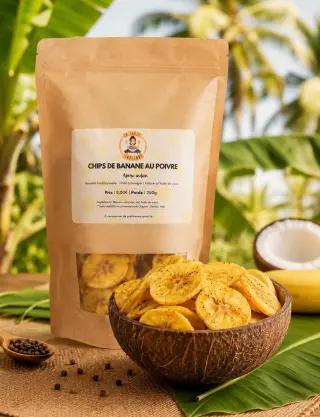
Discover our authentic Kerala Nendran banana chips, fried in wood-pressed organic coconut oil: never reused. Crispy, golden with turmeric and rock salt, sourced from the Kudumbasree women-led farming network in Kerala.
Ready for shipping, delivery time 3-10 business days
Delivery from €4.80 at Mondial Relay pickup points.


A Kerala treasure since the 13th century
Dive into the flavours of Kerala with our Nendran banana chips, known locally as Ethakka Upperi. This iconic South Indian snack is far more than a mere treat: it has been an integral part of Kerala's culture since the 13th century. Traditionally served during the Onam feast on banana leaves, they were once offered at the Sri Padmanabhaswamy Temple during the Murajapam, a royal ceremony held every twelve years.
The Nendran banana: an exceptional variety
What makes these chips unique is the Nendran banana itself. Grown in the fertile regions of Kerala for 800 years, this variety holds a protected Geographical Indication in India. Our Nendran bananas are sourced exclusively from farms in the Thiruvananthapuram district, cultivated by the Kudumbasree network and other women-led farming cooperatives in Kerala. The Nendran stands out for its firm, starchy flesh, ideal for frying. Unlike dessert bananas or common plantains, it offers an incomparably crispy texture and a subtle flavour that reveals its full richness when fried.
Woodpressed organic coconut oil: the secret of authenticity
Our chips are fried in woodpressed organic coconut oil, a traditional process that preserves all the oil's nutritional qualities without chemical alteration. This oil gives the chips their characteristic aroma and irresistible crunch. The oil is never reused: each batch is fried in fresh oil, guaranteeing optimal quality and the absence of degraded fatty acids. Turmeric, added during cooking, gives them their beautiful golden colour while acting as a natural preservative.
Why these are different from regular plantain chips
Banana chips sold in supermarkets are typically made from Ecuadorian or African plantains, fried in refined palm oil. Our Kerala Nendran chips are made with the authentic Nendran variety, fried in woodpressed organic coconut oil, naturally lower in fat thanks to traditional flash frying, and rich in healthy fats.
A naturally healthy snack
Nendran banana chips are naturally vegan, gluten-free, cholesterol-free and with no added sugar. Rich in potassium, vitamin B6 and fibre (twice as much as potato crisps), they are a healthy energy source with less fat than conventional crisps.
The coconut oil used for frying is rich in MCTs (medium-chain triglycerides), fatty acids metabolised more quickly by the body than conventional saturated fats: an additional health benefit.
Our quality commitment
At Table Indienne, we source our banana chips directly from artisan producers in the Thiruvananthapuram district of Kerala, who work with the Kudumbasree network, the world's largest women's solidarity economy network. Free from artificial preservatives and colourings, they are prepared using time-honoured methods to deliver an authentic taste. Ingredients: organic Nendran banana, woodpressed organic coconut oil, rock salt, turmeric.
Storage: Store in an airtight container at room temperature. Best consumed within 2 months of opening.
Nutritional declaration per 100g
| Nutritional component | Per 100g |
|---|---|
| Energy | 2 345 kJ / 563 kcal |
| Fat | ~ 34 g |
| of which saturated fat | ~ 29 g |
| Carbohydrates | ~ 58 g |
| of which sugars | ~ 35 g |
| Dietary fiber | ~ 7,7 g |
| Proteins | ~ 2,3 g |
| Salt | ~ 20 mg |
| Sodium | ~ 10 mg |
| Vegetarian | Yes |
| Origin | Kerala, India |
| Handmade | Yes |
Translated from French

Mihika's note
These banana chips are so deeply rooted in our culture that they are a key part of the festive meals served during our biggest celebrations! Get ready to discover the true taste of India. 🍌✨ The perfect snack to take along on your outings!
Mihika Mahakal
Founder, Table Indienne
Learn more
Nendran banana chips (known as ethakka upperi or kaya varuthathu in Malayalam) are among the foods most deeply rooted in the culture of Kerala. Their story is bound up with that of the banana itself, which has been cultivated in South India for millennia.
The technique is as simple as it is ancient: slice unripe bananas thinly and fry them in coconut oil. This process, which has barely changed in centuries, was originally a way of preserving bananas in times of plenty. Kerala's oral tradition places the origin of these chips in temple kitchens and in the festive dishes prepared for the great Hindu religious celebrations.
The Changalikodan: the royal variety
The Changalikodan Nendran is the most famous sub-variety in Kerala. Grown exclusively in the village of Chengazhikodu on the banks of the Bharathapuzha (Thrissur district), it received the first Geographical Indication ever granted to a banana in India, on 1st April 2015. Farmers wrap the bunches in dried banana leaves 20 to 25 days after flowering: a traditional technique that gives the bananas their characteristic golden-yellow colour with red edges.
During the reign of Kerala's princely kingdoms, the Changalikodan was presented as a special offering at the Murajapam: a religious ceremony held every twelve years at the Sri Padmanabhaswamy temple in Thiruvananthapuram.
The banana chip industry went through a major transformation in the second half of the 20th century, with the partial mechanisation of production and the emergence of regional and then national brands. Kozhikode (Calicut), Thrissur and Thiruvananthapuram became the epicentres of this industry. Today, Nendran chips are exported to Indian diaspora communities around the world, notably in the Middle East, Europe, the United States and Australia.
Nendran chips across languages
| Language | Name |
|---|---|
| French | Chips de banane · Chips de banane Kerala |
| Malayalam (Kerala) | Ethakka Upperi · Kaya Varuthathu · Upperi |
| Hindi | Kele Ke Chips · Kela Chips |
| Tamil | Vaazhaipazha Chips · Nendrangai Chips |
| English | Kerala Banana Chips · Plantain Chips · Nendran Chips |
| Botanical Latin | Musa paradisiaca L., AAB group |
The Nendran is no ordinary banana. It is what is known as a dual-purpose cultivar: eaten as a vegetable when green and unripe, and as a fruit once ripe. This dual nature makes the Nendran one of the most versatile and most prized bananas in Indian cuisine.
| Characteristic | Detail |
|---|---|
| Classification | Musa paradisiaca, AAB genome group |
| Size | Large to very large: significantly longer and thicker than the Cavendish banana |
| Skin | Thick, tough, smooth: it has to be cut open with a knife |
| Green flesh | Firm and starchy: ideal for frying |
| Ripe flesh | Soft and silky, with a delicate aroma: different from Cavendish bananas |
| GI status | Geographical Indication granted on 1st April 2015 (Changalikodan Nendran Banana) |
| Season | Available all year round in Kerala, with peak production from September to April |
The sub-varieties of the Nendran
- Changalikodan: the GI variety and the most prized, wrapped in leaves for its golden colour, 40 to 50 fruits per bunch, Thrissur district
- Attunendran: a variety from the Alappuzha region, with smaller but very aromatic fruits
- Nedunendran: a variety with very long fruits, less sweet, preferred for commercial chips
- Kozhikodan Nendran: a variety from the Kozhikode district, appreciated for its culinary qualities
The Nendran in Kerala culture
The Nendran is a sacred banana in Kerala. Bunches are offered to the deities in Hindu temples, notably at the Guruvayur temple (Sree Krishna), where the Changalikodan is the traditional kazhchakula (bunch offering). During Onam (Kerala's state festival), Nendran bananas are given as ritual gifts. The steamed Nendran (Ethapuzhukku) is a compulsory element of the Onam Sadhya, the 26-dish vegetarian feast served on a banana leaf.
Making Nendran banana chips is an art that looks simple but demands precision, control of temperature and respect for a rigorous sequence of steps. The Keralan artisans who produce the best chips have often refined their techniques over decades.
| Step | Description |
|---|---|
| 1. Selection | Green bananas, at the most unripe stage possible: a slightly ripened banana gives soft, overly sweet chips |
| 2. Peeling | The thick skin is cut lengthwise and removed. The peeled bananas are immediately dropped into salted or turmeric water |
| 3. Turmeric bath | Soaking in water with added turmeric and salt: the turmeric gives the characteristic golden tint and acts as a natural preservative |
| 4. Slicing | Thin slices of 1 to 2 mm, cut with a mandoline or a knife: even thickness is essential for uniform frying |
| 5. Drying | The slices are patted dry to remove surface moisture: leftover water causes spattering and soft chips |
| 6. Frying | Virgin coconut oil heated to 170-180 °C in a kadai (Indian wok). Small batches, so the oil does not cool down |
| 7. Stirring | Constant stirring during frying for an even colour |
| 8. Draining | When the chips rise to the surface golden, they are lifted out with a skimmer and drained on kitchen paper |
| 9. Seasoning | Salt is sprinkled on straight away while they are hot: salt sticks best when the chips are hot |
Why coconut oil cannot be replaced
Virgin coconut oil is the ingredient that gives Kerala banana chips their unique character. Its smoke point of 177 °C is ideal for the gentle frying that lets the chips crisp up without burning. It brings a very discreet but recognisable coconut note. Coconut oil is naturally stable under heat thanks to its high content of saturated fatty acids (including lauric acid): it does not oxidise as easily as polyunsaturated vegetable oils.
Traditional variations
- Classic salted chips (Upperi): turmeric water, salt, coconut oil, the original and most commonly eaten form
- Black pepper chips (Kurumulaku Upperi): crushed black pepper sprinkled on while hot, a classic pairing
- Spicy chips (Mulaku Upperi): red chilli powder or fresh green chilli
- Sarkara Upperi (jaggery chips): chips coated in a thick, caramelised jaggery syrup, sweet, salty and crunchy, a must at the Onam Sadhya
- Masala chips: a spice mix (chilli, coriander, cumin, pepper) sprinkled on, a more modern variation
Few foods in world gastronomy can boast both an everyday culinary role and a deep ritual significance. Nendran banana chips belong to that rare category.
The Onam Sadhya
Onam is Kerala's state festival, celebrated in August and September. This 10-day festival culminates in Thiruonam (the holiest day), when every Keralan family serves the Sadhya: an exceptional vegetarian feast of at least 26 dishes, served on a fresh banana leaf.
Banana chips hold a compulsory, codified place in this feast. Ethakka upperi (salted chips) and sarkara upperi (jaggery chips) are always present: their absence would be considered a flaw in the ritual. The placement of the dishes on the banana leaf is itself codified: the chips are traditionally served in the upper left part of the leaf, alongside the pickles and the papadams.
Banana chips as a divine offering
The Nendran banana is a sacred offering in the Hindu temples of Kerala. At the Guruvayur temple (one of the most important in Kerala, dedicated to Sree Krishna), Changalikodan Nendran bananas are presented as kazhchakula offerings (whole bunches brought to the main deity). This link between everyday food and the sacred is characteristic of Keralan culture, where cooking and spirituality are intimately bound together.
Part of everyday life
- Bakeries: practically every bakery in Kerala has a large kadai permanently on the go with chips frying: the aroma of hot coconut oil is everywhere in the streets of Kerala
- Travel snack: the Keralan travel snack par excellence, taken along on trains, buses and planes
- Diaspora gift: Keralites living abroad carry kilos of chips back for their communities, in the Middle East, Britain and the United States, where Nendran chips are an emotional link with the homeland
- Festivals and celebrations: weddings, ceremonies, celebrations, the chips are always on the table at every Keralan festive meal
Nendran banana chips occupy an interesting position nutritionally: being fried, they are high in calories, yet they keep a significant share of the nutrients of the original banana and offer real advantages over industrial potato crisps.
| Nutrient | Per 100 g of chips |
|---|---|
| Calories | ~519 kcal |
| Carbohydrates | ~58 g of which ~3 g dietary fibre |
| Fat | ~33 g (fatty acids from coconut oil) |
| Protein | ~2.3 g |
| Potassium | ~358 mg |
| Vitamin B6 | Present: essential for neurological metabolism |
| Vitamin C | Present but partly destroyed by heat |
| Manganese | Significant amount: an enzymatic cofactor with antioxidant activity |
The strengths of the green Nendran banana
- Exceptional resistant starch: up to 42% resistant starch out of the total starch. This starch is a powerful prebiotic: it escapes digestion in the small intestine and feeds the beneficial bacteria of the microbiome
- Low glycaemic index: a GI of 30-35, clearly lower than a ripe Cavendish banana (GI 51-65) or potato crisps (GI 70-85)
- Potassium: an essential mineral for blood pressure balance, muscle contraction and kidney function
- Lasting energy: complex carbohydrates provide prolonged energy without a sudden blood sugar spike
- Gluten-free: naturally free from gluten, preservatives, colourings and additives
Precautions
Like any fried product, Nendran chips are dense in calories (~519 kcal/100 g) and rich in fat. Frying in coconut oil provides saturated fatty acids (mainly lauric acid). To be enjoyed in moderation as part of a balanced diet.
Nendran banana chips are easy to make at home, provided you can find the right bananas (Indian or Asian grocers) and follow the technique.
Ingredients (serves 4)
- 4 very green Nendran bananas (or green plantains if you cannot find them)
- 500 ml virgin coconut oil (or a neutral vegetable oil)
- 1 teaspoon ground turmeric
- 1 tablespoon fine salt
- Enough cold water
Method
- Prepare the turmeric bath: dissolve the turmeric and salt in 1 litre of cold water
- Peel the bananas: cut the skin along its whole length, remove it and drop the bananas straight into the turmeric bath to prevent oxidation
- Slice thinly: use a mandoline (1-2 mm thick) or a well-sharpened knife. Even slices are essential
- Pat dry: drain the slices and dry them thoroughly, with no trace of moisture left
- Heat the oil: in a wok or deep frying pan, bring the coconut oil to 170-175 °C
- Fry in small batches: drop in a small handful of slices without overcrowding. Stir constantly
- Watch the colour: after 3-5 minutes, the chips rise to the surface and the sound of the frying changes pitch
- Drain: lift the chips out with a skimmer and blot them on kitchen paper
- Season while hot: sprinkle with salt while the chips are still hot
- Let cool completely before serving or packing
A Keralan chef's tip
The key to a crisp chip is a steady oil temperature. Between batches, let the oil come back up to temperature. Oil that is too cold gives greasy chips. Oil that is too hot gives chips burnt outside and raw inside. The classic test: drop in a test slice; if it sinks then rises again within 4 to 5 seconds with a light sizzle, the temperature is perfect.
Signs of authenticity
- Colour: an even golden yellow with a few slight variations. Too pale = undercooked. Too dark = overcooked or degraded oil
- Texture: crisp and thin, snapping cleanly between the teeth, never rubbery or soft
- Aroma: a subtle scent of coconut plus a slightly starchy note of banana. If the chips smell of sunflower or rapeseed, they were not fried in coconut oil
- Taste: lightly salted, with a subtle note of green banana and the aroma of coconut in the background. No artificial taste
- Ingredients: Nendran banana (or green banana), coconut oil, salt. No artificial flavourings, no synthetic antioxidants, no colourings
- Origin: a reputable producer mentions Kerala, and ideally the Nendran or Changalikodan variety
Storage
- Airtight jar or tightly closed zip bag, away from moisture: moisture is the chips' main enemy
- Shelf life: 2 to 4 weeks at room temperature in an airtight container
- Never refrigerate: the cold makes the chips damp
- If the chips go soft: put them back in the oven for 5 minutes at 150 °C to bring back the crunch
Beware of imitations
Not all banana chips are equal. Industrial chips may use lower-quality bananas, refined vegetable oils instead of coconut oil, and artificial seasonings. The quality of the finished product is directly linked to the quality of the ingredients. Always check the label.
Can you make Nendran chips with ordinary plantains?
Yes. Green plantains sold in African, Caribbean and Asian grocery stores are botanically close to the Nendran (same AAB group) and give very similar chips. The Keralan Nendran has a slightly better texture and aroma profile, but green plantain chips are an excellent substitute. The essential point is to use very green, unripe fruit, never yellow bananas.
Why do banana chips go soft so quickly?
Banana chips are hygroscopic: they absorb moisture from the air very quickly. Freshly fried chips must cool completely before going into an airtight jar. If they are packed while still warm, the residual steam softens them from the inside. Eat them within 2 weeks, or put them back in the oven for 5 minutes at 150 °C to bring back the crunch.
Are Nendran banana chips healthier than potato crisps?
Authentic Nendran chips (fried in coconut oil, without additives) offer several advantages: prebiotic resistant starch (absent from potato crisps), more potassium, vitamins B6 and C, and no additives. On the other hand, they are just as high in calories (~519 kcal/100 g). The difference is not healthy versus unhealthy, but a better nutritional profile made with natural ingredients.
What is the difference between salted chips and Sarkara Upperi?
Ethakka upperi is the classic salted version: the staple of every Keralan table. Sarkara upperi is the sweet-and-salty version made with jaggery (unrefined raw cane sugar). The hot chips are tossed with a thick jaggery syrup that caramelises and coats each chip in a crunchy layer of brown sugar. A sweet, salty and crunchy snack of remarkable complexity: a must at the Onam Sadhya.
Why coconut oil and not another oil?
Virgin coconut oil is the ingredient that gives Kerala banana chips their unique character. Its smoke point of 177 °C is ideal for gentle frying. It brings a discreet but recognisable coconut note. It is naturally stable under heat thanks to its high content of saturated fatty acids and does not oxidise as easily as polyunsaturated vegetable oils. Chips fried in sunflower or palm oil simply do not taste the same.
-
Nendran banana chips (known as ethakka upperi or kaya varuthathu in Malayalam) are among the foods most deeply rooted in the culture of Kerala. Their story is bound up with that of the banana itself, which has been cultivated in South India for millennia.
The technique is as simple as it is ancient: slice unripe bananas thinly and fry them in coconut oil. This process, which has barely changed in centuries, was originally a way of preserving bananas in times of plenty. Kerala's oral tradition places the origin of these chips in temple kitchens and in the festive dishes prepared for the great Hindu religious celebrations.
The Changalikodan: the royal variety
The Changalikodan Nendran is the most famous sub-variety in Kerala. Grown exclusively in the village of Chengazhikodu on the banks of the Bharathapuzha (Thrissur district), it received the first Geographical Indication ever granted to a banana in India, on 1st April 2015. Farmers wrap the bunches in dried banana leaves 20 to 25 days after flowering: a traditional technique that gives the bananas their characteristic golden-yellow colour with red edges.
During the reign of Kerala's princely kingdoms, the Changalikodan was presented as a special offering at the Murajapam: a religious ceremony held every twelve years at the Sri Padmanabhaswamy temple in Thiruvananthapuram.
The banana chip industry went through a major transformation in the second half of the 20th century, with the partial mechanisation of production and the emergence of regional and then national brands. Kozhikode (Calicut), Thrissur and Thiruvananthapuram became the epicentres of this industry. Today, Nendran chips are exported to Indian diaspora communities around the world, notably in the Middle East, Europe, the United States and Australia.
Nendran chips across languages
Language Name French Chips de banane · Chips de banane Kerala Malayalam (Kerala) Ethakka Upperi · Kaya Varuthathu · Upperi Hindi Kele Ke Chips · Kela Chips Tamil Vaazhaipazha Chips · Nendrangai Chips English Kerala Banana Chips · Plantain Chips · Nendran Chips Botanical Latin Musa paradisiaca L., AAB group -
The Nendran is no ordinary banana. It is what is known as a dual-purpose cultivar: eaten as a vegetable when green and unripe, and as a fruit once ripe. This dual nature makes the Nendran one of the most versatile and most prized bananas in Indian cuisine.
Characteristic Detail Classification Musa paradisiaca, AAB genome group Size Large to very large: significantly longer and thicker than the Cavendish banana Skin Thick, tough, smooth: it has to be cut open with a knife Green flesh Firm and starchy: ideal for frying Ripe flesh Soft and silky, with a delicate aroma: different from Cavendish bananas GI status Geographical Indication granted on 1st April 2015 (Changalikodan Nendran Banana) Season Available all year round in Kerala, with peak production from September to April The sub-varieties of the Nendran
- Changalikodan: the GI variety and the most prized, wrapped in leaves for its golden colour, 40 to 50 fruits per bunch, Thrissur district
- Attunendran: a variety from the Alappuzha region, with smaller but very aromatic fruits
- Nedunendran: a variety with very long fruits, less sweet, preferred for commercial chips
- Kozhikodan Nendran: a variety from the Kozhikode district, appreciated for its culinary qualities
The Nendran in Kerala culture
The Nendran is a sacred banana in Kerala. Bunches are offered to the deities in Hindu temples, notably at the Guruvayur temple (Sree Krishna), where the Changalikodan is the traditional kazhchakula (bunch offering). During Onam (Kerala's state festival), Nendran bananas are given as ritual gifts. The steamed Nendran (Ethapuzhukku) is a compulsory element of the Onam Sadhya, the 26-dish vegetarian feast served on a banana leaf.
-
Making Nendran banana chips is an art that looks simple but demands precision, control of temperature and respect for a rigorous sequence of steps. The Keralan artisans who produce the best chips have often refined their techniques over decades.
Step Description 1. Selection Green bananas, at the most unripe stage possible: a slightly ripened banana gives soft, overly sweet chips 2. Peeling The thick skin is cut lengthwise and removed. The peeled bananas are immediately dropped into salted or turmeric water 3. Turmeric bath Soaking in water with added turmeric and salt: the turmeric gives the characteristic golden tint and acts as a natural preservative 4. Slicing Thin slices of 1 to 2 mm, cut with a mandoline or a knife: even thickness is essential for uniform frying 5. Drying The slices are patted dry to remove surface moisture: leftover water causes spattering and soft chips 6. Frying Virgin coconut oil heated to 170-180 °C in a kadai (Indian wok). Small batches, so the oil does not cool down 7. Stirring Constant stirring during frying for an even colour 8. Draining When the chips rise to the surface golden, they are lifted out with a skimmer and drained on kitchen paper 9. Seasoning Salt is sprinkled on straight away while they are hot: salt sticks best when the chips are hot Why coconut oil cannot be replaced
Virgin coconut oil is the ingredient that gives Kerala banana chips their unique character. Its smoke point of 177 °C is ideal for the gentle frying that lets the chips crisp up without burning. It brings a very discreet but recognisable coconut note. Coconut oil is naturally stable under heat thanks to its high content of saturated fatty acids (including lauric acid): it does not oxidise as easily as polyunsaturated vegetable oils.
Traditional variations
- Classic salted chips (Upperi): turmeric water, salt, coconut oil, the original and most commonly eaten form
- Black pepper chips (Kurumulaku Upperi): crushed black pepper sprinkled on while hot, a classic pairing
- Spicy chips (Mulaku Upperi): red chilli powder or fresh green chilli
- Sarkara Upperi (jaggery chips): chips coated in a thick, caramelised jaggery syrup, sweet, salty and crunchy, a must at the Onam Sadhya
- Masala chips: a spice mix (chilli, coriander, cumin, pepper) sprinkled on, a more modern variation
-
Few foods in world gastronomy can boast both an everyday culinary role and a deep ritual significance. Nendran banana chips belong to that rare category.
The Onam Sadhya
Onam is Kerala's state festival, celebrated in August and September. This 10-day festival culminates in Thiruonam (the holiest day), when every Keralan family serves the Sadhya: an exceptional vegetarian feast of at least 26 dishes, served on a fresh banana leaf.
Banana chips hold a compulsory, codified place in this feast. Ethakka upperi (salted chips) and sarkara upperi (jaggery chips) are always present: their absence would be considered a flaw in the ritual. The placement of the dishes on the banana leaf is itself codified: the chips are traditionally served in the upper left part of the leaf, alongside the pickles and the papadams.
Banana chips as a divine offering
The Nendran banana is a sacred offering in the Hindu temples of Kerala. At the Guruvayur temple (one of the most important in Kerala, dedicated to Sree Krishna), Changalikodan Nendran bananas are presented as kazhchakula offerings (whole bunches brought to the main deity). This link between everyday food and the sacred is characteristic of Keralan culture, where cooking and spirituality are intimately bound together.
Part of everyday life
- Bakeries: practically every bakery in Kerala has a large kadai permanently on the go with chips frying: the aroma of hot coconut oil is everywhere in the streets of Kerala
- Travel snack: the Keralan travel snack par excellence, taken along on trains, buses and planes
- Diaspora gift: Keralites living abroad carry kilos of chips back for their communities, in the Middle East, Britain and the United States, where Nendran chips are an emotional link with the homeland
- Festivals and celebrations: weddings, ceremonies, celebrations, the chips are always on the table at every Keralan festive meal
-
Nendran banana chips occupy an interesting position nutritionally: being fried, they are high in calories, yet they keep a significant share of the nutrients of the original banana and offer real advantages over industrial potato crisps.
Nutrient Per 100 g of chips Calories ~519 kcal Carbohydrates ~58 g of which ~3 g dietary fibre Fat ~33 g (fatty acids from coconut oil) Protein ~2.3 g Potassium ~358 mg Vitamin B6 Present: essential for neurological metabolism Vitamin C Present but partly destroyed by heat Manganese Significant amount: an enzymatic cofactor with antioxidant activity The strengths of the green Nendran banana
- Exceptional resistant starch: up to 42% resistant starch out of the total starch. This starch is a powerful prebiotic: it escapes digestion in the small intestine and feeds the beneficial bacteria of the microbiome
- Low glycaemic index: a GI of 30-35, clearly lower than a ripe Cavendish banana (GI 51-65) or potato crisps (GI 70-85)
- Potassium: an essential mineral for blood pressure balance, muscle contraction and kidney function
- Lasting energy: complex carbohydrates provide prolonged energy without a sudden blood sugar spike
- Gluten-free: naturally free from gluten, preservatives, colourings and additives
Precautions
Like any fried product, Nendran chips are dense in calories (~519 kcal/100 g) and rich in fat. Frying in coconut oil provides saturated fatty acids (mainly lauric acid). To be enjoyed in moderation as part of a balanced diet.
-
Nendran banana chips are easy to make at home, provided you can find the right bananas (Indian or Asian grocers) and follow the technique.
Ingredients (serves 4)
- 4 very green Nendran bananas (or green plantains if you cannot find them)
- 500 ml virgin coconut oil (or a neutral vegetable oil)
- 1 teaspoon ground turmeric
- 1 tablespoon fine salt
- Enough cold water
Method
- Prepare the turmeric bath: dissolve the turmeric and salt in 1 litre of cold water
- Peel the bananas: cut the skin along its whole length, remove it and drop the bananas straight into the turmeric bath to prevent oxidation
- Slice thinly: use a mandoline (1-2 mm thick) or a well-sharpened knife. Even slices are essential
- Pat dry: drain the slices and dry them thoroughly, with no trace of moisture left
- Heat the oil: in a wok or deep frying pan, bring the coconut oil to 170-175 °C
- Fry in small batches: drop in a small handful of slices without overcrowding. Stir constantly
- Watch the colour: after 3-5 minutes, the chips rise to the surface and the sound of the frying changes pitch
- Drain: lift the chips out with a skimmer and blot them on kitchen paper
- Season while hot: sprinkle with salt while the chips are still hot
- Let cool completely before serving or packing
A Keralan chef's tip
The key to a crisp chip is a steady oil temperature. Between batches, let the oil come back up to temperature. Oil that is too cold gives greasy chips. Oil that is too hot gives chips burnt outside and raw inside. The classic test: drop in a test slice; if it sinks then rises again within 4 to 5 seconds with a light sizzle, the temperature is perfect.
-
Signs of authenticity
- Colour: an even golden yellow with a few slight variations. Too pale = undercooked. Too dark = overcooked or degraded oil
- Texture: crisp and thin, snapping cleanly between the teeth, never rubbery or soft
- Aroma: a subtle scent of coconut plus a slightly starchy note of banana. If the chips smell of sunflower or rapeseed, they were not fried in coconut oil
- Taste: lightly salted, with a subtle note of green banana and the aroma of coconut in the background. No artificial taste
- Ingredients: Nendran banana (or green banana), coconut oil, salt. No artificial flavourings, no synthetic antioxidants, no colourings
- Origin: a reputable producer mentions Kerala, and ideally the Nendran or Changalikodan variety
Storage
- Airtight jar or tightly closed zip bag, away from moisture: moisture is the chips' main enemy
- Shelf life: 2 to 4 weeks at room temperature in an airtight container
- Never refrigerate: the cold makes the chips damp
- If the chips go soft: put them back in the oven for 5 minutes at 150 °C to bring back the crunch
Beware of imitations
Not all banana chips are equal. Industrial chips may use lower-quality bananas, refined vegetable oils instead of coconut oil, and artificial seasonings. The quality of the finished product is directly linked to the quality of the ingredients. Always check the label.
-
Can you make Nendran chips with ordinary plantains?
Yes. Green plantains sold in African, Caribbean and Asian grocery stores are botanically close to the Nendran (same AAB group) and give very similar chips. The Keralan Nendran has a slightly better texture and aroma profile, but green plantain chips are an excellent substitute. The essential point is to use very green, unripe fruit, never yellow bananas.
Why do banana chips go soft so quickly?
Banana chips are hygroscopic: they absorb moisture from the air very quickly. Freshly fried chips must cool completely before going into an airtight jar. If they are packed while still warm, the residual steam softens them from the inside. Eat them within 2 weeks, or put them back in the oven for 5 minutes at 150 °C to bring back the crunch.
Are Nendran banana chips healthier than potato crisps?
Authentic Nendran chips (fried in coconut oil, without additives) offer several advantages: prebiotic resistant starch (absent from potato crisps), more potassium, vitamins B6 and C, and no additives. On the other hand, they are just as high in calories (~519 kcal/100 g). The difference is not healthy versus unhealthy, but a better nutritional profile made with natural ingredients.
What is the difference between salted chips and Sarkara Upperi?
Ethakka upperi is the classic salted version: the staple of every Keralan table. Sarkara upperi is the sweet-and-salty version made with jaggery (unrefined raw cane sugar). The hot chips are tossed with a thick jaggery syrup that caramelises and coats each chip in a crunchy layer of brown sugar. A sweet, salty and crunchy snack of remarkable complexity: a must at the Onam Sadhya.
Why coconut oil and not another oil?
Virgin coconut oil is the ingredient that gives Kerala banana chips their unique character. Its smoke point of 177 °C is ideal for gentle frying. It brings a discreet but recognisable coconut note. It is naturally stable under heat thanks to its high content of saturated fatty acids and does not oxidise as easily as polyunsaturated vegetable oils. Chips fried in sunflower or palm oil simply do not taste the same.
Questions & Answers
Thank you! Your question has been sent. Mihika will answer soon and you will receive an email.

Kerala Nendran Banana Chips
Discover also
Other products you might like