











€7.80
 Table Indienne
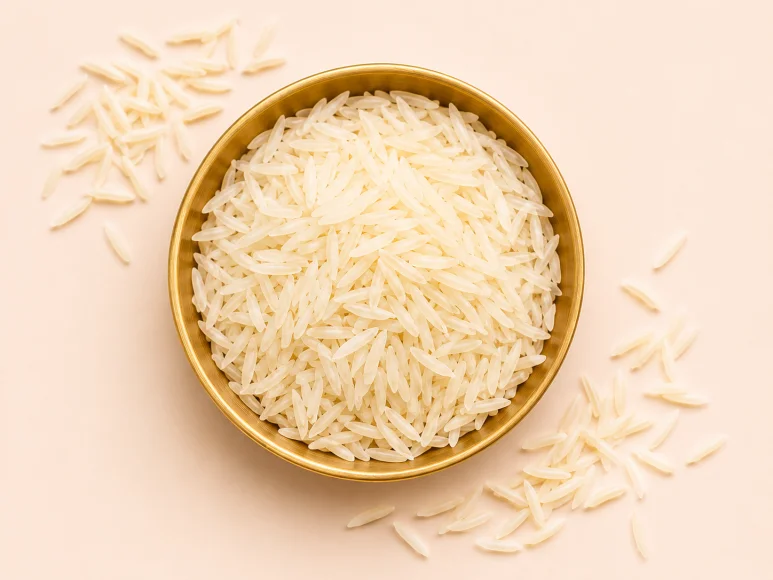
Basmati rice has been grown for centuries in the foothills of the Himalayas, within the geographically protected region spanning Punjab to Uttarakhand. Its long, slender grains and delicate fragrance make it one of the most prized rice varieties in Indian cuisine. We select a premium-grade basmati whose grains elongate further during cooking without breaking.
Unlike regular white rice, basmati has a moderate glycemic index (50 to 58), releasing energy more gradually. Its long grain stays firm and separate once cooked, unlike shorter rice varieties that tend to clump. It's also a naturally gluten-free, neutral base that pairs with any cuisine.
We carefully select our basmati rice for its premium quality: a long, fragrant grain that stays firm and separate once cooked.
Store your basmati rice in a cool, dry place away from light and moisture, in its airtight packaging or a sealed jar. It will keep for several months without losing quality.
Low glycemic index compared to regular white rice
Source of slow-release energy
Naturally gluten-free
Low in fat
Long grain, easy to digest
No added sodium
Neutral base that pairs with every cuisine
Traditionally used for light Ayurvedic meals
Nutritional declaration per 100g
| Nutritional component | Per 100g |
|---|---|
| Energy | 1 481 kJ / 354 kcal |
| Fat | ~ 1,5 g |
| Carbohydrates | ~ 75 g |
| Dietary fiber | ~ 1,7 g |
| Proteins | ~ 8,9 g |
| Vegetarian | Yes |
| Vegan | Yes |
| Gluten-free | Yes |
| Origin | Punjab, India |
| Quality | Premium |
| Type | Long grain |
| Taste profile | Delicate, slightly floral aroma with a mild flavour; grains stay separate and fluffy when cooked. |
Discover our basmati rice, grown in the foothills of the Himalayas, between Punjab and Uttarakhand. Long, fragrant grains with a moderate glycemic index to elevate your biryanis and everyday side dishes.
By purchasing this product, you add €0.20 to your loyalty account, redeemable as a discount on your next order!
From €40.00 in your basket: a free spice gift of your choice, 3 to pick from.
Ready for shipping, delivery time 3-7 business days
Delivery from €5.20 at Mondial Relay pickup points. Free pickup-point delivery from €65.00 (up to 1 kg). *


Discover our kits with recipes to learn how to use this spice
€7.80
€7.50
€6.50
€7.40
The word basmati comes from Sanskrit: vas, fragrance, and mayup, present or ingrained. From vasmati, common usage made basmati: the rice carries its aroma in its very name. Its earliest known mention is in Heer Ranjha, the epic by the Punjabi poet Waris Shah, composed in 1766.
We would love to tell a story of pharaohs or Mughal emperors here, but the sources do not allow it: before that poem, the written trail of basmati escapes us, and we would rather not fill the gap with legends presented as facts. The ones that exist deserve to be told all the same, as long as they are named for what they are.
At the foot of the Himalayas, the Doon valley around Dehradun, in Uttarakhand, is famed for a basmati with a popcorn scent. An oral tradition credits its origin to Dost Mohammad Khan, the emir of Afghanistan exiled to India after the First Anglo-Afghan War, around 1839: a lover of pulao, he is said to have had seeds brought over so that he could have his rice at his table. The versions differ (seeds from Afghanistan’s Kunar province, or bought in Punjab) and no archive is cited in support: it is a legend, and we tell it as one.
His grandson Mohammad Yaqub Khan, exiled to Dehradun in 1879, is said to have encouraged rice growing in the valley. One botanical curiosity is worth noting: “Type 3”, a variety that the press associates with the basmati of the Doon, is among the parents of the line Pusa 614, from which Pusa 1121 later came. If that association is correct, today’s extra long basmati descends, on one side, from the Doon valley.
Many modern basmati varieties carry the name Pusa: Pusa Basmati 1, Pusa 1121, Pusa 1509. It is not the name of a Delhi district but of a village in Bihar, where the Indian Agricultural Research Institute (IARI) was founded in 1905 with the backing of the American philanthropist Henry Phipps. The earthquake of 15 January 1934, which struck Bihar, damaged the institute. Its move to Delhi was approved in July 1934 and the new campus was inaugurated on 29 July 1936. The institute moved; the name stayed on the seeds.
For a long time basmati was a matter of traditional, tall varieties grown at the foot of the Himalayas. In the 20th century, IARI breeders created shorter, more productive varieties, among them Pusa Basmati 1 (yielding up to twice as much as traditional varieties) and then, in 2003, the one that would become the benchmark for extra long grains: Pusa 1121, whose story is told in more detail below.
Taraori Basmati, released in 1996 from a Karnal selection, takes its name from Taraori (or Tarain), in Haryana. Two famous battles were fought there: in 1191 Prithviraj Chauhan drove back Muhammad of Ghor; the following year, in 1192, Muhammad took his revenge on the same site.
Basmati is now one of India’s great agricultural exports. Its main destinations in 2023-2024 are Saudi Arabia, Iran, Iraq, the United Arab Emirates, the United States and Yemen, according to APEDA figures. It is grown on both sides of the India-Pakistan border, Punjab having been partitioned in 1947.
In September 1997 the American company RiceTec was granted US patent no. 5,663,484 on “basmati rice lines and grains”. After India opposed it, RiceTec lost or withdrew most of its claims, including the right to call its rice “basmati”. A narrower varietal patent was granted in 2001, and the original patent expired in 2019.
Basmati (Oryza sativa) is grown at the foot of the Himalayas, on the plains of northern India and Pakistan. Its name is protected: APEDA, India’s agricultural export promotion agency, had basmati registered as a geographical indication on 15 February 2016.
| Feature | Detail |
|---|---|
| Species | Oryza sativa |
| Protected area in India | Seven states or territories: Punjab, Haryana, Himachal Pradesh, Uttarakhand, Delhi, 30 districts of western Uttar Pradesh and 3 districts of Jammu and Kashmir |
| APEDA criteria | An average milled grain length, before cooking, of at least 6.61 mm and a width of up to 2 mm, among other parameters |
| India’s weight | More than 70% of the world’s basmati production |
| Indian exports 2025-2026 | About 6.5 million tonnes, worth nearly 5.7 billion dollars (APEDA) |
India is not alone: Pakistan also grows basmati. In 2019 India accounted for about 65% of international basmati trade and Pakistan for 35%.
Basmati is a rainy-season rice. The seeds are sown in a nursery in early June, and the young plants, about thirty days old, are transplanted into puddled paddy fields by the end of July at the latest. The grain then ripens through the autumn.
“Extra long” describes the length of the grain, not a variety. The trait that makes basmati what it is, and that extra long grains push to the extreme, is that the grain lengthens when cooked without widening: it stays slim, separate, and does not stick.
| Variety | What to remember |
|---|---|
| Basmati 370 | A traditional variety, ancestor of several IARI creations |
| Pusa Basmati 1 (PB1) | Semi-dwarf, created by the IARI in Delhi, far more productive than traditional varieties |
| Taraori Basmati | From a Karnal selection, released in 1996 |
| Pusa Basmati 1121 | The emblematic extra long variety, about 70% of Indian basmati exports |
| Pusa 1509 and 1718 | Other common, more recent Indian varieties |
| Dehradun Basmati | Grown in Uttarakhand, known for its popcorn aroma |
The number is neither a year nor a size grade: it is the number of the breeding line, Pusa 1121-92-8-13-3, selected in the 1992 monsoon season. The variety was developed at the IARI in New Delhi by the researcher Vijaipal Singh, from the line Pusa 614, itself a cross of Basmati 370 and Type 3. It has been sold since 2003 as Pusa 1121 (Pusa Sugandh 4), then renamed Pusa Basmati 1121 and released in Punjab and Haryana in 2008.
Its figures are spectacular: up to 9 mm raw, an elongation ratio of 2 to 2.5, and cooked grains reaching 21.5 mm, 2.7 times their original length, according to the Limca Book of Records 2018. It accounts for about 70% of Indian basmati exports.
We sell it as “extra long basmati”. That description refers to the length of the grain: it is the category whose emblematic variety is Pusa Basmati 1121, but we do not name a specific variety on this page.
Basmati’s fragrance comes mainly from one molecule, 2-acetyl-1-pyrroline. Basmati contains about 0.09 ppm of it, roughly twelve times more than non-basmati rices. It is associated with notes of popcorn and pandan. APEDA’s official description speaks of a “superior aroma” and a “distinct flavour”, with extra long, slender grains that lengthen to at least twice their original size, for a soft, fluffy texture.
Agronomists stress the drying: grain brought down to 13% moisture within 24 hours of harvest keeps its aroma, whereas heat and late drying lower it. The fragrance is therefore prepared in the paddy field, long before the pan.
Cooking reduces the level of 2-acetyl-1-pyrroline. Soaking for 30 minutes before cooking shortens the cooking time by about 20% and keeps more of the fragrance. This is also why the lid is not lifted: it keeps the volatile molecules in the pan.
Traders age basmati: dry, aged rice cooks firmer, sticks less and lengthens more, and its aroma strengthens in storage. Researchers describe conventional ageing of three to six months. In a basmati tasting by the American magazine America’s Test Kitchen, the top-rated rice had been aged 12 to 18 months in temperature-controlled silos, and Cook’s Illustrated’s measurements confirm that aged rice cooks up longer and thinner.
Open the bag and breathe in: a good basmati gives off a delicate, slightly floral scent, sometimes of popcorn. Rice that smells musty or has almost no smell at all is probably old or badly stored.
A good basmati comes down to three gestures: rinse, soak, then leave it alone.
| Absorption method | Guide |
|---|---|
| Ratio of rice to water | 1 part rice to 2 parts water without soaking; 1 to 1.5 with soaking |
| Covered, lowest heat | 15 to 18 minutes without soaking; 10 to 12 minutes with soaking |
| Resting off the heat | 5 to 10 minutes, covered |
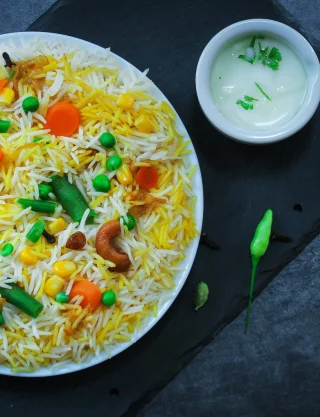
For a biryani the rice is parboiled to about two thirds in a large pan of boiling salted water, for a few minutes only, then drained and finished by steaming in layers with the meat or vegetables, in a sealed pot: this is the dum method. The grains stay whole and perfectly separate.
Almost always because of too much water, unrinsed rice or stirring during cooking. An extra long basmati of the 1121 type is known for not turning sticky, provided you respect these three points.
As for spices, basmati loves green cardamom, cloves, cinnamon, cumin and saffron, tempered in oil or ghee before the rice goes in.
Allow about 70 to 80 g of raw rice per person as a side dish, and up to 100 g for a one-dish meal. Rice swells as it cooks, and an extra long basmati lengthens even more than an ordinary rice.
Rice is naturally gluten-free. Like any white rice, basmati is rich mainly in carbohydrate in the form of starch. Its glycaemic index is considered medium: published values range from about 50 to nearly 70 depending on the variety and the cooking, against 89 for jasmine rice and instant white rice according to the Canadian Diabetes Association.
| Component | Per 100 g of raw long-grain white rice |
|---|---|
| Energy | about 365 kcal |
| Carbohydrate | about 80 g |
| Protein | about 7 g |
| Fat | less than 1 g |
| Fibre | about 1 g |
Values from the USDA database for long-grain white rice, given as a guide. A 75 g portion of raw rice is about 275 kcal. Once cooked, rice absorbs water: allow about 130 kcal per 100 g of cooked rice.
White basmati has lost its bran coat in whitening, hence its low fibre content. Brown, or wholegrain, basmati keeps that bran and contains more fibre.
Rice, grown in flooded paddies, is known to accumulate more arsenic than other cereals. Consumer Reports found that white basmati from California, India and Pakistan contains on average half the inorganic arsenic of most other types of rice. A 2009 British study showed that cooking rice in a large volume of water, which is then drained, reduces arsenic by roughly 35 to 45% for long-grain and basmati rice, whereas absorption cooking does not remove it; rinsing removes only about 10% for basmati. If this concerns you, you can therefore cook your rice in plenty of water, at the cost of a little fragrance.
In 2005 the UK Food Standards Agency estimated that about half of the basmati sold was cut with cheaper rice. A 2010 test still found foreign rice in 4 samples out of 15, one of them with no basmati at all. A DNA (PCR) test can now detect a mixture from 1%.
It is not essential, but soaking for 20 to 30 minutes shortens the cooking time by about 20%, keeps more fragrance and gives longer, better separated grains, closer to a traditional biryani.
“Extra long” describes a particularly elongated grain. The emblematic variety of this category is Pusa Basmati 1121, developed at the IARI in New Delhi and sold since 2003: its grains can exceed 20 mm once cooked. We sell this rice as “extra long basmati”, without naming a specific variety.
Rinsing removes the surface starch responsible for stickiness. Simply rinse in cold water, changing it several times, until it runs almost clear.
Too much water, unrinsed rice or stirring during cooking make the grains stick. Broken grains usually come from stirring too vigorously or cooking for too long. Always fluff with a fork rather than a spoon.
Yes, rice is naturally gluten-free. If you have coeliac disease, simply check the packaging label to rule out any risk of cross-contamination.
Jasmine rice is shorter and clumps when cooked; basmati lengthens and stays separate. The Canadian Diabetes Association rates jasmine at a glycaemic index of 89, against a medium level for basmati.
Yes, once only, provided it was cooled quickly (within the hour), kept in the fridge and eaten within 24 hours. Reheat it until it is piping hot all the way through.
Thank you! Your question has been sent. Mihika will answer soon and you will receive an email.
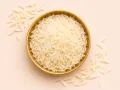
Basmati Rice
Other products you might like

€2.55
€3.00
€51.00/kg
€3.00 €40.00/kg
€3.50 €46.67/kg