Black cardamom is one of the world's oldest spices, and perhaps the oldest still in continuous use. Native to the deep, humid forests of the Eastern Himalayas, in what is today Sikkim, it was first gathered in the wild by the hunter-gatherers of the Lepcha tribe, the oldest people of the Himalayan region, before being progressively domesticated and cultivated from the 19th century onwards.
Its imprint on human history runs deep. The ancient Egyptians already used a form of large cardamom to whiten teeth and perfume medicinal preparations. Ancient Ayurvedic texts, notably the Charaka Samhita and the Sushruta Samhita, cite black cardamom abundantly under the Sanskrit name sthula ela for its digestive and carminative virtues. Traditional Chinese medicine has also catalogued it since the Song dynasty (960–1279 CE) under the name tsao-ko.
The Lepcha: original guardians of the cardamom
The Lepcha tribe are the indigenous people of Sikkim, officially recognised as the region's founding community. Nomadic hunter-gatherers, the Lepcha gathered large cardamom from the natural forests since time immemorial, trading it for cloth and salt in the mountain markets. It is their deep knowledge of Himalayan forest ecology that revealed that the plant thrives in the shade of the Himalayan alder (Alnus nepalensis).
The transition from wild gathering to organised cultivation took place gradually from the mid-19th century onwards, when the Lepcha communities began to practise sedentary agriculture. Large cardamom, at first considered an uncultivable wild plant, became their main cash crop. Organised commercial production took off in the second half of the 20th century, under the impetus of the government of Sikkim, newly integrated into India (1975).
Today, black cardamom is the third most expensive spice in the world, after saffron and vanilla. It lies at the heart of the rural economies of Sikkim, Darjeeling, eastern Nepal and southern Bhutan.
A major climate-change concern
Black cardamom production in Sikkim has seen a worrying decline over recent decades. Climate change is altering temperatures and rainfall patterns in the Himalayan zones, shifting optimal growing altitudes and impacting yields. Tens of thousands of marginal farming families depend directly on this crop.
Did you know?
- Black cardamom is ranked as the 3rd most expensive spice in the world, after saffron and vanilla
- Ayurvedic texts dating back 2,000 BCE already cite it for its digestive properties
- Sikkim holds a near-absolute monopoly on Indian production: 88% of the national output comes from this tiny state of fewer than 700,000 inhabitants
- The Dzongu valley, heartland of the most sought-after cultivar (Dzongu Golsey), is a protected area reserved exclusively for the Lepcha tribe
- The cardamom-alder agroforestry of the Himalayas is one of the only traditional farming practices to have been scientifically validated for its sustainability in journals such as Scientific Reports
- Global production saw a dramatic crash in the early 2000s, tripling the price of the spice in two years
- Scientists have identified 18 distinct cultivars of black cardamom across Sikkim, Nepal and Bhutan
- Black cardamom and green cardamom are not interchangeable: they are two different botanical genera with radically distinct aromatic profiles
Black cardamom across languages
| Language | Name |
|---|
| French | Grande cardamome noire / Cardamome brune / Cardamome du Népal |
| Hindi / Urdu | Badi Elaichi (बड़ी इलायची) / Kali Elaichi |
| Sanskrit | Sthula ela / Brihad ela / Prthvika |
| Nepali | Alainchi / Alaichi |
| Tamil | Perum Elakkai (பெரும் ஏலக்காய்) |
| Bengali | Baro elach (বড় এલાচ) |
| English | Black cardamom / Large cardamom / Hill cardamom |
| Chinese | Cao guo (草果) for the species A. tsao-ko |
| Botanical Latin | Amomum subulatum Roxb. |
The English word 'cardamom' comes from the Latin cardamomum, itself from the Ancient Greek kardamômon, a compound of kardamon (cress) and amômon (amomum, an aromatic plant from Arabia). The qualifier 'black' refers to the dark colour of the dried pods. The Hindi term badi elaichi means literally 'large cardamom'; in contrast, choti elaichi refers to the small green cardamom.
| Characteristic | Detail |
|---|
| Botanical name | Amomum subulatum Roxb. |
| Family | Zingiberaceae, the ginger and turmeric family |
| Local names | Badi Elaichi (Hindi) / Alainchi (Nepali) |
| Part used | Whole dried capsule (pod) and its aromatic seeds |
| Flagship varieties | Dzongu Golsey, Sawney, Seremna, Ramsey, Varlangey |
| Growing altitude | 975 to 2,069 m; optimal between 1,200 and 1,800 m |
| Harvest | October–November, by hand, before full maturity |
| Drying | Traditional wood-fire (bhatti): 24 to 48 hours |
| Companion tree | Alnus nepalensis (Himalayan alder), a natural nitrogen fixer |
Black cardamom is a mountain plant in the strictest sense of the word. It demands a precise altitude, constant humidity, dense shade and a soil rich in organic matter. Such conditions can only be brought together naturally in the sub-Himalayan forests of the eastern Himalayas.
The terroir that makes the difference
- Optimal altitude: between 1,200 and 1,800 metres, with peak productivity reached between 975 and 2,069 m depending on the cultivar
- Rainfall: 2,000 to 3,500 mm per year, spread over two monsoon seasons
- Temperature: between 6 and 28°C depending on the season; prolonged frost is fatal
- Shade: the plant is strictly sciophyte (shade-loving): it grows exclusively under forest cover
- Soil: loamy, well-drained, rich in humus, slightly acidic (pH 5.5–6.5)
- The companion tree: Alnus nepalensis (Himalayan alder), a symbiotic nitrogen fixer that enriches the soil and doubles cardamom yields
The pairing of black cardamom with the Himalayan alder is one of the most elegant examples of traditional agroforestry in the world. This natural symbiosis allows the alder to fix atmospheric nitrogen and return it to the soil, while the cardamom benefits from a humid, shaded microclimate.
| Producing region | Share and characteristics |
|---|
| Nepal (Ilam, Taplejung) | 68% of world production; 1st producer; Ramsey, Golsey varieties |
| India: Sikkim | 88% of Indian production; 22% global; Dzongu Golsey, Sawney varieties |
| India: Darjeeling | Growing share; same varieties as Sikkim; very close quality |
| Southern Bhutan | 9% global; limited exports |
| China (Yunnan / Guangxi) | Amomum tsao-ko, a distinct species with larger pods that are sun-dried |
Dzongu: the sacred valley of cardamom
The Dzongu valley, in the northern district of Sikkim, is a protected area reserved exclusively for the Lepcha community. It is in this forested valley that the Dzongu Golsey cultivar grows, considered by connoisseurs to be the most aromatic and sought-after variety of black cardamom. Its pods are slightly smaller than other cultivars, of a deep red-brown, and develop an incomparable camphoraceous-smoky richness when cooked.
Botany
Black cardamom (Amomum subulatum Roxb.) is a perennial herbaceous plant with a creeping rhizome, belonging to the Zingiberaceae family, the same botanical family as ginger, turmeric, galangal and the small green cardamom. Despite this shared common name, it bears no direct relationship to green cardamom (Elettaria cardamomum): they are two different botanical genera.
- Height: 2 to 2.5 metres of leafy pseudo-stems emerging from a common underground rhizome
- Leaves: oblong-lanceolate, 30 to 60 cm long
- Flowers: dense globular inflorescences growing directly from the ground; cream-white to pale yellow
- Fruits: ovoid capsules 2 to 3 cm long, ribbed, in compact clusters of 15 to 20 capsules per spike
- Seeds: 30 to 40 black-brown aromatic seeds per capsule, each 3–4 mm
- Lifecycle: perennial, can live 15 to 20 years in production, reaching peak productivity between 5 and 15 years
- Pollination: mainly cross-pollinated, ensured by Himalayan honeybees (Apis cerana)
Beware of confusion with green cardamom
Black cardamom and green cardamom are not interchangeable. Green cardamom (Elettaria cardamomum) is floral, sweet and slightly citrusy, perfect for desserts and chai. Black cardamom is smoky, camphoraceous and woody, made for meat dishes and slow-simmered curries. Substituting one for the other will heavily unbalance the dish.
Black cardamom develops an aromatic profile that cannot be confused with any other spice. Complex, powerful and deep, it is often described as 'camphoraceous-smoky', but that description does not fully do justice to the richness of its nuances.
| Tasting phase | Aromatic notes |
|---|
| First impression (olfactory) | Dense smoke, camphoraceous, slightly woody; reminiscent of a wood fire in a damp forest |
| Heart notes | Fresh but warm menthol, eucalyptus, resin, pine |
| Base aromatics | Earthy, slightly tannic, deep umami, almost tobacco-like notes |
| On the palate (crushed pod) | Fresh mentholated attack, camphoraceous development, long sweet-spicy finish |
| Seeds alone (ground) | Lighter aroma, floral-camphoraceous, moderate pungency |
| In long cooking | The aroma integrates and softens: it rounds out and deepens the dish without dominating |
| With fats | Ghee and oils reveal the terpenic compounds particularly well |
The 'backbone' effect
Black cardamom is above all a flavour enhancer and a builder of depth. Unlike green cardamom, which perfumes in the foreground, black cardamom works in the shadow (rounding out flavours and binding the spices together). It brings an earthy, smoky dimension that gives a dish the sense of long cooking and craftsmanship. Great Indian cooks systematically use it in dishes they want to make 'richer' without necessarily making them 'spicier'.
The art of drying: the source of the smoky aroma
If the Himalayan terroir gives black cardamom its raw aromatic richness, it is traditional drying that confers its unique personality. The traditional method in Sikkim is called bhatti drying, a rudimentary kiln built of stone and clay, fired with wood from the forest, in which the fresh pods are spread on bamboo trays for 24 to 48 hours.
Bhatti vs sun-drying
The Chinese variant of black cardamom (Amomum tsao-ko) is sun-dried rather than wood-smoked. The result is aromatically very different: Chinese pods are lighter, less intense, without the smoky notes that characterise Himalayan cardamom. The traditional bhatti cannot be mechanised or industrially replicated; it lies at the heart of the Himalayan black cardamom's identity of origin.
Black cardamom is a spice for long cooking. It reveals its full potential in slow-braised dishes, marinades, broths and complex spice blends. It supports and accompanies intense red meats remarkably well: lamb, kid, game. It also pairs beautifully with pulses and fragrant rices.
In Indian and Himalayan cuisine
- In garam masala: a key structural component of North Indian garam masala. Without black cardamom, a garam masala lacks depth and roundness
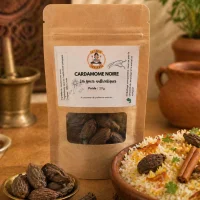
- In biryani: tucked whole between the layers of rice and meat. Its sweet smoke slowly imbues the entire dish during the sealed-pot (dum) cooking
- In meat curries: lamb rogan josh, keema, dal gosht, nihari (added at the start of cooking to hot oil or ghee)
- In Himalayan masala chai: the communities of Sikkim and Nepal infuse it in their mountain tea for a deeper, earthier chai
- In dals and pulses: a few crushed seeds in the tadka to bring depth to a lentil dal
- In marinades: for lamb or kid, paired with yoghurt, garlic, ginger and spices
- In mountain chutneys: the Lepcha use it in fermented preparations and traditional condiments
Techniques of use
- As a lightly crushed whole pod: for biryanis and curries. The pod infuses the hot oil, then the cooking liquid
- As seeds extracted from the pod: the ground seeds blend into spice mixes and marinades
- The pod alone (without seeds): used as an aromatic in broths and infusions (smokier, less camphoraceous)
- Dry-toasted before grinding: strengthens and releases the essential oils, adds a roasted note
- Infused in hot oil or ghee (tadka): optimal extraction of the fat-soluble compounds
In French cuisine: a territory to explore
Black cardamom is practically unknown in France, but its aromatic characteristics (smoke, camphor, woody depth) make it a remarkable potential ally for French cooking:
- Game jus or lamb civet: a pinch of ground seeds for a natural smoky dimension
- Terrines and pâtés: as a replacement for or complement to allspice
- Flavoured butter: a black-cardamom butter to accompany grilled meats
- Beef broth or pot-au-feu: for an unprecedented earthy depth
- Dark chocolate ganache: a remarkably complex camphoraceous-chocolate pairing
Black cardamom has been used for millennia in three distinct medical systems: Indian Ayurveda, traditional Chinese medicine (TCM) and the folk medicine of the Himalayan Lepcha, Bhutia and Nepali peoples. The three traditions largely converge on its digestive and respiratory properties.
The main active compounds identified in the seeds are 1,8-cineole (eucalyptol), alpha-terpineol, limonene, borneol and various coumarins: molecules with documented pharmacological properties.
Documented properties
- Digestive and carminative: stimulates the secretion of digestive enzymes, reduces intestinal spasms, eases bloating (the main use in Ayurveda and TCM)
- Expectorant and bronchodilator: 1,8-cineole (eucalyptol) has scientifically validated mucolytic properties; it is traditionally used against cough and bronchitis
- Antioxidant: the polyphenols and flavonoids in the seeds neutralise free radicals, with significant in vitro antioxidant activity
- Anti-inflammatory: borneol and alpha-terpineol show anti-inflammatory properties documented in animal models
- Antibacterial: the essential oil inhibits the growth of several pathogenic bacterial strains, including E. coli and Salmonella
- Analgesic and antipyretic: used in Himalayan folk medicine against joint pain and fever
- Dental remineralising: the ancient Egyptians and modern Himalayan communities chew the seeds to whiten teeth and freshen breath
- Cardiac and vascular: preliminary studies suggest a modulating effect on blood pressure via 1,8-cineole
Precautions of use
Black cardamom is considered safe at normal culinary doses. At high doses (concentrated extracts, essential oils), 1,8-cineole can irritate mucous membranes. The essential oil should never be used neat on the skin or ingested without medical advice. In pregnant women, caution is warranted for high-dose medicinal uses; culinary quantities remain risk-free.
How to recognise good black cardamom
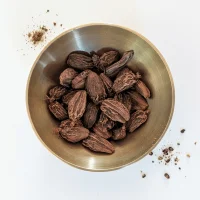
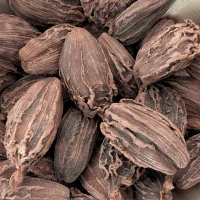
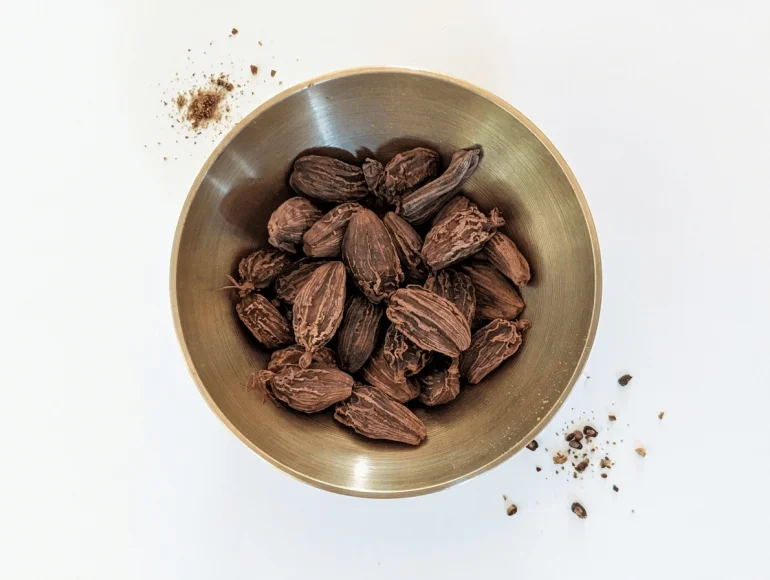
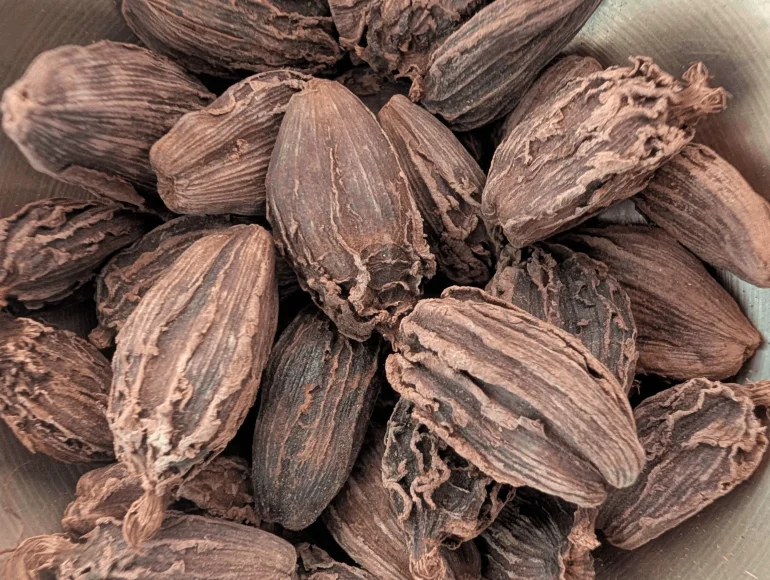
- Colour: uniform dark brown, tending towards red-brown; pods that are too pale or greyish have been poorly dried or are too old
- Texture: hard, dry pods, slightly rough to the touch, with well-defined ribs
- Aroma: on opening the packet, the smell should be powerful, camphoraceous and slightly smoky. If the odour is faint or dusty, the cardamom is too old
- Seeds: on opening a pod, the seeds should be black-brown, compact, not dusty
- Origin: favour pods from Sikkim (Dzongu Golsey if possible) or Nepal, not Chinese-origin (tsao-ko) which yields a different, less smoky aromatic profile
- Size: premium-quality pods are 2 to 3 cm long; small pods have often been picked too early
Storage tips
- Always store as whole pods; never buy ready-to-use black-cardamom powder (aroma loss is too rapid)
- Airtight glass jar, away from light, moisture and heat
- Do not store above the cooker, since steam and heat rapidly degrade the terpenic compounds
- Shelf life: 2 to 3 years as whole pods if well stored; only a few weeks once ground
- Grind at the moment of use: remove the seeds from the pod, toast for 30 seconds in a hot dry pan, then grind in a mortar or spice mill
Can black cardamom be used in place of green cardamom in a recipe?
No, this is not a recommended substitution. The two spices belong to different botanical genera and offer radically different aromatic profiles. Green cardamom is floral, sweet and slightly citrusy, making it ideal for desserts and chai. Black cardamom is smoky, camphoraceous and woody; it's made for meat dishes and slow-simmered curries.
How do you extract the seeds from the pod?
Lay the pod flat and crush it lightly with the flat of a knife or a pestle to open it. Remove the black-brown seeds inside. For a powder, toast the seeds for 30 seconds in a hot dry pan, let them cool, then grind in a spice mill or mortar.
What is the difference between Indian and Chinese black cardamom?
Indian and Nepali black cardamom (Amomum subulatum) and the Chinese variety (Amomum tsao-ko) are two botanically close but distinct species. The Chinese pods are larger (4–5 cm), sun-dried and have a less smoky profile with more herbaceous notes. The Himalayan version offers a superior smoky aromatic complexity for Indian recipes.
How do you dose black cardamom in a dish?
For 4 people: 2 to 3 lightly crushed whole pods for a curry or biryani; 1/4 teaspoon of ground seeds for a spice blend; 1 whole pod per litre of broth. Adjust to your sensitivity.
Why does my black cardamom have no smoky taste?
Several possible reasons: the cardamom may be of Chinese origin (sun-dried, no smoke) rather than Himalayan; it may be too old and have lost its volatile aromatic compounds; or it may have been stored badly. Check the origin (Sikkim or Nepal), buy in small quantities from a fast-turnover supplier, and store airtight away from light.