

Whole Kerala Turmeric
Discover our whole Kerala turmeric, dried turmeric fingers from Wayanad. Grind it yourself for your curries, dals and golden milk.
Ready for shipping, delivery time 3-7 business days
Delivery from €4.80 at Mondial Relay pickup points.


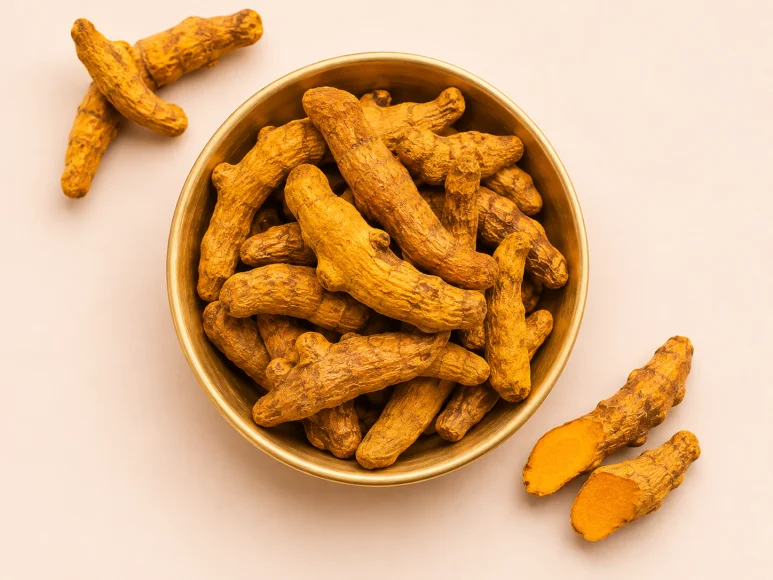
Whole Kerala turmeric: dried turmeric fingers from Wayanad
This turmeric comes from Wayanad, a district in the Western Ghats of northern Kerala, the same origin as our Kerala turmeric powder. It is sold whole, as "fingers": the dried rhizomes of the plant, left unground.
Why choose whole turmeric?
A ground spice slowly loses its aroma. Keeping the fingers whole means you only grind what you need, when you need it, and you choose how fine your powder is. Whole, they also keep much longer than a powder.
The fingers are hard and dry, so they cannot be grated like fresh root. Break them up and grind them in a spice grinder, food processor or mortar, or simmer them whole in your dish.
Culinary uses:
- Ground to order for curries, dals and rice dishes
- Simmered whole in a stock, dal or rice dish, and removed before serving
- Infused in hot milk for golden milk
- Used as a natural colouring for rice and slow-cooked dishes
- Ground with other spices to make your own blends
Storage:
Keep turmeric in a closed container, in a dry, cool place away from light. Be careful: turmeric stains hands, worktops and clothes.
Powerful natural anti-inflammatory thanks to curcumin
Powerful antioxidant that neutralises free radicals
Improves brain function and memory
Reduces the risk of cardiovascular disease
Supports joint health
Aids digestion and protects the liver
Boosts the immune system
Promotes healthy skin
Nutritional declaration per 100g
| Nutritional component | Per 100g |
|---|---|
| Energy | 1 306 kJ / 312 kcal |
| Fat | ~ 3,3 g |
| Carbohydrates | ~ 67,1 g |
| of which sugars | ~ 3,2 g |
| Dietary fiber | ~ 22,7 g |
| Proteins | ~ 9,7 g |
| Salt | ~ 100 mg |
| Directly selected smallholder producers | Yes |
| Origin | Wayanad, Kerala, India |
| Quality | Premium |
| Type | Whole dried fingers |
| Taste profile | Earthy, warm flavour, slightly bitter with peppery notes. Mild and balanced aroma, ideal for everyday cooking. |
Learn more
A rhizome made for travelling: the ʻōlena of Hawaiʻi
A rhizome can be carried whole, and it can be replanted. That explains one of turmeric's most surprising journeys: it is one of the "canoe plants", the species Polynesian navigators took with them to settle the islands of the Pacific, and which reached Hawaiʻi about 1,700 years ago according to Hawaiian botanical sources.
In Hawaiʻi turmeric is called ʻōlena, a name linked to lena, "yellow". It was sprinkled over people, places and objects to purify them, and sliced rhizomes were boiled in water to make a dye. A living rhizome in a canoe is what a powder can never be: colour and ceremony that grow back on arrival.
Pongal: the turmeric plant tied to the pot
In Tamil Nadu, the Thai Pongal harvest festival in mid-January is celebrated around a pot of rice left to boil over, a sign of abundance. The pot, in clay or bronze, is dressed with a whole turmeric plant, roots and leaves included: the manjal kothu, in Tamil. The rhizome is neither grated nor ground; the whole plant serves as decoration and good-luck charm.
Around Erode, a major Tamil turmeric region, farmers even grow a crop reserved for the festival: a bunch to tie around the pot sells there for between 20 and 35 rupees, and the local press sees it as a matter of tradition more than profit.
From field to jar: the vocabulary of the trade
After harvest, dry turmeric is not simply sold "as rhizomes". The Indian trade sorts it into categories: fingers, the side branches of the rhizome, bulbs, the central or "mother" rhizome, rounder and larger, and splits, the fragments.
The fingers are then polished: mechanical rubbing smooths their surface, and sometimes, at the very end, a little turmeric powder mixed with water is added to improve the appearance. As early as 1964, Indian grading and marking rules known as Agmark defined the categories of fingers, bulbs and powder. The top category called for well-formed, perfectly dry fingers, free from weevil damage and from signs of over-boiling.
The best-known trade name for Kerala fingers is "Alleppey Finger", a name that points to the port city of Alleppey (Alappuzha) on the Kerala coast.
Turmeric paper: a spice in the laboratory
Turmeric had a second career, far from the kitchen. In the 19th century and the early 20th, pharmacists made turmeric paper by soaking paper in a tincture of turmeric. Once dry, the yellow paper served as a reagent: it turns brown in the presence of alkalis and red with boric acid. A materia medica manual of 1854 already mentions it for detecting alkalis, and the British Pharmaceutical Codex of 1911 still lists it among the tests for alkalis and boric acid.
That bit of chemistry has a very practical consequence in the kitchen: a turmeric stain that meets soap, which is alkaline, turns red-brown. It is the same phenomenon as on the pharmacist's paper.
From rite to paste: turmeric ground at the right moment
In southern India, the mangala snanam, the purifying bath on the morning of the wedding, is the southern counterpart of the haldi ceremony: older married women apply a thick paste of freshly ground turmeric to the cheeks, arms and feet before pouring the bath water. Further west and north, the haldi kumkum gathering, popular in Maharashtra, Gujarat, Rajasthan and Goa, brings together married women who exchange turmeric and kumkum.
In these gestures it is a paste made at the right moment that counts, more than a shop-bought powder. The idea is not foreign to this guide: grinding for yourself, when you need it.
Did you know?
- Turmeric is one of the "canoe plants" carried by the Polynesians: in Hawaiʻi it is called ʻōlena.
- In Tamil Nadu, the whole plant, roots and leaves included, is tied around the Pongal pot.
- In the Indian trade, dry turmeric is sorted into fingers, bulbs and splits, then polished.
- Turmeric paper was still listed in a British pharmaceutical codex in 1911.
- In Malayalam, the language of Kerala, a "turmeric village" project is called Manjalu Gramam: it was launched in Wayanad.
Wayanad: hills up to 2,100 metres
Wayanad is a highland district of northern Kerala, set on the Western Ghats plateau at roughly 700 to 2,100 metres above sea level, next to Karnataka and Tamil Nadu. It was created in 1980 from parts of the Kozhikode and Kannur districts.
The climate is cool at altitude and very humid: according to local sources the monsoon brings nearly 2,800 mm of rain a year on average, with areas such as Lakkidi, Vythiri and Meppadi among the wettest.
It is a land of spices and plantations: pepper, cardamom, coffee, tea. Pepper grows mostly alongside coffee in the north-east of the district, around Pulpally and Mullankolly. Turmeric belongs to this tradition: the Kudumbashree mission of Wayanad launched a "turmeric village" project (Manjalu Gramam) in Thirunelly, meant to give an income to women of the region's tribal communities, with at least one acre of turmeric in every ward of the panchayat.
Varieties selected in Kerala
Agricultural research in Kerala has long worked on turmeric. Varieties such as Prathibha or Shobha, which come out of that work, are distributed to Wayanad farmers, notably by the Kerala Agricultural University research station at Ambalavayal. We do not claim the exact variety of our lot: what we know for certain is that it comes from Wayanad.
Pazhassi Raja, the "Lion of Kerala", and the forests of Wayanad
The dense forests of Wayanad also made history. At the turn of the 18th and 19th centuries, Kerala Varma Pazhassi Raja, nicknamed the "Lion of Kerala", waged a guerrilla war there against the British East India Company, which the terrain and the forest helped him hold back for years. The Kurichiya, a Wayanad community, took part in the revolt. Pazhassi Raja died in 1805; a memorial at Mananthavady commemorates him.
Twelve tribal communities, skills of land and forest
Wayanad is known for its paddy fields and vast tea and coffee plantations, as much as for cash crops such as pepper and cardamom. The district is home to twelve tribal communities, among them the Paniya, the Kurichiya, the Adiya, the Kurumar and the Kattunaykan. The Paniya are the largest group.
The Kurichiya owe their name to their skill at archery, and it was Kurichiya and Kuruma bowmen that Pazhassi Raja counted in his army against the British. Many of these families live today from farming, in particular rice growing.
The forms of dry turmeric
| Form | What it is | Good to know |
|---|---|---|
| Fingers | The side branches of the rhizome | The form we sell: grind them yourself or simmer them whole |
| Bulbs | The central "mother" rhizome, rounder and larger | A separate category in the Indian grading |
| Splits | Pieces of rhizome | Also sorted separately in the trade |
| Powder | Fingers ground finely | Ready to use: see our Kerala turmeric powder |
Whole, fresh or ground: how to choose
| Fresh root | Dry fingers | Powder | |
|---|---|---|---|
| Preparation | To peel and grate | To grind, or to simmer whole | None |
| Aroma | Fresh, lively | Released on grinding | Immediate, but fades faster |
| Keeping | Perishable | Long, as long as the fingers stay dry | Shorter |
| Ideal for | Juices, fresh pastes | Cooking with freshly ground spice | Everyday meals |
Recognising good fingers
- They are dry and hard: they snap cleanly and do not bend.
- The break is a deep, even yellow-orange.
- They are whole, with no insect holes: the Agmark rules ruled out fingers damaged by weevils.
- They smell neither musty nor damp.
- The surface may be smooth (polished fingers) or rougher: both are normal.
A scent that waits for the grinder
Whole, turmeric smells of very little: as with all dry spices, the aroma is released when the material is broken. Once ground you find the profile of Kerala turmeric: earthy, warm flavour, slightly bitter, with peppery notes. The aroma is mild and balanced, ideal for everyday cooking.
Freshly ground powder is a deep yellow-orange. Colour and aroma spread mostly in fats: a little oil, ghee or coconut oil helps bring them out.
Classic pairings
- Ginger and black pepper, for turmeric milk.
- Cumin, coriander and fenugreek, in curries and dals.
- Mustard seeds, curry leaves and coconut oil, for Kerala-style cooking.
- Coconut milk and milk, which soften its bitterness.
Dosing without masking
Turmeric has a bitterness that asserts itself quickly: too much overwhelms the other spices. Add it in small quantities, taste as you cook, and let the cumin, coriander or ginger do the rest.
Judging your grind
Rub a little powder between your fingers: it should be fine, dry, a clear yellow-orange, with an earthy, warm smell. A smell of dust or mould betrays a powder that is too old or damp that was not kept in check.
Grinding the fingers at home, step by step
The fingers are as hard as wood: they cannot be grated, and they cannot be blitzed just any way. Here is the method found in most kitchens.
- Start with fingers that are properly dry.
- Break them into pieces in a tea towel with a pestle or a small hammer. A mortar works for small quantities, a little at a time.
- Put the pieces through a sturdy spice grinder or a powerful blender, in short bursts so the powder does not heat up. Very hard pieces can damage a grinder with plastic blades.
- Sift, then grind again the pieces left in the sieve.
- Wait a few seconds before opening the bowl: the yellow dust stains.
- Clean the bowl and blade straight away, with lukewarm water.
In Kerala kitchens this work was done by hand on the ammikallu, the traditional grinding stone, which is still found in many homes there. An electric grinder does the same job in seconds. If you prefer a ready-to-use powder, see our Kerala turmeric powder.
What a whole finger allows
- Ground to order, in the same quantity as a powder, in curries, dals and rice dishes.
- Simmered whole in a stock, a dal or the cooking water of rice, as you would a bay leaf or a cinnamon stick: remove it before serving.
- As a natural colouring for rice and slow-cooked dishes.
- Ground with other spices to make your own blends and curry pastes.
A guide to quantities
Turmeric colours far more than it flavours: it is better to use little. A common rule of thumb is half to one teaspoon of freshly ground powder for a dish for four people, to adjust to the recipe and your taste.
Marinating with turmeric
For fish, prawns or vegetables to be pan-fried, a marinade of ground turmeric and salt, a few minutes before cooking, is a very common gesture in Indian cooking. Rub it in, leave to rest, then sear in a pan or in the oven.
A golden rice
Add one whole finger, or a pinch of freshly ground powder, to the cooking water of basmati rice, with the salt and a little oil or butter. Remove the finger at the end of cooking: the rice comes out a soft yellow.
A Kerala classic: moru curry
Moru curry, also called pulissery, is a sour-yoghurt dish found on the menu of Onam feast meals. The yoghurt is whisked with water and turmeric, then a paste of grated coconut ground with cumin, shallot, turmeric and chilli is added. The mixture is heated gently, without boiling so the yoghurt does not split, and finished, depending on the family, with a tempering of coconut oil, mustard seeds and curry leaves.
A cooking tip
Ground, turmeric burns quickly and turns bitter. Add it to hot oil for a few seconds only, or wet it straight away with the onions or the sauce, rather than letting it fry alone.
Homemade turmeric milk
In India, turmeric milk is called haldi doodh: haldi for turmeric, doodh for milk. Use a pinch to half a teaspoon of freshly ground turmeric for a cup of hot milk, with a pinch of black pepper and a little ginger, sweetened with honey or jaggery to taste. You can also let a few pieces of finger infuse gently in the milk, then strain: the colour is slower to come than with the powder.
Beyond the kitchen: dyeing
Like the Hawaiians, you can boil pieces of turmeric in water to make a yellow dye bath. Note that the colour fades in light and turns red-brown on contact with an alkaline product such as soap.
Turmeric contains curcumin, the pigment that gives it its colour. It has a long place in traditional Indian medicine, Ayurveda, where it is called haldi. That history is detailed in the guide to our Kerala turmeric powder: we do not repeat it here.
We sell these fingers as a cooking spice and do not attribute any therapeutic effect to them. For any health question, ask a professional.
What the nutrition table says
For information, 100 g of turmeric contains about 22.7 g of fibre, 67 g of carbohydrates and 9.7 g of protein (see the product page). In the kitchen it is used a few grams at a time.
A cooking point
Curcumin dissolves in fats more than in water alone, which is why many recipes heat turmeric in a little oil or ghee, or infuse it in milk.
Whole fingers
Keep them in a closed container, in a dry, cool place away from light. As long as they stay dry, the fingers keep much longer than a powder: damp is their only real enemy, because a finger that takes on water can go mouldy.
After grinding
Grind small quantities. Homemade powder loses its aroma faster than the whole finger: keep it in a closed jar, away from light.
Stains
Blot quickly, before using soap: soap, being alkaline, turns the stain red-brown. On plastic or pale fabric, daylight fades the yellow over time.
Grind little, often
Grind enough to cook with for a few weeks and keep the rest as whole fingers. Write the grinding date on the jar: it is the simplest way to know when to renew your powder.
How do I grind turmeric fingers?
Break them into pieces in a tea towel with a pestle or a small hammer, then put them through a sturdy spice grinder or a powerful blender in short bursts. Sift, then grind the pieces left behind again.
Can I grate the fingers like fresh turmeric?
No. Once dried, they are as hard as wood. They need to be ground, or simmered whole in the dish.
Will a coffee grinder do?
Yes, if it is sturdy, with short bursts and pieces already broken up. It will turn yellow: keep it for this use or clean it straight away.
How is it different from your Kerala turmeric powder?
It is the same origin, Wayanad in Kerala. The powder is ready to use; the fingers are ground at home, as and when you need them. The powder guide goes into the history of turmeric and its traditional use.
Can I leave a whole finger in a simmering dish?
Yes, like a bay leaf. Remove it before serving.
Why does a turmeric stain turn red with soap?
Turmeric turns red-brown in an alkaline environment, as on the pharmacists' turmeric paper. Blot the stain before using soap.
Is whole turmeric used in festivals too?
Yes. In Tamil Nadu, during Pongal, a whole turmeric plant, roots and leaves included, is tied around the pot.
Do I need to peel the fingers before grinding?
No, it is not necessary: they are ground whole, skin included.
How long do whole fingers keep?
As long as they stay dry, much longer than a powder. The essential thing is to keep them in a closed container, dry, cool and away from light.
Can I marinate with whole turmeric?
You need to grind it first: then rub the fish or vegetables with the powder and salt, a few minutes before cooking.
-
A rhizome made for travelling: the ʻōlena of Hawaiʻi
A rhizome can be carried whole, and it can be replanted. That explains one of turmeric's most surprising journeys: it is one of the "canoe plants", the species Polynesian navigators took with them to settle the islands of the Pacific, and which reached Hawaiʻi about 1,700 years ago according to Hawaiian botanical sources.
In Hawaiʻi turmeric is called ʻōlena, a name linked to lena, "yellow". It was sprinkled over people, places and objects to purify them, and sliced rhizomes were boiled in water to make a dye. A living rhizome in a canoe is what a powder can never be: colour and ceremony that grow back on arrival.
Pongal: the turmeric plant tied to the pot
In Tamil Nadu, the Thai Pongal harvest festival in mid-January is celebrated around a pot of rice left to boil over, a sign of abundance. The pot, in clay or bronze, is dressed with a whole turmeric plant, roots and leaves included: the manjal kothu, in Tamil. The rhizome is neither grated nor ground; the whole plant serves as decoration and good-luck charm.
Around Erode, a major Tamil turmeric region, farmers even grow a crop reserved for the festival: a bunch to tie around the pot sells there for between 20 and 35 rupees, and the local press sees it as a matter of tradition more than profit.
From field to jar: the vocabulary of the trade
After harvest, dry turmeric is not simply sold "as rhizomes". The Indian trade sorts it into categories: fingers, the side branches of the rhizome, bulbs, the central or "mother" rhizome, rounder and larger, and splits, the fragments.
The fingers are then polished: mechanical rubbing smooths their surface, and sometimes, at the very end, a little turmeric powder mixed with water is added to improve the appearance. As early as 1964, Indian grading and marking rules known as Agmark defined the categories of fingers, bulbs and powder. The top category called for well-formed, perfectly dry fingers, free from weevil damage and from signs of over-boiling.
The best-known trade name for Kerala fingers is "Alleppey Finger", a name that points to the port city of Alleppey (Alappuzha) on the Kerala coast.
Turmeric paper: a spice in the laboratory
Turmeric had a second career, far from the kitchen. In the 19th century and the early 20th, pharmacists made turmeric paper by soaking paper in a tincture of turmeric. Once dry, the yellow paper served as a reagent: it turns brown in the presence of alkalis and red with boric acid. A materia medica manual of 1854 already mentions it for detecting alkalis, and the British Pharmaceutical Codex of 1911 still lists it among the tests for alkalis and boric acid.
That bit of chemistry has a very practical consequence in the kitchen: a turmeric stain that meets soap, which is alkaline, turns red-brown. It is the same phenomenon as on the pharmacist's paper.
From rite to paste: turmeric ground at the right moment
In southern India, the mangala snanam, the purifying bath on the morning of the wedding, is the southern counterpart of the haldi ceremony: older married women apply a thick paste of freshly ground turmeric to the cheeks, arms and feet before pouring the bath water. Further west and north, the haldi kumkum gathering, popular in Maharashtra, Gujarat, Rajasthan and Goa, brings together married women who exchange turmeric and kumkum.
In these gestures it is a paste made at the right moment that counts, more than a shop-bought powder. The idea is not foreign to this guide: grinding for yourself, when you need it.
Did you know?
- Turmeric is one of the "canoe plants" carried by the Polynesians: in Hawaiʻi it is called ʻōlena.
- In Tamil Nadu, the whole plant, roots and leaves included, is tied around the Pongal pot.
- In the Indian trade, dry turmeric is sorted into fingers, bulbs and splits, then polished.
- Turmeric paper was still listed in a British pharmaceutical codex in 1911.
- In Malayalam, the language of Kerala, a "turmeric village" project is called Manjalu Gramam: it was launched in Wayanad.
-
Wayanad: hills up to 2,100 metres
Wayanad is a highland district of northern Kerala, set on the Western Ghats plateau at roughly 700 to 2,100 metres above sea level, next to Karnataka and Tamil Nadu. It was created in 1980 from parts of the Kozhikode and Kannur districts.
The climate is cool at altitude and very humid: according to local sources the monsoon brings nearly 2,800 mm of rain a year on average, with areas such as Lakkidi, Vythiri and Meppadi among the wettest.
It is a land of spices and plantations: pepper, cardamom, coffee, tea. Pepper grows mostly alongside coffee in the north-east of the district, around Pulpally and Mullankolly. Turmeric belongs to this tradition: the Kudumbashree mission of Wayanad launched a "turmeric village" project (Manjalu Gramam) in Thirunelly, meant to give an income to women of the region's tribal communities, with at least one acre of turmeric in every ward of the panchayat.
Varieties selected in Kerala
Agricultural research in Kerala has long worked on turmeric. Varieties such as Prathibha or Shobha, which come out of that work, are distributed to Wayanad farmers, notably by the Kerala Agricultural University research station at Ambalavayal. We do not claim the exact variety of our lot: what we know for certain is that it comes from Wayanad.
Pazhassi Raja, the "Lion of Kerala", and the forests of Wayanad
The dense forests of Wayanad also made history. At the turn of the 18th and 19th centuries, Kerala Varma Pazhassi Raja, nicknamed the "Lion of Kerala", waged a guerrilla war there against the British East India Company, which the terrain and the forest helped him hold back for years. The Kurichiya, a Wayanad community, took part in the revolt. Pazhassi Raja died in 1805; a memorial at Mananthavady commemorates him.
Twelve tribal communities, skills of land and forest
Wayanad is known for its paddy fields and vast tea and coffee plantations, as much as for cash crops such as pepper and cardamom. The district is home to twelve tribal communities, among them the Paniya, the Kurichiya, the Adiya, the Kurumar and the Kattunaykan. The Paniya are the largest group.
The Kurichiya owe their name to their skill at archery, and it was Kurichiya and Kuruma bowmen that Pazhassi Raja counted in his army against the British. Many of these families live today from farming, in particular rice growing.
The forms of dry turmeric
Form What it is Good to know Fingers The side branches of the rhizome The form we sell: grind them yourself or simmer them whole Bulbs The central "mother" rhizome, rounder and larger A separate category in the Indian grading Splits Pieces of rhizome Also sorted separately in the trade Powder Fingers ground finely Ready to use: see our Kerala turmeric powder Whole, fresh or ground: how to choose
Fresh root Dry fingers Powder Preparation To peel and grate To grind, or to simmer whole None Aroma Fresh, lively Released on grinding Immediate, but fades faster Keeping Perishable Long, as long as the fingers stay dry Shorter Ideal for Juices, fresh pastes Cooking with freshly ground spice Everyday meals Recognising good fingers
- They are dry and hard: they snap cleanly and do not bend.
- The break is a deep, even yellow-orange.
- They are whole, with no insect holes: the Agmark rules ruled out fingers damaged by weevils.
- They smell neither musty nor damp.
- The surface may be smooth (polished fingers) or rougher: both are normal.
-
A scent that waits for the grinder
Whole, turmeric smells of very little: as with all dry spices, the aroma is released when the material is broken. Once ground you find the profile of Kerala turmeric: earthy, warm flavour, slightly bitter, with peppery notes. The aroma is mild and balanced, ideal for everyday cooking.
Freshly ground powder is a deep yellow-orange. Colour and aroma spread mostly in fats: a little oil, ghee or coconut oil helps bring them out.
Classic pairings
- Ginger and black pepper, for turmeric milk.
- Cumin, coriander and fenugreek, in curries and dals.
- Mustard seeds, curry leaves and coconut oil, for Kerala-style cooking.
- Coconut milk and milk, which soften its bitterness.
Dosing without masking
Turmeric has a bitterness that asserts itself quickly: too much overwhelms the other spices. Add it in small quantities, taste as you cook, and let the cumin, coriander or ginger do the rest.
Judging your grind
Rub a little powder between your fingers: it should be fine, dry, a clear yellow-orange, with an earthy, warm smell. A smell of dust or mould betrays a powder that is too old or damp that was not kept in check.
-
Grinding the fingers at home, step by step
The fingers are as hard as wood: they cannot be grated, and they cannot be blitzed just any way. Here is the method found in most kitchens.
- Start with fingers that are properly dry.
- Break them into pieces in a tea towel with a pestle or a small hammer. A mortar works for small quantities, a little at a time.
- Put the pieces through a sturdy spice grinder or a powerful blender, in short bursts so the powder does not heat up. Very hard pieces can damage a grinder with plastic blades.
- Sift, then grind again the pieces left in the sieve.
- Wait a few seconds before opening the bowl: the yellow dust stains.
- Clean the bowl and blade straight away, with lukewarm water.
In Kerala kitchens this work was done by hand on the ammikallu, the traditional grinding stone, which is still found in many homes there. An electric grinder does the same job in seconds. If you prefer a ready-to-use powder, see our Kerala turmeric powder.
What a whole finger allows
- Ground to order, in the same quantity as a powder, in curries, dals and rice dishes.
- Simmered whole in a stock, a dal or the cooking water of rice, as you would a bay leaf or a cinnamon stick: remove it before serving.
- As a natural colouring for rice and slow-cooked dishes.
- Ground with other spices to make your own blends and curry pastes.
A guide to quantities
Turmeric colours far more than it flavours: it is better to use little. A common rule of thumb is half to one teaspoon of freshly ground powder for a dish for four people, to adjust to the recipe and your taste.
Marinating with turmeric
For fish, prawns or vegetables to be pan-fried, a marinade of ground turmeric and salt, a few minutes before cooking, is a very common gesture in Indian cooking. Rub it in, leave to rest, then sear in a pan or in the oven.
A golden rice
Add one whole finger, or a pinch of freshly ground powder, to the cooking water of basmati rice, with the salt and a little oil or butter. Remove the finger at the end of cooking: the rice comes out a soft yellow.
A Kerala classic: moru curry
Moru curry, also called pulissery, is a sour-yoghurt dish found on the menu of Onam feast meals. The yoghurt is whisked with water and turmeric, then a paste of grated coconut ground with cumin, shallot, turmeric and chilli is added. The mixture is heated gently, without boiling so the yoghurt does not split, and finished, depending on the family, with a tempering of coconut oil, mustard seeds and curry leaves.
A cooking tip
Ground, turmeric burns quickly and turns bitter. Add it to hot oil for a few seconds only, or wet it straight away with the onions or the sauce, rather than letting it fry alone.
Homemade turmeric milk
In India, turmeric milk is called haldi doodh: haldi for turmeric, doodh for milk. Use a pinch to half a teaspoon of freshly ground turmeric for a cup of hot milk, with a pinch of black pepper and a little ginger, sweetened with honey or jaggery to taste. You can also let a few pieces of finger infuse gently in the milk, then strain: the colour is slower to come than with the powder.
Beyond the kitchen: dyeing
Like the Hawaiians, you can boil pieces of turmeric in water to make a yellow dye bath. Note that the colour fades in light and turns red-brown on contact with an alkaline product such as soap.
-
Turmeric contains curcumin, the pigment that gives it its colour. It has a long place in traditional Indian medicine, Ayurveda, where it is called haldi. That history is detailed in the guide to our Kerala turmeric powder: we do not repeat it here.
We sell these fingers as a cooking spice and do not attribute any therapeutic effect to them. For any health question, ask a professional.
What the nutrition table says
For information, 100 g of turmeric contains about 22.7 g of fibre, 67 g of carbohydrates and 9.7 g of protein (see the product page). In the kitchen it is used a few grams at a time.
A cooking point
Curcumin dissolves in fats more than in water alone, which is why many recipes heat turmeric in a little oil or ghee, or infuse it in milk.
-
Whole fingers
Keep them in a closed container, in a dry, cool place away from light. As long as they stay dry, the fingers keep much longer than a powder: damp is their only real enemy, because a finger that takes on water can go mouldy.
After grinding
Grind small quantities. Homemade powder loses its aroma faster than the whole finger: keep it in a closed jar, away from light.
Stains
Blot quickly, before using soap: soap, being alkaline, turns the stain red-brown. On plastic or pale fabric, daylight fades the yellow over time.
Grind little, often
Grind enough to cook with for a few weeks and keep the rest as whole fingers. Write the grinding date on the jar: it is the simplest way to know when to renew your powder.
-
How do I grind turmeric fingers?
Break them into pieces in a tea towel with a pestle or a small hammer, then put them through a sturdy spice grinder or a powerful blender in short bursts. Sift, then grind the pieces left behind again.
Can I grate the fingers like fresh turmeric?
No. Once dried, they are as hard as wood. They need to be ground, or simmered whole in the dish.
Will a coffee grinder do?
Yes, if it is sturdy, with short bursts and pieces already broken up. It will turn yellow: keep it for this use or clean it straight away.
How is it different from your Kerala turmeric powder?
It is the same origin, Wayanad in Kerala. The powder is ready to use; the fingers are ground at home, as and when you need them. The powder guide goes into the history of turmeric and its traditional use.
Can I leave a whole finger in a simmering dish?
Yes, like a bay leaf. Remove it before serving.
Why does a turmeric stain turn red with soap?
Turmeric turns red-brown in an alkaline environment, as on the pharmacists' turmeric paper. Blot the stain before using soap.
Is whole turmeric used in festivals too?
Yes. In Tamil Nadu, during Pongal, a whole turmeric plant, roots and leaves included, is tied around the pot.
Do I need to peel the fingers before grinding?
No, it is not necessary: they are ground whole, skin included.
How long do whole fingers keep?
As long as they stay dry, much longer than a powder. The essential thing is to keep them in a closed container, dry, cool and away from light.
Can I marinate with whole turmeric?
You need to grind it first: then rub the fish or vegetables with the powder and salt, a few minutes before cooking.
Why choose Whole Kerala Turmeric from La Table Indienne?

Exceptional freshness and quality
Our spices are imported directly from India and packaged on demand to guarantee optimal freshness. Unlike spices sold in supermarkets that can sit on shelves for months, we ensure each spice retains its full flavor and aroma.
Authenticity and traceability
Each spice comes from specific regions in India renowned for their expertise. We work directly with local producers who grow their spices traditionally.
How to best use this spice?
To reveal all the aromas, we recommend lightly toasting whole spices in a dry pan before grinding them. Store them in a dry place away from light to preserve their freshness as long as possible.

Did you know?
Whole spices are much better than ground spices
Check out our blog article to discover why whole spices retain their aromas better.
Questions & Answers
Thank you! Your question has been sent. Mihika will answer soon and you will receive an email.

Whole Kerala Turmeric
Discover also
Other products you might like