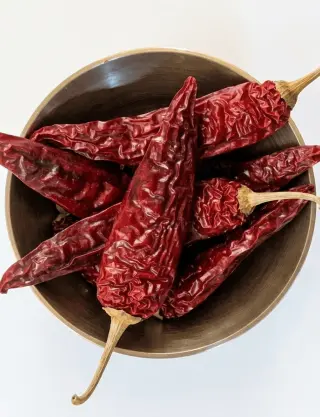




Sirarakhong Chilli – GI-Tagged Dried Chilli from Manipur
Discover our Sirarakhong chilli, a GI-tagged dried red chilli grown by the Tangkhul Naga community in Sirarakhong, Ukhrul district, Manipur. Unique aroma, thin skin and deep red colour to enhance chutneys, achars and homemade chilli powders.
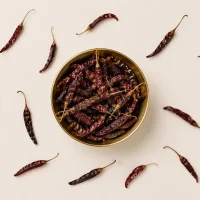
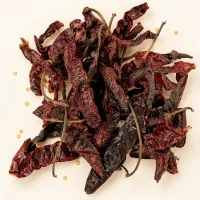
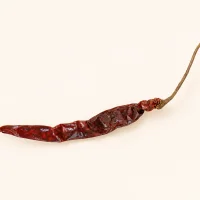
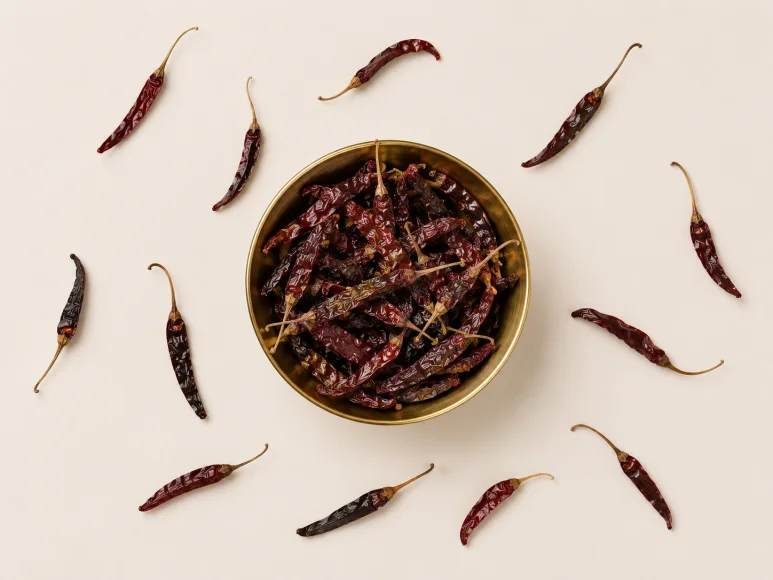
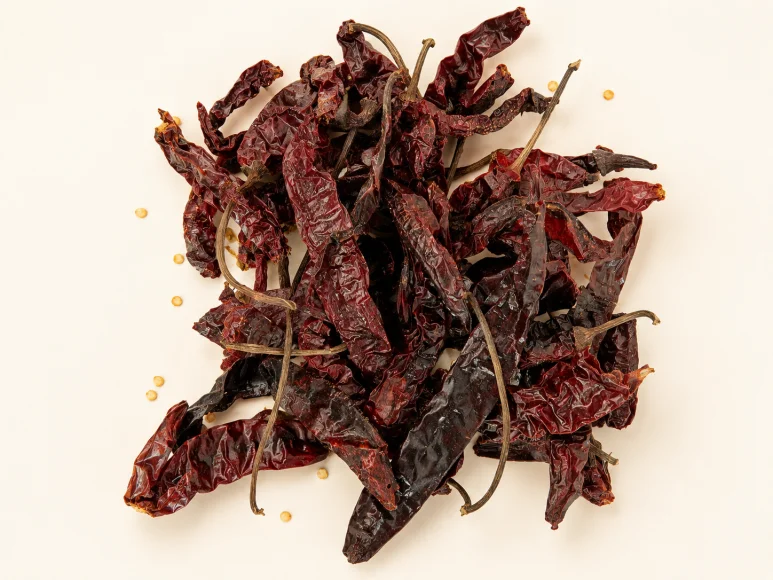
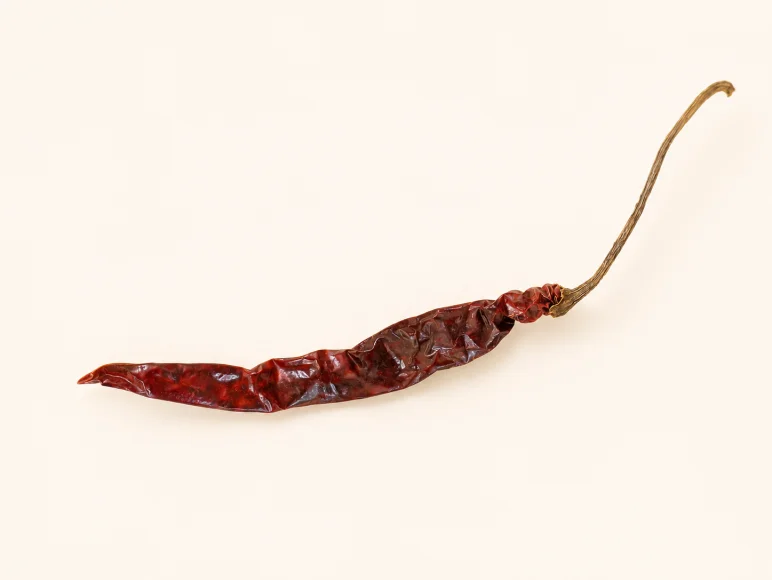
Sirarakhong Chilli: Manipur's Geographical Indication chilli
Sirarakhong chilli (also called Hathei, meaning "bitter" in the Tangkhul language) is a dried red chilli native to Sirarakhong village, Ukhrul district, Manipur, in North-East India. Grown for generations by the Tangkhul Naga community, it received Geographical Indication (GI) status from the Indian government in 2021, recognising its unique origin and know-how. Sun-dried in the Himalayan hills, it stands out for its thin skin, deep red colour and characteristic smoky, fruity aroma.
Why choose whole dried chillies?
Unlike an already-ground chilli powder, the whole Sirarakhong chilli keeps all the richness of its essential oils and aromas until the moment you use it. You can infuse it whole in oil, soak it to prepare a chilli paste (as in achars), or grind it yourself just before use for a fresh, fragrant powder that is far more intense than an industrial one.
Culinary uses:
- Soaked then blended into a paste for North-East Indian achars (pickled chillies) and chutneys
- Ground just before use for a homemade chilli powder, far more aromatic
- Infused whole in hot oil for a fragrant condiment (chilli oil)
- Crumbled into dals and curries for a progressive heat and smoky aroma
- Added to marinades for grilled meat and fish
- Essential in traditional Tangkhul Naga fermented chilli recipes
Origin and quality:
Our Sirarakhong chilli comes directly from smallholder farms in Sirarakhong village, in the hills of Ukhrul, Manipur, where it is grown by the Tangkhul Naga community and hand-labelled. These small farms grow their chillies, guaranteeing a natural, authentic product true to the traditional know-how of North-East India.
To discover the story of this Manipur Geographical Indication chilli, read our guide to Sirarakhong chilli.
Storage:
To preserve all its aromas, store your Sirarakhong chilli in a dry place, away from light and moisture, in its airtight packaging.
Rich in vitamin C, boosts immunity
Boosts metabolism thanks to capsaicin
Supports digestion and stimulates appetite
Traditionally recognised anti-inflammatory properties
Traditionally used to relieve muscle and joint pain
Stimulates blood circulation
Rich in antioxidants (carotenoids)
Traditionally used by the Tangkhul Naga to warm the body in the mountain climate
| Directly selected smallholder producers | No |
| Spice level | Strong |
| Vegetarian | Yes |
| Origin | Sirarakhong, Ukhrul district, Manipur, India |
| Quality | Premium |
| Type | Whole dried chillies |
| Taste profile | Smoky and fruity aroma, with a progressive rather than fierce heat. Slightly sweet notes and a unique flavour tied to its mountain terroir. |
| Possible traces of allergens | No known allergens. Packaged in a facility that also handles mustard and celery (may contain traces). |
Learn more
Sirarakhong chilli's other name, "hathei", comes from the local Tangkhul language: "ha" means "bitter" or "pungent", a word that directly describes the sensation in the mouth rather than a borrowed botanical name. Long grown in Sirarakhong village, it is the region's main source of agricultural income and holds an important cultural place among the Tangkhul Naga.
On 14 September 2021, Sirarakhong hathei chilli was granted a Geographical Indication by the Geographical Indications Registry in Chennai, valid until September 2027. The application, filed in January 2017 by the Manipur Organic Mission in Imphal, made this chilli the first variety from Manipur and the seventh product from the state to receive this official recognition.
A festival dedicated to the chilli
Every year, Ukhrul hosts a festival dedicated to Sirarakhong chilli, where several hundred local growers showcase their harvest. The event highlights both the region's traditional farming and the economic importance of this Geographical Indication for Sirarakhong's farming households.
Did you know?
Sirarakhong hathei can reach up to 20 cm in length, an exceptional size for a dried chilli. Its elongated shape and deep colour make it an easily recognisable variety among the chillies of northeast India.
According to local tradition, village elders are said to have discovered the sirarakhong chilli while hunting in the forest, an almost legendary origin still told today in Sirarakhong. A Tangkhul folk song even compares the chilli to khuilang, a prized shawl traditionally worn by the Tangkhul Naga, a sign of the prestige the community grants this local variety.
Since 2010, the village has held an annual "Hathei Phanit" festival devoted to the chilli; the September 2025 edition marked the 14th instalment of an event that has become a key fixture for local agriculture in Manipur.
For the Tangkhul community, sirarakhong chilli is more than a food crop: the Hathei Phanit festival celebrates it as a true gift from the land to the community, a way of collectively honouring a variety that has long secured the village's economic survival.
| Characteristic | Detail |
|---|---|
| Latin name | Capsicum annuum |
| Botanical family | Solanaceae |
| Local name | Sirarakhong hathei (Tangkhul), "ha" meaning bitter/pungent |
| Part used | Whole dried fruit |
| Growing region | Sirarakhong village, Ukhrul district, Manipur |
| Geographical Indication | Registered 14 September 2021, valid until September 2027 |
Sirarakhong chilli grows in the hills of Ukhrul district, a mid-altitude region of Manipur. The long, tapering fruits can reach an unusual length for a chilli, turning a deep, rich red once dried.
A crop at the heart of local identity
- Grown mainly in and around Sirarakhong village
- The main source of agricultural income for many households in the region
- Harvested and dried using traditional methods passed down through generations
- Celebrated at an annual festival gathering several hundred growers
Did you know?
In the Table Indienne catalogue, Sirarakhong is the mildest of three notable chillies: the Himalayan dalle khursani (100,000-350,000 Scoville) and Kerala's kanthari (50,000-100,000 Scoville) are both considerably hotter.
One technical trait sets sirarakhong apart from other Indian chillies: its ASTA value (the scale measuring a chilli's colouring power, independent of heat) reaches 164, a high figure reflecting a colouring strength much prized by the food industry for naturally tinting dishes and preparations deep red.
The GI application was filed by the Manipur Organic Mission, a public body promoting local organic farming in Manipur state.
Sirarakhong chilli has a moderate heat, around 7,500 Scoville Heat Units, far below India's hottest chillies. This relative mildness makes it an approachable chilli, valued for its flavour more than for raw heat.
A flavour profile more complex than fiery
Dried Sirarakhong develops smoky, slightly fruity aromas, with a heat that stays discreet compared to other northeast Indian chillies. This relative mildness makes it a versatile chilli that can be used more generously without fear of overpowering a dish.
On the Scoville scale, sirarakhong peaks around 7,500 units, a score placing it among mild to moderately hot chillies, far behind dalle khursani or kanthari in the same catalogue. It is precisely this relative mildness, combined with an intense aroma, that makes it prized for colour and fragrance more than heat alone.
Its ASTA value, the scale used to measure how intensely red a chilli is, reaches 164, an exceptionally high figure that explains why a single pinch of ground sirarakhong is enough to deeply colour a dish, well beyond what its heat alone would suggest.
In Tangkhul and wider Manipuri cooking, Sirarakhong accompanies both meat dishes and fermented vegetable preparations typical of northeast Indian cuisine.
In Manipuri cooking
- Ground into a powder to season grilled meats and stews
- Used whole in traditional broths and soups
- Combined with local fermented vegetables for spicy preparations
- Dried then crumbled as a table condiment
How to use it at home
- Rehydrated in warm water before blending into a curry paste
- Dry-toasted briefly to intensify its smoky notes
- Crumbled into a soup or broth near the end of cooking
Did you know?
Manipur, like much of northeast India, has a long tradition of fermenting vegetables and fish. Sirarakhong, with its measured heat, pairs particularly well with these fermented preparations, balancing rather than overpowering their already assertive flavours.
In Naga cuisine
- Pounded with ginger and garlic into a base paste for Naga curries
- Smoked alongside meat or dried fish, a traditional mountain preservation technique
- Mixed with fresh coriander and salt into a quick chutney, served with rice
- Dried whole and ground as needed, to best preserve its strong colouring power
Like most chillies, Sirarakhong owes some of its nutritional interest to its vitamin C content and to capsaicin, its active compound, present here in a more moderate amount than in the hottest chillies.
What we know about its composition
- Vitamin C: present in the fresh fruit, as in most red chillies
- Capsaicin: the compound responsible for the heat, here at a moderate concentration (around 7,500 Scoville Heat Units)
- Traditional farming: often grown in Sirarakhong households
Usage precautions
Sirarakhong remains a mild chilli by Indian standards, but it does carry real heat. Handle it with the usual precautions for any dried chilli: wash your hands after handling it and avoid contact with your eyes.
Sirarakhong's high colouring power, measured by its ASTA value, is also linked to its richness in carotenoids, the pigments responsible for the deep red of the ripe fruit, a compound family otherwise studied for antioxidant properties, without this being a health claim specific to this variety.
Sirarakhong is also locally noted for its calcium content, a trait less commonly highlighted than vitamin C among chillies, alongside the natural antioxidants linked to its deep red pigmentation.
Quality criteria
- Colour: deep, even red along the full length of the fruit
- Texture: pliable but dry skin, free of mould
- Size: long, tapering fruits, a sign of good quality
Storage tips
- In an airtight container, away from light and moisture
- Shelf life: 1 to 2 years when stored well
- Store whole rather than crumbled to preserve its aroma longer
Sirarakhong's colouring power fades with prolonged light exposure; an opaque container or a closed cupboard preserves its deep red better than a clear jar left on display.
Is Sirarakhong chilli very hot?
No, it is fairly mild for an Indian chilli, at around 7,500 Scoville Heat Units, well below the Himalayan dalle khursani or Kerala's kanthari. Its appeal lies mainly in its smoky, fruity aromas.
Why is Sirarakhong also called hathei?
"Hathei" comes from Tangkhul, the local language of Ukhrul district: "ha" means bitter or pungent. The name directly describes the chilli's sensation rather than a botanical origin.
Does Sirarakhong chilli have official protection?
Yes, it was granted a Geographical Indication on 14 September 2021, valid until September 2027, making it the first chilli variety from Manipur to receive this recognition.
How do I use Sirarakhong in cooking?
Grind it into a powder to season meats and stews, rehydrate it for a curry paste, or dry-toast it briefly to intensify its smoky notes before crumbling it into a soup.
What is the difference between Sirarakhong and other chillies in the range?
Sirarakhong is notably milder than the Himalayan dalle khursani or Kerala's kanthari, both much hotter. It is the chilli of choice for complex aromas without excessive heat.
Is sirarakhong very hot?
No, compared to other hot Indian chillies it stays moderate: around 7,500 Scoville units, versus 50,000 to 100,000 for Kerala's kanthari or 100,000 to 350,000 for Himalayan dalle khursani. It is prized above all for its colour and aroma.
What is a chilli's ASTA value?
A scale measuring a chilli's colouring power, independent of its heat (measured separately in Scoville units). Sirarakhong shows a particularly high ASTA value of 164, which explains its prized use for naturally tinting dishes and preparations.
Is sirarakhong chilli exported outside India?
Its GI recognition and strong colouring power (high ASTA value) make it an increasingly sought after product in Indian and international spice markets, even though production remains concentrated around Sirarakhong village and the Ukhrul region.
-
Sirarakhong chilli's other name, "hathei", comes from the local Tangkhul language: "ha" means "bitter" or "pungent", a word that directly describes the sensation in the mouth rather than a borrowed botanical name. Long grown in Sirarakhong village, it is the region's main source of agricultural income and holds an important cultural place among the Tangkhul Naga.
On 14 September 2021, Sirarakhong hathei chilli was granted a Geographical Indication by the Geographical Indications Registry in Chennai, valid until September 2027. The application, filed in January 2017 by the Manipur Organic Mission in Imphal, made this chilli the first variety from Manipur and the seventh product from the state to receive this official recognition.
A festival dedicated to the chilli
Every year, Ukhrul hosts a festival dedicated to Sirarakhong chilli, where several hundred local growers showcase their harvest. The event highlights both the region's traditional farming and the economic importance of this Geographical Indication for Sirarakhong's farming households.
Did you know?
Sirarakhong hathei can reach up to 20 cm in length, an exceptional size for a dried chilli. Its elongated shape and deep colour make it an easily recognisable variety among the chillies of northeast India.
According to local tradition, village elders are said to have discovered the sirarakhong chilli while hunting in the forest, an almost legendary origin still told today in Sirarakhong. A Tangkhul folk song even compares the chilli to khuilang, a prized shawl traditionally worn by the Tangkhul Naga, a sign of the prestige the community grants this local variety.
Since 2010, the village has held an annual "Hathei Phanit" festival devoted to the chilli; the September 2025 edition marked the 14th instalment of an event that has become a key fixture for local agriculture in Manipur.
For the Tangkhul community, sirarakhong chilli is more than a food crop: the Hathei Phanit festival celebrates it as a true gift from the land to the community, a way of collectively honouring a variety that has long secured the village's economic survival.
-
Characteristic Detail Latin name Capsicum annuum Botanical family Solanaceae Local name Sirarakhong hathei (Tangkhul), "ha" meaning bitter/pungent Part used Whole dried fruit Growing region Sirarakhong village, Ukhrul district, Manipur Geographical Indication Registered 14 September 2021, valid until September 2027 Sirarakhong chilli grows in the hills of Ukhrul district, a mid-altitude region of Manipur. The long, tapering fruits can reach an unusual length for a chilli, turning a deep, rich red once dried.
A crop at the heart of local identity
- Grown mainly in and around Sirarakhong village
- The main source of agricultural income for many households in the region
- Harvested and dried using traditional methods passed down through generations
- Celebrated at an annual festival gathering several hundred growers
Did you know?
In the Table Indienne catalogue, Sirarakhong is the mildest of three notable chillies: the Himalayan dalle khursani (100,000-350,000 Scoville) and Kerala's kanthari (50,000-100,000 Scoville) are both considerably hotter.
One technical trait sets sirarakhong apart from other Indian chillies: its ASTA value (the scale measuring a chilli's colouring power, independent of heat) reaches 164, a high figure reflecting a colouring strength much prized by the food industry for naturally tinting dishes and preparations deep red.
The GI application was filed by the Manipur Organic Mission, a public body promoting local organic farming in Manipur state.
-
Sirarakhong chilli has a moderate heat, around 7,500 Scoville Heat Units, far below India's hottest chillies. This relative mildness makes it an approachable chilli, valued for its flavour more than for raw heat.
A flavour profile more complex than fiery
Dried Sirarakhong develops smoky, slightly fruity aromas, with a heat that stays discreet compared to other northeast Indian chillies. This relative mildness makes it a versatile chilli that can be used more generously without fear of overpowering a dish.
On the Scoville scale, sirarakhong peaks around 7,500 units, a score placing it among mild to moderately hot chillies, far behind dalle khursani or kanthari in the same catalogue. It is precisely this relative mildness, combined with an intense aroma, that makes it prized for colour and fragrance more than heat alone.
Its ASTA value, the scale used to measure how intensely red a chilli is, reaches 164, an exceptionally high figure that explains why a single pinch of ground sirarakhong is enough to deeply colour a dish, well beyond what its heat alone would suggest.
-
In Tangkhul and wider Manipuri cooking, Sirarakhong accompanies both meat dishes and fermented vegetable preparations typical of northeast Indian cuisine.
In Manipuri cooking
- Ground into a powder to season grilled meats and stews
- Used whole in traditional broths and soups
- Combined with local fermented vegetables for spicy preparations
- Dried then crumbled as a table condiment
How to use it at home
- Rehydrated in warm water before blending into a curry paste
- Dry-toasted briefly to intensify its smoky notes
- Crumbled into a soup or broth near the end of cooking
Did you know?
Manipur, like much of northeast India, has a long tradition of fermenting vegetables and fish. Sirarakhong, with its measured heat, pairs particularly well with these fermented preparations, balancing rather than overpowering their already assertive flavours.
In Naga cuisine
- Pounded with ginger and garlic into a base paste for Naga curries
- Smoked alongside meat or dried fish, a traditional mountain preservation technique
- Mixed with fresh coriander and salt into a quick chutney, served with rice
- Dried whole and ground as needed, to best preserve its strong colouring power
-
Like most chillies, Sirarakhong owes some of its nutritional interest to its vitamin C content and to capsaicin, its active compound, present here in a more moderate amount than in the hottest chillies.
What we know about its composition
- Vitamin C: present in the fresh fruit, as in most red chillies
- Capsaicin: the compound responsible for the heat, here at a moderate concentration (around 7,500 Scoville Heat Units)
- Traditional farming: often grown in Sirarakhong households
Usage precautions
Sirarakhong remains a mild chilli by Indian standards, but it does carry real heat. Handle it with the usual precautions for any dried chilli: wash your hands after handling it and avoid contact with your eyes.
Sirarakhong's high colouring power, measured by its ASTA value, is also linked to its richness in carotenoids, the pigments responsible for the deep red of the ripe fruit, a compound family otherwise studied for antioxidant properties, without this being a health claim specific to this variety.
Sirarakhong is also locally noted for its calcium content, a trait less commonly highlighted than vitamin C among chillies, alongside the natural antioxidants linked to its deep red pigmentation.
-
Quality criteria
- Colour: deep, even red along the full length of the fruit
- Texture: pliable but dry skin, free of mould
- Size: long, tapering fruits, a sign of good quality
Storage tips
- In an airtight container, away from light and moisture
- Shelf life: 1 to 2 years when stored well
- Store whole rather than crumbled to preserve its aroma longer
Sirarakhong's colouring power fades with prolonged light exposure; an opaque container or a closed cupboard preserves its deep red better than a clear jar left on display.
-
Is Sirarakhong chilli very hot?
No, it is fairly mild for an Indian chilli, at around 7,500 Scoville Heat Units, well below the Himalayan dalle khursani or Kerala's kanthari. Its appeal lies mainly in its smoky, fruity aromas.
Why is Sirarakhong also called hathei?
"Hathei" comes from Tangkhul, the local language of Ukhrul district: "ha" means bitter or pungent. The name directly describes the chilli's sensation rather than a botanical origin.
Does Sirarakhong chilli have official protection?
Yes, it was granted a Geographical Indication on 14 September 2021, valid until September 2027, making it the first chilli variety from Manipur to receive this recognition.
How do I use Sirarakhong in cooking?
Grind it into a powder to season meats and stews, rehydrate it for a curry paste, or dry-toast it briefly to intensify its smoky notes before crumbling it into a soup.
What is the difference between Sirarakhong and other chillies in the range?
Sirarakhong is notably milder than the Himalayan dalle khursani or Kerala's kanthari, both much hotter. It is the chilli of choice for complex aromas without excessive heat.
Is sirarakhong very hot?
No, compared to other hot Indian chillies it stays moderate: around 7,500 Scoville units, versus 50,000 to 100,000 for Kerala's kanthari or 100,000 to 350,000 for Himalayan dalle khursani. It is prized above all for its colour and aroma.
What is a chilli's ASTA value?
A scale measuring a chilli's colouring power, independent of its heat (measured separately in Scoville units). Sirarakhong shows a particularly high ASTA value of 164, which explains its prized use for naturally tinting dishes and preparations.
Is sirarakhong chilli exported outside India?
Its GI recognition and strong colouring power (high ASTA value) make it an increasingly sought after product in Indian and international spice markets, even though production remains concentrated around Sirarakhong village and the Ukhrul region.
Why choose Sirarakhong Chilli – GI-Tagged Dried Chilli from Manipur from La Table Indienne?

Exceptional freshness and quality
Our spices are imported directly from India and packaged on demand to guarantee optimal freshness. Unlike spices sold in supermarkets that can sit on shelves for months, we ensure each spice retains its full flavor and aroma.
Authenticity and traceability
Each spice comes from specific regions in India renowned for their expertise. We work directly with local producers who grow their spices traditionally.
How to best use this spice?
To reveal all the aromas, we recommend lightly toasting whole spices in a dry pan before grinding them. Store them in a dry place away from light to preserve their freshness as long as possible.

Did you know?
Whole spices are much better than ground spices
Check out our blog article to discover why whole spices retain their aromas better.
Questions & Answers
Thank you! Your question has been sent. Mihika will answer soon and you will receive an email.
Discover also
Other products you might like