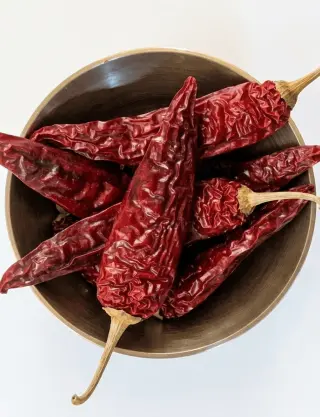




Discover our Dalle Khursani, a small round, fleshy pepper grown in the valleys of Sikkim, in the Indian Himalayas. Fruity, slightly smoky and fiercely powerful to set your pickles, hot sauces and slow-cooked curries ablaze.
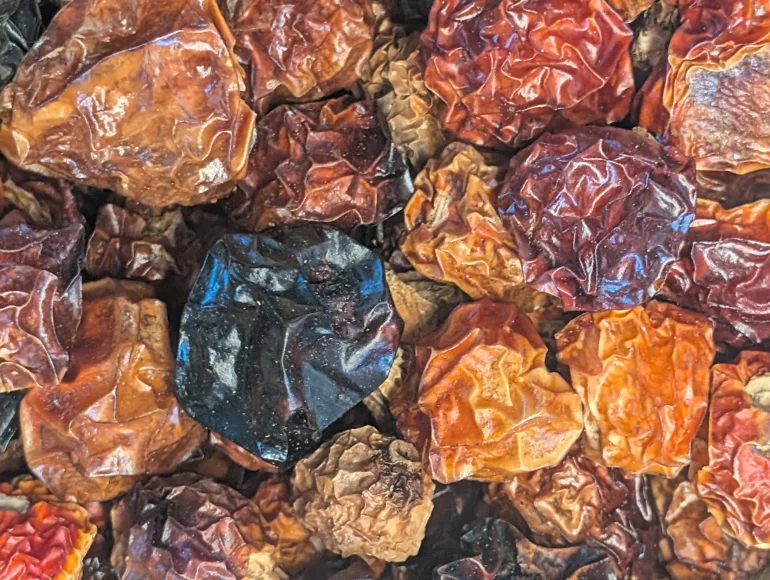
Dalle Khursani: the cherry pepper that sets the Himalayas on fire
Dalle Khursani (also called Akbare Khursani, literally "round chilli" in Nepali) is a small cherry pepper, round and fleshy, that turns bright red as it ripens. Grown in the valleys of Sikkim and the neighbouring Darjeeling and Kalimpong districts, it earned a Geographical Indication (GI) tag in 2020 for Sikkim, extended in 2021 to those two West Bengal districts. It is one of the most powerful chillies in the world, with a heat level comparable to the habanero.
Why choose whole dried peppers?
Dried whole, Dalle Khursani keeps the full strength of its essential oils and capsaicin, concentrated in the seeds and internal membranes. This lets you control the intensity of your dishes precisely: let the whole pepper infuse for a diffuse heat, or crumble it for an immediate blast. This whole form is also truest to Himalayan tradition, where the pepper is sun-dried and kept all year round.
Culinary uses:
- The star ingredient of dalle ko achar, the famous fermented chilli pickle of Nepal and Sikkim
- Homemade hot sauces and explosive chutneys
- For tempering (tadka): infused whole in hot oil or ghee
- Enhances dals, vegetable curries and slow-cooked meat dishes
- Crumbled over momos (Himalayan dumplings) and soups
- Use sparingly: a single pepper is enough to spice up an entire dish
Origin and quality:
Our Dalle Khursani comes from small family farms in the Himalayan valleys of Sikkim and eastern Nepal.
To learn all about this Sikkim Geographical Indication chilli, read our guide to Dalle Khursani.
Storage:
To preserve all its aromatic power, store your Dalle Khursani in a dry place, away from light and humidity, in its airtight packaging.
Rich in vitamin C
Boosts metabolism thanks to capsaicin
Antioxidant properties
Supports digestion
Supports healthy blood circulation
Anti-inflammatory properties
Rich in vitamin A
Promotes endorphin release (feel-good effect)
| Directly selected smallholder producers | No |
| Spice level | Very strong |
| Vegetarian | Yes |
| Origin | Eastern Himalayas (Sikkim), India |
| Quality | Premium |
| Type | Whole dried peppers |
| Taste profile | A round, fleshy pepper with a fruity, slightly smoky flavour, delivering an intense, long-lasting heat (100,000 to 350,000 SHU, on par with habanero). |
| Possible traces of allergens | May contain traces of mustard and celery (packaged in a facility handling these allergens). |
Translated from French
Learn more
The name "dalle khursani" comes from Nepali and literally means "round chilli", a reference to its almost spherical shape, unusual among chillies. Grown for generations in the kitchen gardens of the Himalayan hills, it only entered Sikkim's formal trade in the 1990s, before becoming a pillar of the region's culinary identity.
The first documented commercial processing dates back to 1998, in Rabongla in southern Sikkim, where Samir Tamhane launched a production line under the brand name "High Altitude", a milestone often cited as the starting point of the crop's move from pure home consumption and village markets towards a structured supply chain.
In 2020, Sikkim's dalle khursani was granted a Geographical Indication by the Department for Promotion of Industry and Internal Trade (DPIIT), registered with the Geographical Indications Registry in Chennai, an official recognition reserving the name for chillies grown in the region. The GI status was extended in September 2021 to the neighbouring districts of Darjeeling and Kalimpong in West Bengal, at the request of the North Eastern Regional Agricultural Marketing Corporation.
Nicknames that match its strength
Dalle khursani carries several local nicknames that speak to its reputation. In Nepali it is sometimes called "akabare khursani", the "king of chillies", and more rarely "jyaanamara khursani", which translates bluntly as "chilli that kills": a folkloric nickname describing a heat fierce enough to floor anyone careless with it. In Sikkim, in the local Bhutia language, it is also fondly known as "akubari", the spicy uncle of the chilli family.
Did you know?
According to some botanical sources, dalle khursani may be the only known chilli variety that is polyploid, meaning it carries more sets of chromosomes than usual. Grown in open fields, the plant reaches 100 to 130 cm in height; under greenhouse conditions, where growing conditions are gentler, it can climb to 150-180 cm. A rare genetic trait that could partly explain both its distinctive round shape and its concentrated capsaicin content.
Production today remains modest and largely local: Sikkim harvested around 250 tonnes in 2019, more than half of it consumed within the state, the rest reaching northern Bengal and the wider Indian northeast.
A 2024 study (bioRxiv, cytogenetic characterisation of dalle khursani) measured notable variation in capsaicin content across accessions grown throughout Sikkim and Darjeeling, confirming both the plant's polyploid nature and the absence of a perfectly uniform heat profile from batch to batch.
Official recognition also opened the door to export: in 2025, India's APEDA organised the first shipments of Sikkim dalle chillies to the Solomon Islands, a sign of growing international visibility for a spice long confined to local Himalayan markets.
| Characteristic | Detail |
|---|---|
| Latin name | Capsicum annuum |
| Botanical family | Solanaceae, the same family as tomatoes and aubergines |
| Local name | Dalle khursani, akabare khursani (Nepali) |
| Part used | Whole dried fruit |
| Main growing regions | Sikkim, Darjeeling and Kalimpong districts (West Bengal), the hills of Nepal and Bhutan |
Dalle khursani grows on a hardy, cold-tolerant perennial plant suited to the mid-hills of the Himalayas, reaching 100 to 130 cm in the open field. The small, near-round fruits turn from green to bright red as they ripen, standing out sharply against the plant's dark foliage.
A mid-mountain crop
- Grown in kitchen gardens and small plots, often alongside other vegetables
- Hand-picked as fruits ripen, several times over a season
- Sun-dried or air-dried for long storage outside the harvest season
- A growing share of the crop is sold fresh, mainly for local achar-making
Did you know?
In the Table Indienne catalogue, dalle khursani has two fiery cousins with very different profiles: the milder kanthari chilli from Kerala, and the Sirarakhong chilli from Manipur, also protected by a Geographical Indication but noticeably gentler.
GI recognition also changed the economics for growers: it encouraged more structured cultivation, with growing technical support to standardise quality and open new commercial outlets beyond the local market, up to the first Asia-Pacific export shipments in 2025.
Dalle khursani first surprises with its power: its capsaicin content ranges between 100,000 and 350,000 Scoville Heat Units, a level comparable to the habanero, one of the world's hottest chillies. But beyond the heat, it reveals a fruity, slightly sweet note quite different from the dry bitterness of some dried chillies.
A heat that builds gradually
Unlike chillies whose heat hits instantly then fades, dalle khursani builds its warmth gradually, with a sensation that lingers. This slow build, combined with its fruity roundness, makes it a sought-after ingredient for lifting a dish without overwhelming its other flavours, provided it is used with a careful hand.
Dried, it concentrates its aroma and strength even further, developing subtly smoky notes when it meets the heat of cooking, whether in hot oil or a simmering dish.
Where the heat really hides
Contrary to a stubborn myth, it isn't the small seeds that carry most of the dalle khursani's heat, but the thin whitish membrane surrounding them inside the fruit, called the placenta. It concentrates capsaicin at a much higher density; removing this membrane rather than just the seeds lets you tone down a dish's intensity without losing all of the pepper's character.
To put this heat in perspective on the pepper scale: cayenne pepper typically tops out around 30,000 to 50,000 Scoville units, Thai bird's eye chilli around 50,000 to 100,000, while the world's most extreme peppers, such as the Carolina Reaper, exceed 2,000,000 units. Dalle khursani sits well above everyday peppers, without reaching these record extremes.
In Sikkim and the surrounding hills, dalle khursani accompanies almost every meal, in forms ranging from a raw condiment to a long-fermented pickle.
In Himalayan cooking
- Crushed as an accompaniment to dal bhat, the everyday rice-and-lentil staple
- Ground into a paste to lift vegetable or meat curries and sauces
- Prepared as a pickle, "dalle achar", marinated with salt, mustard oil and sometimes lime
- Used to flavour dipping sauces for momos, the region's steamed dumplings
- Fermented with yak buttermilk in some traditional preparations, a rare method that softens and deepens its heat
How to use it at home
- Rehydrated in warm water for a few minutes before blending into a paste for a curry
- Crumbled sparingly into a soup or broth near the end of cooking
- Infused into hot neutral oil to make a homemade chilli oil
Did you know?
Dal bhat, literally "lentils and rice", is the reference meal across the Nepali and Sikkimese Himalayas. Dalle khursani, crushed or as a pickle, plays the role of the final seasoning each diner adds to their own taste, served at the table rather than cooked into the dish.
The traditional dalle achar method
The most authentic preparation starts with sun-drying the whole chillies alongside roughly chopped garlic and ginger for a day or two, to concentrate their flavour. The spices (fenugreek, turmeric, cumin, coriander, mustard seeds) are then lightly fried before coating the dried chillies. Everything goes into a jar with mustard or a neutral oil, then sits in the sun for four to five days: this controlled exposure limits mould growth and starts a light fermentation that softens the heat over time.
Dalle khursani also holds a place in the Himalayan festive calendar: during Maghe Sankranti, the festival marking the end of winter in January in the Nepali calendar, it features in shared family meals, and some communities even attribute it a protective quality beyond its strictly culinary role. In recent years the supply chain has also diversified towards higher value-added products, locally processed chilli powder and infused oils, a shift that has accompanied GI recognition.
Like most hot chillies, dalle khursani owes much of its nutritional interest to its vitamin C content and to capsaicin, the active compound responsible for its heat.
What we know about its composition
- Vitamin C: the fresh fruit reportedly contains up to five times more than an orange, a high level even for a chilli
- Vitamin A: present in notable amounts, as in many ripe red chillies
- Capsaicin: the compound responsible for its heat, studied for its thermogenic effect and its role in heat perception
- Potassium: the fruit is thought to contain useful amounts, alongside a naturally low sodium content
Usage precautions
A chilli this powerful (100,000 to 350,000 Scoville Heat Units) should be used sparingly, especially dried, when the heat concentrates further. Wear gloves or wash your hands thoroughly after cutting it, and avoid any contact with your eyes. People with heat-sensitive digestive conditions may wish to limit their intake.
Indicative nutritional values (per 100 g fresh fruit)
| Component | Approximate content |
|---|---|
| Vitamin C | around 240 mg, nearly five times more than an orange |
| Vitamin A | around 11,000 IU |
| Vitamin E | around 0.7 mg |
Beyond vitamin C, research on chilli capsaicin has for several years explored its possible role in thermogenesis (a slight rise in energy expenditure after consumption), findings documented mainly on concentrated extracts, not directly transferable to occasional culinary use in small quantities.
Biochemically, capsaicin works by binding to the TRPV1 receptor, the same sensory receptor normally activated by physical heat, which explains why the brain interprets the heat as a genuine burning sensation even though no real tissue damage occurs at reasonable culinary doses.
Quality criteria
- Colour: deep, even red for dried fruits, with no dull or browned patches
- Texture: wrinkled but pliable skin, free of mould or white bloom
- Smell: sharp, slightly fruity heat as soon as the bag is opened
Storage tips
- In an airtight container, away from light and moisture
- Shelf life: 1 to 2 years when stored well
- Always handle with care: gloves recommended, avoid any contact with the eyes
For even longer storage, whole dried pods freeze well in an airtight bag: this slows aroma loss further without affecting texture once thawed.
Is dalle khursani as hot as a habanero?
Roughly, yes: dalle khursani sits between 100,000 and 350,000 Scoville Heat Units, a level comparable to the habanero. It is one of the hottest chillies grown in the Himalayas, best used sparingly.
What is the difference between dalle khursani and kanthari chilli?
Both are small hot chillies, but dalle khursani (100,000 to 350,000 Scoville, Himalayas) is noticeably hotter than Kerala's kanthari chilli (around 50,000 to 100,000 Scoville). Their growing regions and culinary uses also differ widely.
How do I use dried dalle khursani in cooking?
Rehydrate it in warm water for a few minutes before blending into a paste for a curry, or crumble it sparingly into a soup or simmered dish near the end of cooking. It can also be infused into hot neutral oil to make a homemade chilli oil.
What is dalle achar?
Dalle achar is a traditional pickle from Sikkim and Nepal, made by marinating dalle khursani chillies with salt, mustard oil and sometimes lime. It accompanies dal bhat, the everyday rice-and-lentil meal.
Does dalle khursani have official protection?
Yes, it was granted a Geographical Indication (GI) in 2020 for Sikkim, extended in 2021 to the neighbouring Darjeeling and Kalimpong districts in West Bengal. This official recognition reserves the name for chillies actually grown in this Himalayan region.
Can dalle khursani be substituted with another chilli in a recipe?
Not easily at an equivalent heat level: few common chillies reach 100,000 to 350,000 Scoville units. Failing that, a bird's eye chilli or habanero come closest in intensity, though their fruity aroma profile differs. Reduce the quantity and taste as you go.
Where does the nickname "king of chillies" sometimes given to dalle khursani come from?
The nickname "akabare khursani" reflects its power and central place in local Himalayan cuisine, where it is considered the benchmark for heat among regionally grown varieties, well before more recently imported chillies arrived.
-
The name "dalle khursani" comes from Nepali and literally means "round chilli", a reference to its almost spherical shape, unusual among chillies. Grown for generations in the kitchen gardens of the Himalayan hills, it only entered Sikkim's formal trade in the 1990s, before becoming a pillar of the region's culinary identity.
The first documented commercial processing dates back to 1998, in Rabongla in southern Sikkim, where Samir Tamhane launched a production line under the brand name "High Altitude", a milestone often cited as the starting point of the crop's move from pure home consumption and village markets towards a structured supply chain.
In 2020, Sikkim's dalle khursani was granted a Geographical Indication by the Department for Promotion of Industry and Internal Trade (DPIIT), registered with the Geographical Indications Registry in Chennai, an official recognition reserving the name for chillies grown in the region. The GI status was extended in September 2021 to the neighbouring districts of Darjeeling and Kalimpong in West Bengal, at the request of the North Eastern Regional Agricultural Marketing Corporation.
Nicknames that match its strength
Dalle khursani carries several local nicknames that speak to its reputation. In Nepali it is sometimes called "akabare khursani", the "king of chillies", and more rarely "jyaanamara khursani", which translates bluntly as "chilli that kills": a folkloric nickname describing a heat fierce enough to floor anyone careless with it. In Sikkim, in the local Bhutia language, it is also fondly known as "akubari", the spicy uncle of the chilli family.
Did you know?
According to some botanical sources, dalle khursani may be the only known chilli variety that is polyploid, meaning it carries more sets of chromosomes than usual. Grown in open fields, the plant reaches 100 to 130 cm in height; under greenhouse conditions, where growing conditions are gentler, it can climb to 150-180 cm. A rare genetic trait that could partly explain both its distinctive round shape and its concentrated capsaicin content.
Production today remains modest and largely local: Sikkim harvested around 250 tonnes in 2019, more than half of it consumed within the state, the rest reaching northern Bengal and the wider Indian northeast.
A 2024 study (bioRxiv, cytogenetic characterisation of dalle khursani) measured notable variation in capsaicin content across accessions grown throughout Sikkim and Darjeeling, confirming both the plant's polyploid nature and the absence of a perfectly uniform heat profile from batch to batch.
Official recognition also opened the door to export: in 2025, India's APEDA organised the first shipments of Sikkim dalle chillies to the Solomon Islands, a sign of growing international visibility for a spice long confined to local Himalayan markets.
-
Characteristic Detail Latin name Capsicum annuum Botanical family Solanaceae, the same family as tomatoes and aubergines Local name Dalle khursani, akabare khursani (Nepali) Part used Whole dried fruit Main growing regions Sikkim, Darjeeling and Kalimpong districts (West Bengal), the hills of Nepal and Bhutan Dalle khursani grows on a hardy, cold-tolerant perennial plant suited to the mid-hills of the Himalayas, reaching 100 to 130 cm in the open field. The small, near-round fruits turn from green to bright red as they ripen, standing out sharply against the plant's dark foliage.
A mid-mountain crop
- Grown in kitchen gardens and small plots, often alongside other vegetables
- Hand-picked as fruits ripen, several times over a season
- Sun-dried or air-dried for long storage outside the harvest season
- A growing share of the crop is sold fresh, mainly for local achar-making
Did you know?
In the Table Indienne catalogue, dalle khursani has two fiery cousins with very different profiles: the milder kanthari chilli from Kerala, and the Sirarakhong chilli from Manipur, also protected by a Geographical Indication but noticeably gentler.
GI recognition also changed the economics for growers: it encouraged more structured cultivation, with growing technical support to standardise quality and open new commercial outlets beyond the local market, up to the first Asia-Pacific export shipments in 2025.
-
Dalle khursani first surprises with its power: its capsaicin content ranges between 100,000 and 350,000 Scoville Heat Units, a level comparable to the habanero, one of the world's hottest chillies. But beyond the heat, it reveals a fruity, slightly sweet note quite different from the dry bitterness of some dried chillies.
A heat that builds gradually
Unlike chillies whose heat hits instantly then fades, dalle khursani builds its warmth gradually, with a sensation that lingers. This slow build, combined with its fruity roundness, makes it a sought-after ingredient for lifting a dish without overwhelming its other flavours, provided it is used with a careful hand.
Dried, it concentrates its aroma and strength even further, developing subtly smoky notes when it meets the heat of cooking, whether in hot oil or a simmering dish.
Where the heat really hides
Contrary to a stubborn myth, it isn't the small seeds that carry most of the dalle khursani's heat, but the thin whitish membrane surrounding them inside the fruit, called the placenta. It concentrates capsaicin at a much higher density; removing this membrane rather than just the seeds lets you tone down a dish's intensity without losing all of the pepper's character.
To put this heat in perspective on the pepper scale: cayenne pepper typically tops out around 30,000 to 50,000 Scoville units, Thai bird's eye chilli around 50,000 to 100,000, while the world's most extreme peppers, such as the Carolina Reaper, exceed 2,000,000 units. Dalle khursani sits well above everyday peppers, without reaching these record extremes.
-
In Sikkim and the surrounding hills, dalle khursani accompanies almost every meal, in forms ranging from a raw condiment to a long-fermented pickle.
In Himalayan cooking
- Crushed as an accompaniment to dal bhat, the everyday rice-and-lentil staple
- Ground into a paste to lift vegetable or meat curries and sauces
- Prepared as a pickle, "dalle achar", marinated with salt, mustard oil and sometimes lime
- Used to flavour dipping sauces for momos, the region's steamed dumplings
- Fermented with yak buttermilk in some traditional preparations, a rare method that softens and deepens its heat
How to use it at home
- Rehydrated in warm water for a few minutes before blending into a paste for a curry
- Crumbled sparingly into a soup or broth near the end of cooking
- Infused into hot neutral oil to make a homemade chilli oil
Did you know?
Dal bhat, literally "lentils and rice", is the reference meal across the Nepali and Sikkimese Himalayas. Dalle khursani, crushed or as a pickle, plays the role of the final seasoning each diner adds to their own taste, served at the table rather than cooked into the dish.
The traditional dalle achar method
The most authentic preparation starts with sun-drying the whole chillies alongside roughly chopped garlic and ginger for a day or two, to concentrate their flavour. The spices (fenugreek, turmeric, cumin, coriander, mustard seeds) are then lightly fried before coating the dried chillies. Everything goes into a jar with mustard or a neutral oil, then sits in the sun for four to five days: this controlled exposure limits mould growth and starts a light fermentation that softens the heat over time.
Dalle khursani also holds a place in the Himalayan festive calendar: during Maghe Sankranti, the festival marking the end of winter in January in the Nepali calendar, it features in shared family meals, and some communities even attribute it a protective quality beyond its strictly culinary role. In recent years the supply chain has also diversified towards higher value-added products, locally processed chilli powder and infused oils, a shift that has accompanied GI recognition.
-
Like most hot chillies, dalle khursani owes much of its nutritional interest to its vitamin C content and to capsaicin, the active compound responsible for its heat.
What we know about its composition
- Vitamin C: the fresh fruit reportedly contains up to five times more than an orange, a high level even for a chilli
- Vitamin A: present in notable amounts, as in many ripe red chillies
- Capsaicin: the compound responsible for its heat, studied for its thermogenic effect and its role in heat perception
- Potassium: the fruit is thought to contain useful amounts, alongside a naturally low sodium content
Usage precautions
A chilli this powerful (100,000 to 350,000 Scoville Heat Units) should be used sparingly, especially dried, when the heat concentrates further. Wear gloves or wash your hands thoroughly after cutting it, and avoid any contact with your eyes. People with heat-sensitive digestive conditions may wish to limit their intake.
Indicative nutritional values (per 100 g fresh fruit)
Component Approximate content Vitamin C around 240 mg, nearly five times more than an orange Vitamin A around 11,000 IU Vitamin E around 0.7 mg Beyond vitamin C, research on chilli capsaicin has for several years explored its possible role in thermogenesis (a slight rise in energy expenditure after consumption), findings documented mainly on concentrated extracts, not directly transferable to occasional culinary use in small quantities.
Biochemically, capsaicin works by binding to the TRPV1 receptor, the same sensory receptor normally activated by physical heat, which explains why the brain interprets the heat as a genuine burning sensation even though no real tissue damage occurs at reasonable culinary doses.
-
Quality criteria
- Colour: deep, even red for dried fruits, with no dull or browned patches
- Texture: wrinkled but pliable skin, free of mould or white bloom
- Smell: sharp, slightly fruity heat as soon as the bag is opened
Storage tips
- In an airtight container, away from light and moisture
- Shelf life: 1 to 2 years when stored well
- Always handle with care: gloves recommended, avoid any contact with the eyes
For even longer storage, whole dried pods freeze well in an airtight bag: this slows aroma loss further without affecting texture once thawed.
-
Is dalle khursani as hot as a habanero?
Roughly, yes: dalle khursani sits between 100,000 and 350,000 Scoville Heat Units, a level comparable to the habanero. It is one of the hottest chillies grown in the Himalayas, best used sparingly.
What is the difference between dalle khursani and kanthari chilli?
Both are small hot chillies, but dalle khursani (100,000 to 350,000 Scoville, Himalayas) is noticeably hotter than Kerala's kanthari chilli (around 50,000 to 100,000 Scoville). Their growing regions and culinary uses also differ widely.
How do I use dried dalle khursani in cooking?
Rehydrate it in warm water for a few minutes before blending into a paste for a curry, or crumble it sparingly into a soup or simmered dish near the end of cooking. It can also be infused into hot neutral oil to make a homemade chilli oil.
What is dalle achar?
Dalle achar is a traditional pickle from Sikkim and Nepal, made by marinating dalle khursani chillies with salt, mustard oil and sometimes lime. It accompanies dal bhat, the everyday rice-and-lentil meal.
Does dalle khursani have official protection?
Yes, it was granted a Geographical Indication (GI) in 2020 for Sikkim, extended in 2021 to the neighbouring Darjeeling and Kalimpong districts in West Bengal. This official recognition reserves the name for chillies actually grown in this Himalayan region.
Can dalle khursani be substituted with another chilli in a recipe?
Not easily at an equivalent heat level: few common chillies reach 100,000 to 350,000 Scoville units. Failing that, a bird's eye chilli or habanero come closest in intensity, though their fruity aroma profile differs. Reduce the quantity and taste as you go.
Where does the nickname "king of chillies" sometimes given to dalle khursani come from?
The nickname "akabare khursani" reflects its power and central place in local Himalayan cuisine, where it is considered the benchmark for heat among regionally grown varieties, well before more recently imported chillies arrived.
Why choose Dalle Khursani – Himalayan Cherry Pepper (Sikkim) from La Table Indienne?

Exceptional freshness and quality
Our spices are imported directly from India and packaged on demand to guarantee optimal freshness. Unlike spices sold in supermarkets that can sit on shelves for months, we ensure each spice retains its full flavor and aroma.
Authenticity and traceability
Each spice comes from specific regions in India renowned for their expertise. We work directly with local producers who grow their spices traditionally.
How to best use this spice?
To reveal all the aromas, we recommend lightly toasting whole spices in a dry pan before grinding them. Store them in a dry place away from light to preserve their freshness as long as possible.

Did you know?
Whole spices are much better than ground spices
Check out our blog article to discover why whole spices retain their aromas better.
Questions & Answers
Thank you! Your question has been sent. Mihika will answer soon and you will receive an email.
Discover also
Other products you might like