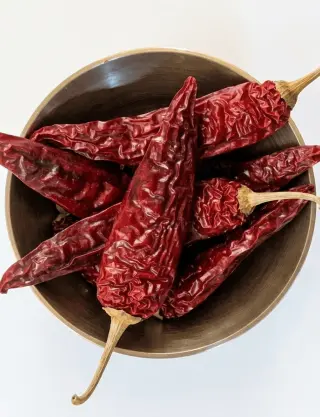




Long Pepper (Pippali) from Madhya Pradesh
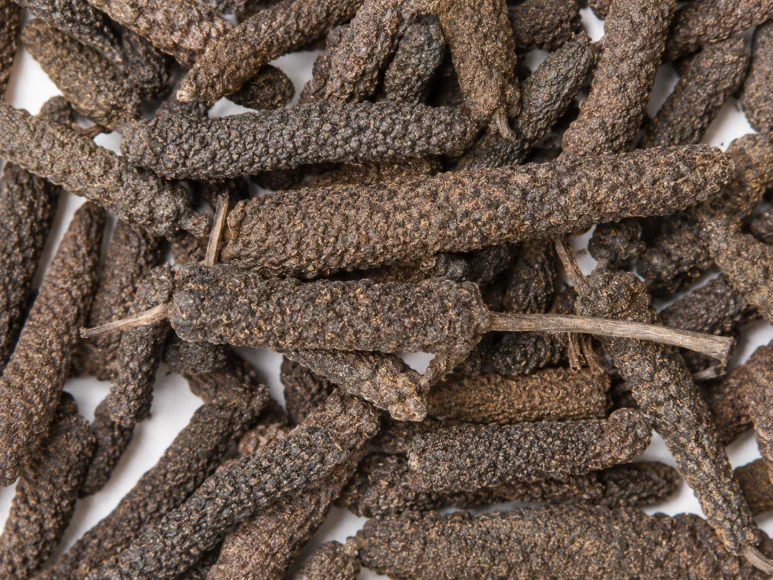
Discover our long pepper (pippali), whole dried catkins grown in Madhya Pradesh, India. Warm, sweet-pungent flavour with notes of honey and cinnamon to enhance your pickles, chai and slow-cooked dishes.
Ready for shipping, delivery time 3-10 business days
Delivery from €4.80 at Mondial Relay pickup points.



Long pepper (pippali): the Ayurvedic spice of a thousand uses
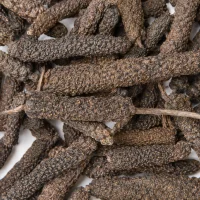
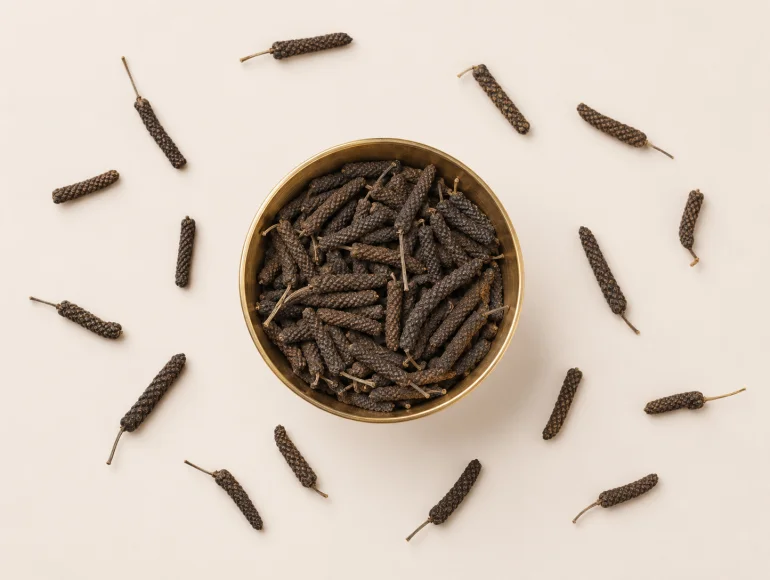
Long pepper (Piper longum), known as pippali in Hindi, is a botanical cousin of black pepper, sharing the same Piperaceae family. It comes as small whole dried catkins, resembling tiny spikes, harvested in Madhya Pradesh, in the heart of India. A pillar of Ayurvedic medicine for millennia, it is also a prized culinary spice, with a flavour far more complex and penetrating than black pepper.
Why choose whole catkins?
Whole, long pepper catkins keep their essential oils and piperine far longer than a pre-ground powder. You can infuse them as they are in a chai or broth for a soft, gradual flavour, or grind them at the last moment for maximum aromatic power in your marinades and Ayurvedic preparations.
Culinary uses:
- Infused whole in a chai or Ayurvedic decoction for a gentle, spiced warmth
- Ground to season Indian-style pickles and chutneys
- Added to slow-cooked dishes (curries, dals) for aromatic depth
- Used in meat or fish marinades
- A key ingredient of Ayurvedic trikatu, alongside ginger and black pepper
- Infused into honey or ghee for traditional Ayurvedic preparations
Origin and quality:
Our long pepper comes from Madhya Pradesh, in the heart of India.
To explore the thousand Ayurvedic and culinary uses of this spice, read our complete guide to long pepper.
Storage:
To preserve all its aromas, store your long pepper in a dry place, away from light and humidity, in its airtight packaging.
Supports digestion
Supports respiratory health (expectorant, decongestant)
Boosts memory and concentration (Medhya herb)
Antioxidant properties
Helps regulate metabolism
Anti-inflammatory properties
Strengthens natural defenses (antimicrobial)
Supports healthy circulation with a warming effect
| Directly selected smallholder producers | No |
| Spice level | Strong |
| Vegetarian | Yes |
| Origin | Madhya Pradesh, India |
| Quality | Premium |
| Type | Whole dried catkins |
| Taste profile | Warm, sweet-pungent flavour, more complex and penetrating than black pepper, with notes of honey and cinnamon. |
| Possible traces of allergens | May contain traces of mustard and celery (packaged in a facility handling these allergens). |
Learn more
Pippali is among the very earliest spices mentioned in Sanskrit texts, between 1000 and 500 BCE, long before black pepper became the leading spice of international trade. In antiquity, it was one of the most prized goods exchanged between India, Greece and Rome.
The Roman writer and naturalist Pliny the Elder recorded in the 1st century that long pepper sold for up to three times the price of black pepper, its more intense and complex flavour sought after by Roman elites in both cooking and medicine.
Dethroned by sea routes, then by chilli peppers
From the 12th century onward, black pepper, carried by sea routes more reliable and faster than the overland routes used for pippali, began to supplant it in Europe. By the 14th century, the shift was nearly complete. The final blow came later, with the discovery of chilli peppers in the Americas: easier to grow in European climates, they finished pushing long pepper out of Western trade by the 18th century.
Did you know?
The Sanskrit name "pippali" is said to literally mean "that which makes one drink and digest", a direct nod to its traditional use as a digestive aid, long before modern science took an interest in its active compounds.
In India, unlike in the West, pippali never disappeared from kitchens or Ayurvedic medicine, where it holds a prized place alongside ginger and black pepper.
The confusion perpetuated by Pliny the Elder, who believed long pepper and black pepper came from the same plant harvested at different stages, long clouded European understanding of this spice. It took modern botanical classification to clearly establish these as two distinct species within the same Piper genus.
In recent years, pippali has seen renewed interest outside India, driven by Western chefs seeking historic flavours and a food literature that rediscovers it as "the forgotten spice of kings", more complex than black pepper, with notes evoking both peppery heat and a light woody sweetness.
This Sanskrit name "pippali" left an unexpected linguistic trace far broader than long pepper itself: it is thought to have given, via the Dravidian "tippali", the ancient Greek "peperi", then the Latin "piper", from which English "pepper" and French "poivre" directly descend. In other words, the very name of black pepper, today far better known and widespread, historically comes from the name of its long-fruited cousin, once considered the benchmark spice.
| Characteristic | Detail |
|---|---|
| Latin name | Piper longum |
| Botanical family | Piperaceae, the same family as black pepper |
| Local name | Pipli, pippali (Sanskrit and Hindi) |
| Part used | Dried flower spike, often mistakenly called a "fruit" |
| Growing regions | Madhya Pradesh, Assam, Tamil Nadu, Andhra Pradesh |
Unlike black pepper, which grows as round berries on a climbing vine, long pepper takes the form of an elongated spike, studded with tiny fruits fused together, resembling a small plant catkin. It is this whole, dried spike that is used in cooking and in Ayurvedic medicine.
A plant of the humid tropical forests
- Grows wild in India's evergreen forests, often in the undergrowth
- Cultivated in regions with high rainfall and relative humidity
- Harvested once the spike reaches full maturity, before drying completely in the sun
- Used either whole or ground, depending on the preparation
Did you know?
In the Table Indienne catalogue, long pepper and whole Malabar black pepper share the same botanical family and the same active compound, piperine, but offer quite distinct aromatic profiles: the former sweeter and more complex, the latter rounder and more versatile.
Long pepper should not be confused with a related species, Piper retrofractum, grown in Indonesia and sometimes sold under a similar name: botanically distinct, it shares a similar look but a slightly different flavour profile, less complex according to connoisseurs.
Long pepper shares piperine, its pungent compound, with black pepper, but its flavour is considered more complex and slightly sweeter. Some detect notes reminiscent of nutmeg or clove, alongside the characteristic pepper heat.
A heat that settles in deeply
Unlike the sharp, immediate bite of freshly ground black pepper, long pepper develops a heat that builds more gradually and lingers longer on the palate. Its aromatic complexity makes it prized in both savoury cooking and sweet preparations or infusions.
Like black pepper, pippali owes its heat to piperine, but its concentration and distribution through the catkin give a warmth that builds more gradually, accompanied by sweet and slightly musky notes absent from classic black pepper.
Where the heat hides
Unlike black pepper, whose heat comes from piperine spread throughout the whole peppercorn, long pepper concentrates most of its strength in the tiny seeds lodged along its fleshy spike: this is why it is grated or crushed whole rather than ground like an ordinary pepper, releasing its heat gradually rather than all at once.
Its aromatic complexity goes well beyond simple heat: warm notes of nutmeg and cinnamon mingle with a hint of resin and burnt sugar, a profile that explains why some Western chefs prefer it to black pepper for game dishes or spiced pastries.
In India, long pepper finds its place both in cooking, where it seasons simmered dishes and pickles, and in Ayurvedic medicine, where it holds a prized position.
In Indian cooking
- Ground to season curries and stews, as an alternative or complement to black pepper
- Used whole, infused into broths or long-simmered dishes
- An ingredient in some regional spice blends of central and northern India
- Used in pickles and marinades for its deep warmth
In Ayurvedic medicine
- The central ingredient of trikatu, a traditional blend of three pungent spices with ginger and black pepper
- Traditionally associated with supporting digestion and respiratory health
- Used as a powder, decoction or tincture depending on the preparation
Did you know?
Trikatu, literally "the three pungents", combines equal parts long pepper, black pepper and dried ginger. It is one of the oldest and most widely used formulas in Ayurvedic medicine, still prescribed today to support digestion.
An ingredient sought after by perfumery and mixology
Beyond traditional Indian cooking, long pepper has recently attracted the attention of Western perfumers and bartenders, who infuse it into spirits or use it as a base note in fragrance compositions, valuing its aromatic complexity beyond that of standard black pepper.
Long pepper owes part of its interest to piperine, the same active compound found in black pepper, present here alongside other alkaloids specific to the Piper longum species.
What we know about its composition
- Piperine: the compound responsible for its pungency, studied for its role in improving the absorption of other active compounds
- Traditional Ayurvedic use: long used as a rasayana, a general tonic, particularly for respiratory health
- Trikatu component: traditional formula associated with digestive support, without modern clinical evidence at a pharmaceutical level
Usage precautions
Consumed in normal culinary amounts, long pepper is well tolerated. Traditional uses in Ayurvedic medicine often rely on more concentrated doses than culinary use: seek advice from a healthcare professional before any regular therapeutic use, particularly if pregnant, breastfeeding or undergoing treatment.
Piperine from long pepper is the subject of research, notably as a potential bioavailability enhancer: several studies explore its ability to improve absorption of other nutritional compounds when paired with them, an active research field that does not, however, support any health claim from simple culinary use of long pepper in home cooking.
Quality criteria
- Colour: dark brown to black, even along the whole spike
- Texture: dry and firm spike, free of mould or softening
- Smell: pungent, slightly sweet aroma as soon as opened
Storage tips
- In an airtight container, away from light and moisture
- Shelf life: 2 to 3 years stored whole, much longer than ground
- Grind it at the last moment to preserve its aroma
Unlike round black peppercorns, the elongated whole catkin of long pepper doesn't work well in a standard pepper mill: grate it finely with a microplane or crush it in a mortar just before use.
What is the difference between long pepper and black pepper?
Both share piperine, their pungent compound, and belong to the same botanical family, Piperaceae. But long pepper offers a more complex, slightly sweet flavour, sometimes reminiscent of nutmeg, while black pepper is rounder and more immediate.
Why did long pepper disappear from Western cooking?
It was actually more expensive and sought after than black pepper in ancient Rome. But from the 12th century, black pepper, carried by more reliable sea routes, gradually supplanted it in Europe, before the discovery of chilli peppers finished pushing it out of Western kitchens by the 18th century.
What is trikatu?
Trikatu is a traditional Ayurvedic formula combining equal parts long pepper, black pepper and dried ginger. It is one of the oldest blends in Ayurvedic medicine, traditionally used to support digestion.
How do I use long pepper in cooking?
Grind it to season curries and stews, much like black pepper, or use the whole spike infused into a broth or long-simmered dish for a gentler, more gradual warmth.
Where does the name pippali come from?
Pippali comes from Sanskrit and is said to literally mean "that which makes one drink and digest", a nod to its traditional use as a digestive aid, long before modern science took an interest in its active compounds.
Is long pepper stronger than black pepper?
Its piperine gives it a comparable heat, but the sensation builds more gradually and comes with sweet, slightly musky notes absent from black pepper. It is a more complex spice to use, not simply stronger or milder.
Can black pepper be replaced with long pepper in a recipe?
Yes, using a slightly smaller amount and adding it towards the end of cooking to preserve its more subtle aromas. It pairs particularly well with slow cooked dishes, infusions and certain spiced sweet preparations like gingerbread.
-
Pippali is among the very earliest spices mentioned in Sanskrit texts, between 1000 and 500 BCE, long before black pepper became the leading spice of international trade. In antiquity, it was one of the most prized goods exchanged between India, Greece and Rome.
The Roman writer and naturalist Pliny the Elder recorded in the 1st century that long pepper sold for up to three times the price of black pepper, its more intense and complex flavour sought after by Roman elites in both cooking and medicine.
Dethroned by sea routes, then by chilli peppers
From the 12th century onward, black pepper, carried by sea routes more reliable and faster than the overland routes used for pippali, began to supplant it in Europe. By the 14th century, the shift was nearly complete. The final blow came later, with the discovery of chilli peppers in the Americas: easier to grow in European climates, they finished pushing long pepper out of Western trade by the 18th century.
Did you know?
The Sanskrit name "pippali" is said to literally mean "that which makes one drink and digest", a direct nod to its traditional use as a digestive aid, long before modern science took an interest in its active compounds.
In India, unlike in the West, pippali never disappeared from kitchens or Ayurvedic medicine, where it holds a prized place alongside ginger and black pepper.
The confusion perpetuated by Pliny the Elder, who believed long pepper and black pepper came from the same plant harvested at different stages, long clouded European understanding of this spice. It took modern botanical classification to clearly establish these as two distinct species within the same Piper genus.
In recent years, pippali has seen renewed interest outside India, driven by Western chefs seeking historic flavours and a food literature that rediscovers it as "the forgotten spice of kings", more complex than black pepper, with notes evoking both peppery heat and a light woody sweetness.
This Sanskrit name "pippali" left an unexpected linguistic trace far broader than long pepper itself: it is thought to have given, via the Dravidian "tippali", the ancient Greek "peperi", then the Latin "piper", from which English "pepper" and French "poivre" directly descend. In other words, the very name of black pepper, today far better known and widespread, historically comes from the name of its long-fruited cousin, once considered the benchmark spice.
-
Characteristic Detail Latin name Piper longum Botanical family Piperaceae, the same family as black pepper Local name Pipli, pippali (Sanskrit and Hindi) Part used Dried flower spike, often mistakenly called a "fruit" Growing regions Madhya Pradesh, Assam, Tamil Nadu, Andhra Pradesh Unlike black pepper, which grows as round berries on a climbing vine, long pepper takes the form of an elongated spike, studded with tiny fruits fused together, resembling a small plant catkin. It is this whole, dried spike that is used in cooking and in Ayurvedic medicine.
A plant of the humid tropical forests
- Grows wild in India's evergreen forests, often in the undergrowth
- Cultivated in regions with high rainfall and relative humidity
- Harvested once the spike reaches full maturity, before drying completely in the sun
- Used either whole or ground, depending on the preparation
Did you know?
In the Table Indienne catalogue, long pepper and whole Malabar black pepper share the same botanical family and the same active compound, piperine, but offer quite distinct aromatic profiles: the former sweeter and more complex, the latter rounder and more versatile.
Long pepper should not be confused with a related species, Piper retrofractum, grown in Indonesia and sometimes sold under a similar name: botanically distinct, it shares a similar look but a slightly different flavour profile, less complex according to connoisseurs.
-
Long pepper shares piperine, its pungent compound, with black pepper, but its flavour is considered more complex and slightly sweeter. Some detect notes reminiscent of nutmeg or clove, alongside the characteristic pepper heat.
A heat that settles in deeply
Unlike the sharp, immediate bite of freshly ground black pepper, long pepper develops a heat that builds more gradually and lingers longer on the palate. Its aromatic complexity makes it prized in both savoury cooking and sweet preparations or infusions.
Like black pepper, pippali owes its heat to piperine, but its concentration and distribution through the catkin give a warmth that builds more gradually, accompanied by sweet and slightly musky notes absent from classic black pepper.
Where the heat hides
Unlike black pepper, whose heat comes from piperine spread throughout the whole peppercorn, long pepper concentrates most of its strength in the tiny seeds lodged along its fleshy spike: this is why it is grated or crushed whole rather than ground like an ordinary pepper, releasing its heat gradually rather than all at once.
Its aromatic complexity goes well beyond simple heat: warm notes of nutmeg and cinnamon mingle with a hint of resin and burnt sugar, a profile that explains why some Western chefs prefer it to black pepper for game dishes or spiced pastries.
-
In India, long pepper finds its place both in cooking, where it seasons simmered dishes and pickles, and in Ayurvedic medicine, where it holds a prized position.
In Indian cooking
- Ground to season curries and stews, as an alternative or complement to black pepper
- Used whole, infused into broths or long-simmered dishes
- An ingredient in some regional spice blends of central and northern India
- Used in pickles and marinades for its deep warmth
In Ayurvedic medicine
- The central ingredient of trikatu, a traditional blend of three pungent spices with ginger and black pepper
- Traditionally associated with supporting digestion and respiratory health
- Used as a powder, decoction or tincture depending on the preparation
Did you know?
Trikatu, literally "the three pungents", combines equal parts long pepper, black pepper and dried ginger. It is one of the oldest and most widely used formulas in Ayurvedic medicine, still prescribed today to support digestion.
An ingredient sought after by perfumery and mixology
Beyond traditional Indian cooking, long pepper has recently attracted the attention of Western perfumers and bartenders, who infuse it into spirits or use it as a base note in fragrance compositions, valuing its aromatic complexity beyond that of standard black pepper.
-
Long pepper owes part of its interest to piperine, the same active compound found in black pepper, present here alongside other alkaloids specific to the Piper longum species.
What we know about its composition
- Piperine: the compound responsible for its pungency, studied for its role in improving the absorption of other active compounds
- Traditional Ayurvedic use: long used as a rasayana, a general tonic, particularly for respiratory health
- Trikatu component: traditional formula associated with digestive support, without modern clinical evidence at a pharmaceutical level
Usage precautions
Consumed in normal culinary amounts, long pepper is well tolerated. Traditional uses in Ayurvedic medicine often rely on more concentrated doses than culinary use: seek advice from a healthcare professional before any regular therapeutic use, particularly if pregnant, breastfeeding or undergoing treatment.
Piperine from long pepper is the subject of research, notably as a potential bioavailability enhancer: several studies explore its ability to improve absorption of other nutritional compounds when paired with them, an active research field that does not, however, support any health claim from simple culinary use of long pepper in home cooking.
-
Quality criteria
- Colour: dark brown to black, even along the whole spike
- Texture: dry and firm spike, free of mould or softening
- Smell: pungent, slightly sweet aroma as soon as opened
Storage tips
- In an airtight container, away from light and moisture
- Shelf life: 2 to 3 years stored whole, much longer than ground
- Grind it at the last moment to preserve its aroma
Unlike round black peppercorns, the elongated whole catkin of long pepper doesn't work well in a standard pepper mill: grate it finely with a microplane or crush it in a mortar just before use.
-
What is the difference between long pepper and black pepper?
Both share piperine, their pungent compound, and belong to the same botanical family, Piperaceae. But long pepper offers a more complex, slightly sweet flavour, sometimes reminiscent of nutmeg, while black pepper is rounder and more immediate.
Why did long pepper disappear from Western cooking?
It was actually more expensive and sought after than black pepper in ancient Rome. But from the 12th century, black pepper, carried by more reliable sea routes, gradually supplanted it in Europe, before the discovery of chilli peppers finished pushing it out of Western kitchens by the 18th century.
What is trikatu?
Trikatu is a traditional Ayurvedic formula combining equal parts long pepper, black pepper and dried ginger. It is one of the oldest blends in Ayurvedic medicine, traditionally used to support digestion.
How do I use long pepper in cooking?
Grind it to season curries and stews, much like black pepper, or use the whole spike infused into a broth or long-simmered dish for a gentler, more gradual warmth.
Where does the name pippali come from?
Pippali comes from Sanskrit and is said to literally mean "that which makes one drink and digest", a nod to its traditional use as a digestive aid, long before modern science took an interest in its active compounds.
Is long pepper stronger than black pepper?
Its piperine gives it a comparable heat, but the sensation builds more gradually and comes with sweet, slightly musky notes absent from black pepper. It is a more complex spice to use, not simply stronger or milder.
Can black pepper be replaced with long pepper in a recipe?
Yes, using a slightly smaller amount and adding it towards the end of cooking to preserve its more subtle aromas. It pairs particularly well with slow cooked dishes, infusions and certain spiced sweet preparations like gingerbread.
Why choose Long Pepper (Pippali) from Madhya Pradesh from La Table Indienne?

Exceptional freshness and quality
Our spices are imported directly from India and packaged on demand to guarantee optimal freshness. Unlike spices sold in supermarkets that can sit on shelves for months, we ensure each spice retains its full flavor and aroma.
Authenticity and traceability
Each spice comes from specific regions in India renowned for their expertise. We work directly with local producers who grow their spices traditionally.
How to best use this spice?
To reveal all the aromas, we recommend lightly toasting whole spices in a dry pan before grinding them. Store them in a dry place away from light to preserve their freshness as long as possible.

Did you know?
Whole spices are much better than ground spices
Check out our blog article to discover why whole spices retain their aromas better.
Questions & Answers
Thank you! Your question has been sent. Mihika will answer soon and you will receive an email.

Long Pepper (Pippali) from Madhya Pradesh
Discover also
Other products you might like