


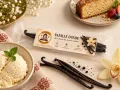
Karnataka Vanilla Beans
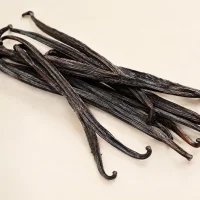
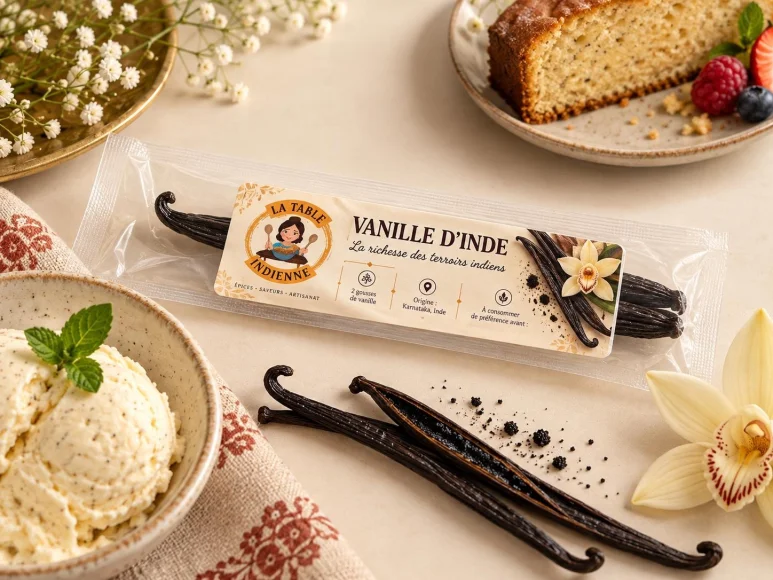
Discover our whole Karnataka vanilla beans, grown in the lush plantations of Karnataka, India. Intense, creamy, fruity and slightly woody aroma to elevate your desserts and warm beverages.
Ready for shipping, delivery time 3-21 business days
Delivery from €4.80 at Mondial Relay pickup points.
Free spice samples with every order.



-
Karnataka Vanilla Beans: India's most refined aroma
Karnataka vanilla is cultivated in the humid forests of southern India, where the tropical climate creates ideal conditions for developing exceptionally complex aromas. Our pods are carefully selected for their length, suppleness, and high natural vanillin content. Harvested at peak ripeness and dried using traditional methods, they deliver an intense, creamy, and slightly woody aromatic profile — far richer than any industrial extract.
Why choose whole pods?
Whole pods contain thousands of tiny seeds and natural essential oils that are released slowly with heat, offering an incomparable depth of flavour. Unlike extract or powder, the whole pod can be steeped at length in cream, milk, or syrup to draw out its full complexity. Used pods can be rinsed, dried, and buried in sugar to make a wonderful homemade vanilla sugar.
Culinary uses:
- Custards and ice cream: split the pod and scrape the seeds to flavour a crème anglaise or homemade vanilla ice cream
- Masala Chai: steep in warm milk with cardamom and ginger for a deeply fragrant, velvety spiced tea
- Kheer and Payasam: Indian rice or vermicelli puddings scented with vanilla and coconut milk
- Baked goods: cakes, financiers, and madeleines elevated by a pod steeped in butter or cream
- Homemade vanilla sugar: bury spent pods in caster sugar for 2 weeks for an incomparable result
- Homemade extract: steep 3-4 split pods in rum or vodka for 2 months for a pure natural vanilla extract
Origin and quality:
Our Karnataka vanilla beans are from the Vanilla planifolia variety, hand-harvested and traditionally dried to preserve their full aromatic character.
Storage:
To preserve all the aromas, store your vanilla beans in a dry place away from light and moisture, in the airtight packaging. Avoid the refrigerator, which dries the pods out. At a stable room temperature they keep for up to 2 years without losing their fragrance.
-
Rich in natural antioxidants
Promotes relaxation and reduces stress
Anti-inflammatory properties
Improves digestion
Boosts the immune system
Natural antibacterial properties
Helps regulate blood sugar
Elevates mood through vanillin
-
Nutritional declaration per 100g
Nutritional component Per 100g Energy 1 205 kJ / 288 kcal Fat ~ 60 mg of which saturated fat ~ 10 mg Carbohydrates ~ 12,7 g of which sugars ~ 12,7 g Dietary fiber ~ 0 mg Proteins ~ 60 mg Salt ~ 10 mg -
Directly selected smallholder producers Yes Pesticides free Yes Vegetarian Yes Origin Karnataka, India Quality Premium Type Whole pods Taste profile Intense and creamy aroma with fruity, slightly woody notes. Natural vanillin develops a warm, enveloping sweetness.
Learn more
Vanilla originates in Mexico, where the Totonac people of the Veracruz region were already cultivating the orchid Vanilla planifolia long before the arrival of Europeans, considering it a sacred gift. Conquered by the Aztecs in 1427, the Totonac were forced to pay their pods as tribute to the empire, which used them to flavour a cacao based drink, xocolatl.
In 1519, the Spanish conquistador Hernán Cortés encountered this drink at the court of Emperor Moctezuma and brought it back to Europe, where it became a luxury reserved for royal courts. Yet for more than three centuries vanilla remained a Mexican exclusive: transplanted elsewhere in the world, the orchid vine flowered readily but almost never fruited, for lack of its natural pollinator, a bee of the genus Melipona found only in Central America.
A 12 year old boy solves the puzzle
The solution came in 1841 on the island of Réunion, then called Bourbon, from the hands of a 12 year old enslaved boy, Edmond Albius. Having observed a technique used on squash, he developed a hand pollination method still used today: with a thin sliver, he lifted the membrane separating the flower's male and female organs and pressed the two together with his thumb and forefinger. Since each flower opens for a single day only, the operation must be repeated by hand, flower by flower, across the whole plantation.
This discovery opened vanilla growing to the rest of the world: Réunion, the Comoros and then Madagascar adopted the technique, and by the late 19th century Madagascar had become the world's leading producer, a rank it still holds today.
Did you know?
Edmond Albius, to whom the world owes its vanilla, was never compensated for his discovery and died in poverty a few decades later, largely forgotten by the history he had made possible.
Vanilla reaches India, then Karnataka
Vanilla was introduced to India as early as 1835 by the British, but for a long time it remained little more than a botanical garden curiosity. Only in the mid 1990s did Karnataka growers, hit by falling coffee and rubber prices, turn to this little known orchid as an alternative crop. A Vanilla Development Trust was founded in 1994 to organise the young industry.
The rise was sudden: in 2000, a cyclone devastated north eastern Madagascar, the world's main supplier. Since a vine takes three years to bear its first pods, Madagascar's harvests collapsed for several years, and vanilla prices climbed above 600 dollars a kilo by 2003. Thousands of Indian growers, many in Karnataka, planted heavily in response, pushing local production to its peak in 2007.
But from 2005 prices collapsed almost as fast as they had risen, falling back to around 40 dollars a kilo. Many discouraged growers tore out their vines. Only the most committed producers, often small holdings selling directly rather than through global brokers, kept up a demanding crop true to the traditional methods inherited from Réunion and Madagascar.
| Characteristic | Detail |
|---|---|
| Latin name | Vanilla planifolia |
| Botanical family | Orchidaceae, the only orchid grown anywhere for an edible fruit |
| Local name | Vanilla, also called Bourbon vanilla after its curing method |
| Part used | The pod, botanically a capsule, fermented then dried |
| Growing regions | Sirsi and the Malnad region, in Uttara Kannada, Karnataka |
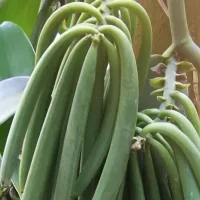
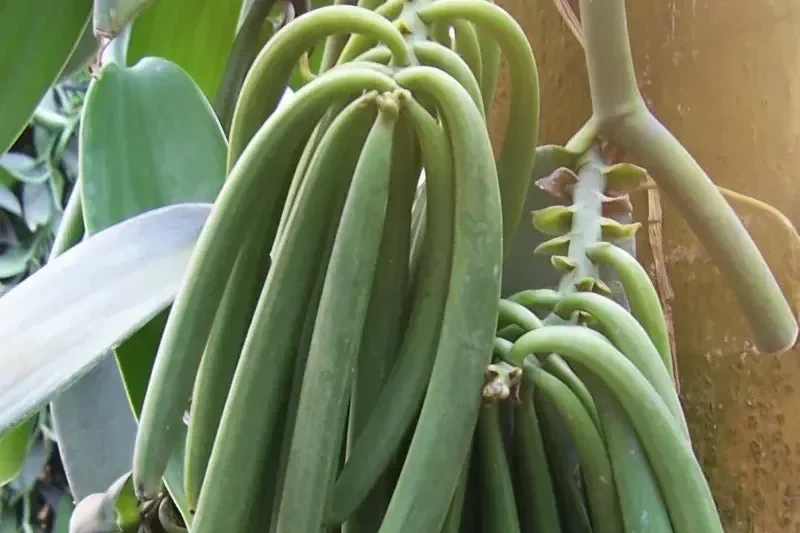
Vanilla grows on a climbing vine that can reach several metres in height, clinging to a living support, often a shade tree, by means of aerial roots. Its green, fleshy flower opens for a single morning only: once that window closes, it wilts without ever being fertilised. Outside Mexico, where a wild bee provides rare natural pollination, every flower must be pollinated by hand, one at a time, within hours of opening.
A demanding crop, kept alive by small growers
- Harvested roughly nine months after each flower is hand pollinated
- Green and practically odourless at picking: its scent develops entirely during curing
- Grown as an intercrop in the shade of trees or coffee plantations, a traditional Malnad practice
- Today kept going by a small number of committed growers, after many left the crop following the 2005 price crash
Did you know?
The hand pollination gesture invented by Edmond Albius in 1841 on Réunion is, to this day, exactly what Karnataka growers repeat every morning, flower by flower, along entire rows of vines.
Vanilla's aroma owes much to vanillin, its main aromatic compound, but a properly cured pod develops more than two hundred others, responsible for its complexity: creamy, woody, sometimes faintly smoky or spicy notes, far beyond the flat, sweet scent of synthetic vanillin alone.
A scent built during curing
The freshly picked pod is green and virtually odourless: it is curing, a repeated cycle of scalding, sun "sweating" and slow drying, that activates the enzymes responsible for its aromatic transformation. The more carefully this process is carried out, the wider the range of flavours the pod develops.
The finest pods can develop a thin, crystalline white coating known as "frost", made of pure crystallised vanillin on the surface: a mark prized by connoisseurs, never to be confused with mould.
Did you know?
Synthetic vanillin, first isolated in 1874 by the German chemists Tiemann and Haarmann from coniferin extracted from pine bark, reproduces only one of the more than two hundred aromatic molecules found in a naturally cured vanilla pod, which explains why artificial aroma feels so much flatter than a real pod.
The four stages of curing
- Scalding: the green pod, picked just before ripening, is dipped for a few seconds in water at around 80°C, several times over. This thermal shock halts plant growth and triggers the enzymatic reactions responsible for the aroma.
- Sweating: the scalded pods are wrapped in wool blankets, left in the sun for a few hours, then sealed overnight in sweating boxes between 45 and 65°C. Most aromatic compounds form at this stage.
- Drying: the pods are then spread out in the sun, then in the shade, for several weeks, until they lose two-thirds of their original weight.
- Conditioning: stored in closed trunks, the pods complete their maturing over roughly three more months, developing their final aromatic bouquet.
From field to the black, pliable pod ready for use, the full curing process takes five to eight months under the Bourbon method, inherited from Réunion and Madagascar and still followed in Karnataka today.
In the kitchen, the whole pod is far more versatile than a simple sweet flavouring: split lengthwise, it releases thousands of tiny black seeds, the most fragrant part, while the pod itself keeps flavouring a preparation left to infuse.
How to use it
- Split the pod lengthwise and scrape the inside with the tip of a knife to extract the seeds, to add directly to a custard, a flan or a cake batter
- Infuse the whole pod, scraped or not, in hot milk or cream for at least twenty minutes before straining
- Reuse the pod once infused: rinsed and dried, it will keep flavouring a jar of sugar for several weeks
- A classic pairing in Indian desserts alongside cardamom and saffron, in a kheer or a phirni
Did you know?
A single vanilla pod can flavour several preparations in succession if it is rinsed and dried between uses: nothing goes to waste, not even a pod already infused once, which keeps releasing aroma long after its first use.
Beyond the sweet side
Less known in the West, vanilla also has a place in savoury cooking: some chefs use a small amount to round out a butter sauce, a seafood dish or a marinade, where its aromatic depth balances the acidity or heat of other ingredients.
Grade A or Grade B: two uses, not a hierarchy
In international trade, vanilla pods fall into two broad categories. Grade A pods, moister (30% moisture or more), supple and glossy, give up their aroma easily and are simple to work with in cooking. Grade B pods, drier (15 to 25% moisture), concentrate more vanillin per gram and are mainly sought for making homemade extract, where they steep for a long time in alcohol: this is not a sign of lower quality, just a different use.
The most famous pairing between vanilla and savoury cooking is probably lobster with vanilla, a classic of French haute cuisine for decades: the sweetness of the meat and the delicate aroma of vanilla answer each other in a butter sauce or a reduced stock.
A more Western spice than an Indian one
Unlike turmeric or cardamom, vanilla is not part of the traditional Indian pastry repertoire: kulfi has historically been flavoured with cardamom, saffron or rose water, never with vanilla originally. Today it appears mainly in contemporary fusion creations, vanilla-scented kulfi or Indian-inspired vanilla sponge, rather than in an age-old recipe.
Vanilla is prized above all for its aroma rather than for proven medicinal properties: no health claim can be made about simply eating the pod in cooking.
What is known about its composition
- Vanillin: the main aromatic compound, the subject of preliminary research into antioxidant properties, without a level of clinical evidence sufficient for a health claim
- More than 200 aromatic compounds: developed during curing, responsible for the olfactory complexity unique to natural vanilla, absent from synthetic vanillin
- Traditional use: long used for its soothing scent in popular aromatherapy, without scientific validation equivalent to a therapeutic use
Precautions
Eaten in normal culinary amounts, vanilla is well tolerated. People allergic to Peru balsam or other closely related aromatic compounds should remain cautious and seek advice from a healthcare professional if in doubt.
Real vanilla versus industrial vanillin
Less than one percent of the vanilla flavouring sold worldwide actually comes from a vanilla pod: out of the 16,000 to 18,000 tonnes of vanilla flavouring produced each year, only about 40 tonnes are extracted from real pods. The rest is synthetic vanillin, made today 80-85% from guaiacol, a petrochemical precursor, and the remainder from lignin, a paper-industry byproduct used industrially since the 1930s.
This guaiacol synthesis route was discovered by German chemist Karl Reimer in 1876, two years after Tiemann and Haarmann's first synthesis of vanillin from pine bark. The pure petrochemical process, which became widespread in the 1970s, now supplies the vast majority of the vanillin consumed worldwide.
Quality criteria
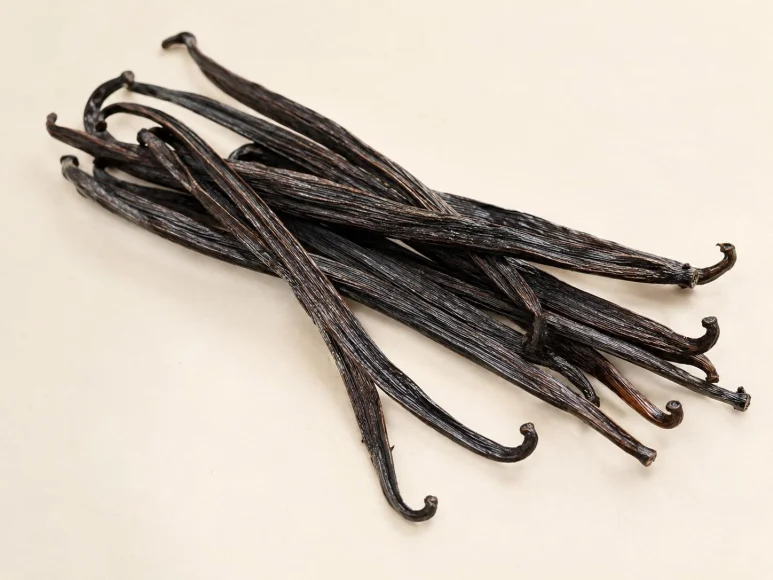
- Suppleness: a good quality pod should be supple and slightly oily to the touch, never brittle or dry
- Colour: deep brown to near black, even along its whole length
- Frost: a thin, crystalline white coating on the surface is a sign of quality, not a flaw
Storage tips
- Wrap in parchment paper, then place in an airtight container away from light
- Avoid the fridge, which dries the pod out: a cool, dark cupboard is enough
- Shelf life: one to two years if kept well wrapped and airtight
A pod that dries out slightly over time is not lost: rehydrate it for a few minutes in a warm liquid before using it.
What is the difference between Karnataka vanilla and Madagascar vanilla?
Both belong to the same species, Vanilla planifolia, and are cured using the same method known as Bourbon curing. The difference lies mainly in terroir and scale: Karnataka is a much younger, smaller growing region led by small producers, while Madagascar remains by far the world's leading supplier.
Why is vanilla so expensive?
Every flower must be hand pollinated within hours of opening, since there is no natural pollinator outside Mexico. The pod then takes about nine months to ripen, followed by several months of careful curing to reveal its aroma: a considerable amount of manual work for a limited yield.
How do I use a whole vanilla pod?
Split it lengthwise and scrape the inside with the tip of a knife to collect the seeds, to add directly to a preparation. The pod itself can then be infused in hot milk or cream, then rinsed and reused.
What is the white "frost" on a vanilla pod?
A thin, crystalline white coating that can appear on the surface of the very finest pods, made of pure vanillin. It is a mark prized by connoisseurs, never to be mistaken for mould.
Who invented hand pollination of vanilla?
Edmond Albius, a 12 year old enslaved boy on the island of Réunion, developed this technique in 1841. His method, which involves manually pressing the flower's organs together, is still used today everywhere outside Mexico.
How should I store a vanilla pod?
Wrap it in parchment paper, then place it in an airtight container away from light and heat, without refrigerating it. Properly stored, it keeps its aroma for one to two years.
Can I reuse a vanilla pod that has already been infused?
Yes: rinse it, dry it, then slip it into a jar of sugar, which it will flavour for several weeks, or infuse it a second time for a lighter flavour.
-
Vanilla originates in Mexico, where the Totonac people of the Veracruz region were already cultivating the orchid Vanilla planifolia long before the arrival of Europeans, considering it a sacred gift. Conquered by the Aztecs in 1427, the Totonac were forced to pay their pods as tribute to the empire, which used them to flavour a cacao based drink, xocolatl.
In 1519, the Spanish conquistador Hernán Cortés encountered this drink at the court of Emperor Moctezuma and brought it back to Europe, where it became a luxury reserved for royal courts. Yet for more than three centuries vanilla remained a Mexican exclusive: transplanted elsewhere in the world, the orchid vine flowered readily but almost never fruited, for lack of its natural pollinator, a bee of the genus Melipona found only in Central America.
A 12 year old boy solves the puzzle
The solution came in 1841 on the island of Réunion, then called Bourbon, from the hands of a 12 year old enslaved boy, Edmond Albius. Having observed a technique used on squash, he developed a hand pollination method still used today: with a thin sliver, he lifted the membrane separating the flower's male and female organs and pressed the two together with his thumb and forefinger. Since each flower opens for a single day only, the operation must be repeated by hand, flower by flower, across the whole plantation.
This discovery opened vanilla growing to the rest of the world: Réunion, the Comoros and then Madagascar adopted the technique, and by the late 19th century Madagascar had become the world's leading producer, a rank it still holds today.
Did you know?
Edmond Albius, to whom the world owes its vanilla, was never compensated for his discovery and died in poverty a few decades later, largely forgotten by the history he had made possible.
Vanilla reaches India, then Karnataka
Vanilla was introduced to India as early as 1835 by the British, but for a long time it remained little more than a botanical garden curiosity. Only in the mid 1990s did Karnataka growers, hit by falling coffee and rubber prices, turn to this little known orchid as an alternative crop. A Vanilla Development Trust was founded in 1994 to organise the young industry.
The rise was sudden: in 2000, a cyclone devastated north eastern Madagascar, the world's main supplier. Since a vine takes three years to bear its first pods, Madagascar's harvests collapsed for several years, and vanilla prices climbed above 600 dollars a kilo by 2003. Thousands of Indian growers, many in Karnataka, planted heavily in response, pushing local production to its peak in 2007.
But from 2005 prices collapsed almost as fast as they had risen, falling back to around 40 dollars a kilo. Many discouraged growers tore out their vines. Only the most committed producers, often small holdings selling directly rather than through global brokers, kept up a demanding crop true to the traditional methods inherited from Réunion and Madagascar.
-
Characteristic Detail Latin name Vanilla planifolia Botanical family Orchidaceae, the only orchid grown anywhere for an edible fruit Local name Vanilla, also called Bourbon vanilla after its curing method Part used The pod, botanically a capsule, fermented then dried Growing regions Sirsi and the Malnad region, in Uttara Kannada, Karnataka Vanilla grows on a climbing vine that can reach several metres in height, clinging to a living support, often a shade tree, by means of aerial roots. Its green, fleshy flower opens for a single morning only: once that window closes, it wilts without ever being fertilised. Outside Mexico, where a wild bee provides rare natural pollination, every flower must be pollinated by hand, one at a time, within hours of opening.
A demanding crop, kept alive by small growers
- Harvested roughly nine months after each flower is hand pollinated
- Green and practically odourless at picking: its scent develops entirely during curing
- Grown as an intercrop in the shade of trees or coffee plantations, a traditional Malnad practice
- Today kept going by a small number of committed growers, after many left the crop following the 2005 price crash
Did you know?
The hand pollination gesture invented by Edmond Albius in 1841 on Réunion is, to this day, exactly what Karnataka growers repeat every morning, flower by flower, along entire rows of vines.
-
Vanilla's aroma owes much to vanillin, its main aromatic compound, but a properly cured pod develops more than two hundred others, responsible for its complexity: creamy, woody, sometimes faintly smoky or spicy notes, far beyond the flat, sweet scent of synthetic vanillin alone.
A scent built during curing
The freshly picked pod is green and virtually odourless: it is curing, a repeated cycle of scalding, sun "sweating" and slow drying, that activates the enzymes responsible for its aromatic transformation. The more carefully this process is carried out, the wider the range of flavours the pod develops.
The finest pods can develop a thin, crystalline white coating known as "frost", made of pure crystallised vanillin on the surface: a mark prized by connoisseurs, never to be confused with mould.
Did you know?
Synthetic vanillin, first isolated in 1874 by the German chemists Tiemann and Haarmann from coniferin extracted from pine bark, reproduces only one of the more than two hundred aromatic molecules found in a naturally cured vanilla pod, which explains why artificial aroma feels so much flatter than a real pod.
The four stages of curing
- Scalding: the green pod, picked just before ripening, is dipped for a few seconds in water at around 80°C, several times over. This thermal shock halts plant growth and triggers the enzymatic reactions responsible for the aroma.
- Sweating: the scalded pods are wrapped in wool blankets, left in the sun for a few hours, then sealed overnight in sweating boxes between 45 and 65°C. Most aromatic compounds form at this stage.
- Drying: the pods are then spread out in the sun, then in the shade, for several weeks, until they lose two-thirds of their original weight.
- Conditioning: stored in closed trunks, the pods complete their maturing over roughly three more months, developing their final aromatic bouquet.
From field to the black, pliable pod ready for use, the full curing process takes five to eight months under the Bourbon method, inherited from Réunion and Madagascar and still followed in Karnataka today.
-
In the kitchen, the whole pod is far more versatile than a simple sweet flavouring: split lengthwise, it releases thousands of tiny black seeds, the most fragrant part, while the pod itself keeps flavouring a preparation left to infuse.
How to use it
- Split the pod lengthwise and scrape the inside with the tip of a knife to extract the seeds, to add directly to a custard, a flan or a cake batter
- Infuse the whole pod, scraped or not, in hot milk or cream for at least twenty minutes before straining
- Reuse the pod once infused: rinsed and dried, it will keep flavouring a jar of sugar for several weeks
- A classic pairing in Indian desserts alongside cardamom and saffron, in a kheer or a phirni
Did you know?
A single vanilla pod can flavour several preparations in succession if it is rinsed and dried between uses: nothing goes to waste, not even a pod already infused once, which keeps releasing aroma long after its first use.
Beyond the sweet side
Less known in the West, vanilla also has a place in savoury cooking: some chefs use a small amount to round out a butter sauce, a seafood dish or a marinade, where its aromatic depth balances the acidity or heat of other ingredients.
Grade A or Grade B: two uses, not a hierarchy
In international trade, vanilla pods fall into two broad categories. Grade A pods, moister (30% moisture or more), supple and glossy, give up their aroma easily and are simple to work with in cooking. Grade B pods, drier (15 to 25% moisture), concentrate more vanillin per gram and are mainly sought for making homemade extract, where they steep for a long time in alcohol: this is not a sign of lower quality, just a different use.
The most famous pairing between vanilla and savoury cooking is probably lobster with vanilla, a classic of French haute cuisine for decades: the sweetness of the meat and the delicate aroma of vanilla answer each other in a butter sauce or a reduced stock.
A more Western spice than an Indian one
Unlike turmeric or cardamom, vanilla is not part of the traditional Indian pastry repertoire: kulfi has historically been flavoured with cardamom, saffron or rose water, never with vanilla originally. Today it appears mainly in contemporary fusion creations, vanilla-scented kulfi or Indian-inspired vanilla sponge, rather than in an age-old recipe.
-
Vanilla is prized above all for its aroma rather than for proven medicinal properties: no health claim can be made about simply eating the pod in cooking.
What is known about its composition
- Vanillin: the main aromatic compound, the subject of preliminary research into antioxidant properties, without a level of clinical evidence sufficient for a health claim
- More than 200 aromatic compounds: developed during curing, responsible for the olfactory complexity unique to natural vanilla, absent from synthetic vanillin
- Traditional use: long used for its soothing scent in popular aromatherapy, without scientific validation equivalent to a therapeutic use
Precautions
Eaten in normal culinary amounts, vanilla is well tolerated. People allergic to Peru balsam or other closely related aromatic compounds should remain cautious and seek advice from a healthcare professional if in doubt.
Real vanilla versus industrial vanillin
Less than one percent of the vanilla flavouring sold worldwide actually comes from a vanilla pod: out of the 16,000 to 18,000 tonnes of vanilla flavouring produced each year, only about 40 tonnes are extracted from real pods. The rest is synthetic vanillin, made today 80-85% from guaiacol, a petrochemical precursor, and the remainder from lignin, a paper-industry byproduct used industrially since the 1930s.
This guaiacol synthesis route was discovered by German chemist Karl Reimer in 1876, two years after Tiemann and Haarmann's first synthesis of vanillin from pine bark. The pure petrochemical process, which became widespread in the 1970s, now supplies the vast majority of the vanillin consumed worldwide.
-
Quality criteria
- Suppleness: a good quality pod should be supple and slightly oily to the touch, never brittle or dry
- Colour: deep brown to near black, even along its whole length
- Frost: a thin, crystalline white coating on the surface is a sign of quality, not a flaw
Storage tips
- Wrap in parchment paper, then place in an airtight container away from light
- Avoid the fridge, which dries the pod out: a cool, dark cupboard is enough
- Shelf life: one to two years if kept well wrapped and airtight
A pod that dries out slightly over time is not lost: rehydrate it for a few minutes in a warm liquid before using it.
-
What is the difference between Karnataka vanilla and Madagascar vanilla?
Both belong to the same species, Vanilla planifolia, and are cured using the same method known as Bourbon curing. The difference lies mainly in terroir and scale: Karnataka is a much younger, smaller growing region led by small producers, while Madagascar remains by far the world's leading supplier.
Why is vanilla so expensive?
Every flower must be hand pollinated within hours of opening, since there is no natural pollinator outside Mexico. The pod then takes about nine months to ripen, followed by several months of careful curing to reveal its aroma: a considerable amount of manual work for a limited yield.
How do I use a whole vanilla pod?
Split it lengthwise and scrape the inside with the tip of a knife to collect the seeds, to add directly to a preparation. The pod itself can then be infused in hot milk or cream, then rinsed and reused.
What is the white "frost" on a vanilla pod?
A thin, crystalline white coating that can appear on the surface of the very finest pods, made of pure vanillin. It is a mark prized by connoisseurs, never to be mistaken for mould.
Who invented hand pollination of vanilla?
Edmond Albius, a 12 year old enslaved boy on the island of Réunion, developed this technique in 1841. His method, which involves manually pressing the flower's organs together, is still used today everywhere outside Mexico.
How should I store a vanilla pod?
Wrap it in parchment paper, then place it in an airtight container away from light and heat, without refrigerating it. Properly stored, it keeps its aroma for one to two years.
Can I reuse a vanilla pod that has already been infused?
Yes: rinse it, dry it, then slip it into a jar of sugar, which it will flavour for several weeks, or infuse it a second time for a lighter flavour.
Why choose Karnataka Vanilla Beans from La Table Indienne?

Exceptional freshness and quality
Our spices are imported directly from India and packaged on demand to guarantee optimal freshness. Unlike spices sold in supermarkets that can sit on shelves for months, we ensure each spice retains its full flavor and aroma.
Authenticity and traceability
Each spice comes from specific regions in India renowned for their expertise. We work directly with local producers who grow their spices traditionally, without pesticides or chemicals.
How to best use this spice?
To reveal all the aromas, we recommend lightly toasting whole spices in a dry pan before grinding them. Store them in a dry place away from light to preserve their freshness as long as possible.

Did you know?
Whole spices are much better than ground spices
Check out our blog article to discover why whole spices retain their aromas better.
Questions & Answers
Thank you! Your question has been sent. Mihika will answer soon and you will receive an email.
Karnataka Vanilla Beans
Discover also
Other products you might like