Butterfly Pea Flower
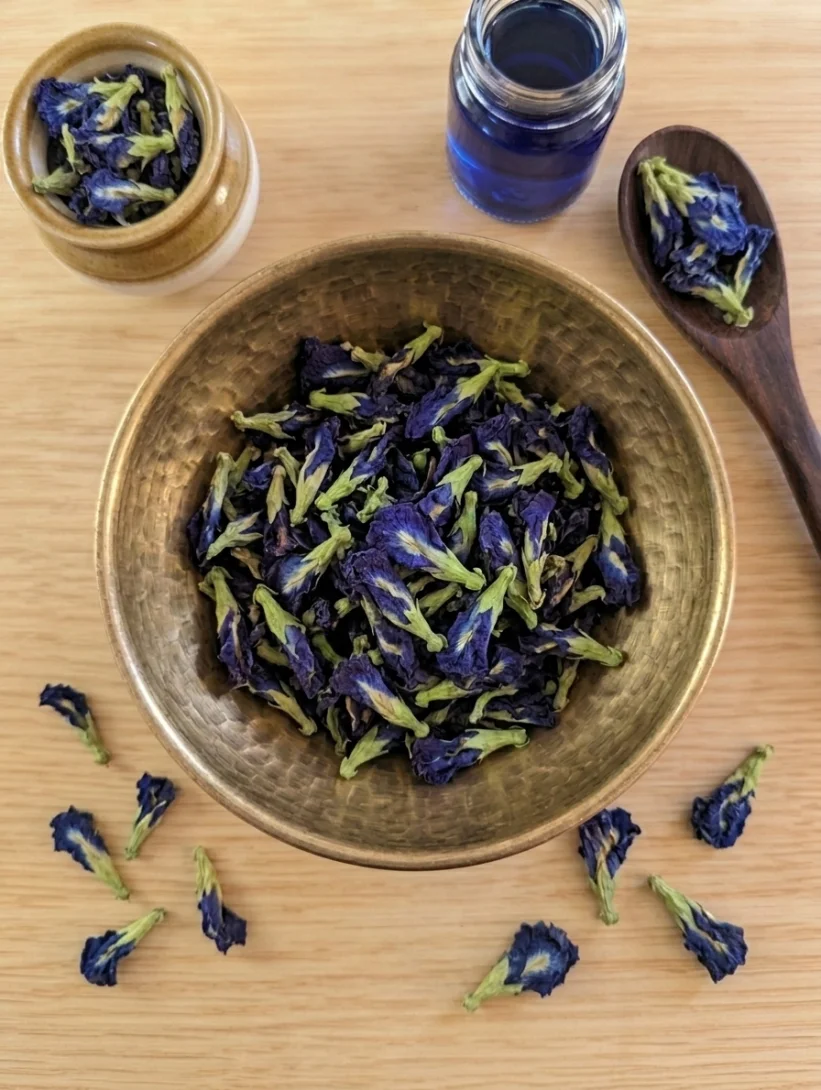
Discover our dried butterfly pea flowers (Aparajita), harvested in the tropical regions of India and Southeast Asia. A fascinating natural colourant that changes colour — steep for a deep blue that turns purple with a drop of lemon.
Ready for shipping, delivery time 2-5 business days
Delivery from €4.80 at Mondial Relay pickup points. Free shipping from €50.
Free spice samples with every order.
-
Butterfly Pea Flower (Aparajita): the magic of natural blue
The butterfly pea flower (Clitoria ternatea L., Fabaceae), known as Aparajita in India, is a climbing plant with deep blue flowers used for centuries in Ayurvedic medicine and Southeast Asian cuisine. We source these dried flowers from India to guarantee a premium-quality product, rich in anthocyanins and free from artificial additives.
Why choose dried flowers?
Dried flowers concentrate natural pigments and antioxidants at their peak. They offer a spectacular visual effect thanks to their colour-changing property: the intense blue turns purple or pink on contact with an acid (lemon juice, hibiscus). This natural reaction, due to anthocyanins, is entirely additive-free and without artificial colouring. An ingredient as beautiful as it is useful, for drinks and baking alike.
Culinary uses:
- Hot or cold blue infusion — serve plain or with a slice of lemon for the purple effect
- Colourful cocktails and mocktails — ideal base for Instagram-worthy alcohol-free drinks
- Natural colouring for rice, pasta and bread — replaces artificial food colouring
- Creative baking — icings, macarons and creams in natural blue shades
- Floral hot latte — blend with plant-based milk and a touch of honey for a blue golden milk
- Yoghurt and frozen desserts — a spectacular natural colour with no additives whatsoever
Origin and quality:
We source our flowers from India, selected for their premium quality.
Storage:
To preserve all its colour and aroma, store your butterfly pea flowers in a dry place, away from light and humidity, in their airtight packaging.
-
Powerful natural antioxidant thanks to anthocyanins
Supports cognitive function and memory
Rich in protective anthocyanins
Promotes eye health
Natural anti-inflammatory properties
Calming and adaptogenic properties
Supports hair and skin health
Naturally caffeine-free, ideal in the evening
-
Nutritional declaration per 100g
Nutritional component Per 100g Energy 1 172 kJ / 280 kcal Fat ~ 2 g of which saturated fat ~ 500 mg Carbohydrates ~ 55 g of which sugars ~ 3 g Dietary fiber ~ 12 g Proteins ~ 18 g Salt ~ 50 mg -
Directly selected smallholder producers Yes Vegetarian Yes Origin India and Southeast Asia Quality Premium Type Dried flowers Taste profile Very mild and slightly earthy taste, almost neutral. The primary appeal is visual and nutritional: the vivid blue colour shifts spectacularly to purple or pink on contact with an acid, thanks to the flower's anthocyanins. Composition 100% dried butterfly pea flowers (Clitoria ternatea L.)
Learn more
The exact geographic origin of butterfly pea flower is still debated among botanists. Many place its cradle in Southeast Asia, around the Indonesian Moluccas, while others point to an older origin in tropical Africa, the plant having naturalised so widely across the tropics over the centuries that it is now difficult to say with certainty. What is certain is that the climbing plant became established in India many centuries ago, where it has since held a culinary, ornamental and spiritual place.
A flower named after the spice islands
The botanical name Clitoria ternatea was fixed in the 18th century by the Swedish naturalist Carl von Linné (Linnaeus), based on specimens from the island of Ternate, in the Moluccas archipelago, in present day Indonesia. This small volcanic island is none other than one of the historic cradles of the spice trade: almost all the clove sold in Europe until the 18th century came from Ternate and its neighbour Tidore, before Dutch colonists spread its cultivation elsewhere in Asia to break this monopoly.
Did you know?
Butterfly pea flower owes its Latin name to an island Table Indienne knows well through a completely different route: Ternate and its neighbour Tidore were, for centuries, the only places on earth where the clove tree grew, before the Dutch broke this monopoly in the 18th century. The blue flower and the clove thus share, with no direct botanical link, the very same geographic origin.
A memory tonic in Ayurvedic texts
In India, butterfly pea flower carries the Sanskrit name Aparajita, literally "she who cannot be defeated" or "the unconquered one". Mentions of the plant under this name appear in foundational Ayurvedic texts such as the Charaka Samhita and the Sushruta Samhita, where its roots, seeds and leaves are classed among the Medhya Rasayana, a category of rejuvenating plants said to support memory and mental faculties. This reputation as a brain tonic has carried through the centuries and remains, to this day, one of the traditional uses most associated with the plant across the Indian subcontinent.
The flower of the unconquered goddess
The name Aparajita is not only that of the plant: it is also one of the names of the goddess Durga herself, in her unconquered form. In Bengal, tradition holds that the last day of the Durga Puja festival, called Vijaya Dashami, opens with a ritual named Aparajita Puja: armbands woven from the plant's leaves are offered to the goddess and then worn by devotees, in the belief that they protect health, prosperity and success for the year ahead.
Did you know?
Wearing Aparajita leaves on Vijaya Dashami, the last day of the Durga Puja festival in Bengal, is a ritual that lends its name to the plant itself: Aparajita, "the unconquered one", is also one of the names of the goddess Durga. The very same flower thus carries, depending on the context, a botanical name inspired by an Indonesian spice island and a Sanskrit name inspired by a Hindu goddess.
From India to Southeast Asia, then to the world
Through trade, butterfly pea flower spread across Southeast Asia, where it became a culinary ingredient in its own right. In Thailand, it is called dok anchan, and its petals are steeped to prepare nam dok anchan, a herbal tea traditionally served after meals or before bedtime. In Malaysia and Singapore, where it is known as bunga telang, it colours the rice of nasi kerabu blue, along with several Peranakan pastries known as kueh. It was only more recently, driven by social media in the mid 2010s, that "blue tea" conquered Western cafés and bars, rediscovered for its spectacular visual effect rather than for its original Ayurvedic properties.
| Characteristic | Detail |
|---|---|
| Latin name | Clitoria ternatea L. |
| Botanical family | Fabaceae (Legumes), the same family as tamarind and chickpea |
| Local names | Aparajita (Hindi, Bengali), Sangu pushpam (Tamil), Dok anchan (Thai), Bunga telang (Malay) |
| Part used | Whole flowers, picked fresh then dried |
| Main producing regions in India | Kerala, Tamil Nadu, West Bengal |
| Other growing regions | Thailand, Malaysia, Indonesia, widely naturalised across the tropics |
The plant is a fast growing, perennial climbing vine that clings by its tendrils to fences, trellises and hedges in tropical gardens. It thrives in a warm, humid climate, well drained soil and a sunny position, and flowers almost continuously once established, which also makes it a widely grown ornamental plant well beyond its culinary use.
Botany
- Foliage: compound, imparipinnate, with five to seven small oval leaflets
- Flowers: fan shaped, an intense violet blue, often marked with a white or pale yellow patch at the throat; double flowered and pure white varieties also exist, though rarer
- Pods: thin, flat and elongated, containing the plant's seeds; they are not used in cooking
- Root system: deep, which contributes to the plant's good tolerance of dry spells once well established
- Flowering: near continuous in a tropical climate, allowing several successive harvests from the same plant
From fresh flower to dried flower
- Flowers are picked by hand, early in the morning, just as they have opened and concentrate the most pigment
- They are then dried in the shade, away from direct sun, to best preserve their blue colour and antioxidant compounds
- Unlike many edible flowers sold as a powder, they are offered whole, which limits oxidation and lets you check their quality visually before use
Unlike most spices in this collection, butterfly pea flower is not prized for its taste but for its colour. Its aromatic profile is deliberately discreet: a lightly vegetal, grassy flavour, close to a very light green tea, with no marked bitterness and entirely free of caffeine.
A natural pH indicator
The flower's characteristic blue colour comes from a family of pigments called ternatins, delphinidin based anthocyanins, the very same pigment family found in blueberries or red cabbage. These molecules change colour depending on the acidity of the liquid they are in: in a neutral or slightly alkaline medium, such as tap water, they give a deep blue; on contact with an acid, such as lemon juice, vinegar or the natural acidity of hibiscus, they turn purple then pink, depending on how much acid is added.
Did you know?
The very same chemistry that turns a blue tea into a purple cocktail before your eyes is also used, on a scientific scale, as a natural pH indicator in some classroom experiments: a few drops of lemon in a butterfly pea flower infusion reproduce, in a cup, the same colour shift as litmus paper in a chemistry lesson.
What tasting reveals
| Stage | What you observe |
|---|---|
| Plain infusion | Deep blue, an almost neutral, barely vegetal flavour |
| With a touch of lemon | A gradual shift to purple then pink depending on the amount added |
| With honey or sugar | No effect on colour, only on sweetness |
| Steeped in milk | A more pastel blue, the classic base of the "blue latte" |
Chef's Tip
Steep 5 to 6 dried flowers in 250 ml of hot, not boiling, water for 5 to 10 minutes: the longer the infusion, the deeper the blue. Add the lemon only when serving, to enjoy the colour shift in front of your guests rather than in the teapot.
Butterfly pea flower lends itself, first and foremost, to any preparation where colour steals the show, even before flavour.
As an infusion and drink
- Hot or cold blue tea, plain or lifted with a slice of lemon for the purple effect
- Nam dok anchan, the Thai herbal tea traditionally sweetened with palm sugar and served after meals
- Cocktails and mocktails that change colour live in front of your guests
- A warm floral latte, blended with plant based milk, a touch of honey and, for the curious, a crushed pod of green cardamom
In Southeast Asian cooking
- The blue rice of nasi kerabu, a Malaysian speciality where rice is coloured with the flower before being served with dried fish or fried chicken
- Kueh and pastries of Peranakan cuisine, where the flower's extract gives its blue tinge to several glutinous rice preparations
In creative baking
- Icings, macarons and creams in natural blue or purple shades, with no artificial colouring
- Yoghurts and frozen desserts, where a few steeped flowers are enough for a spectacular colour
Did you know?
In Thailand, it is not unusual for beachside hotels to greet guests with a glass of chilled nam dok anchan, sometimes lifted with lemongrass, as a welcome drink: butterfly pea flower is as much a gesture of hospitality there as it is a cooking ingredient.
In traditional Ayurvedic medicine, butterfly pea flower is classed among the Medhya Rasayana, a category of rejuvenating plants said to support memory and mental clarity, a use that dates back to the foundational texts of Ayurveda.
What we know about its composition
- Ternatins: a family of delphinidin based anthocyanins responsible for the blue colour, studied for their antioxidant properties
- Kaempferol: a flavonoid compound also present in the flower, studied for its antioxidant properties
- No caffeine: unlike green or black tea, a butterfly pea flower infusion contains none whatsoever
- Few vitamins or minerals: the dried flower is valued mainly for its antioxidant compounds rather than for any nutritional content
Did you know?
A study published in 2018 found that a drink made with butterfly pea flower extract increased certain antioxidant markers and reduced blood sugar and insulin levels after a sugary meal, in a small group of volunteers, despite the drink tested containing sugar. Encouraging preliminary results, which still need confirming in larger studies.
Precautions
Consumed in ordinary culinary amounts, butterfly pea flower is well tolerated. As with any plant used for traditional purposes, seek advice from a healthcare professional if pregnant, breastfeeding, or undergoing medical treatment.
Quality criteria
- Colour: a deep, even violet blue, never dull, brownish or faded
- Integrity: whole flowers rather than powder or fragments, a sign of freshness and colouring power
- Smell: almost neutral, lightly vegetal, with no musty odour
Storage tips
- In an airtight container, away from light, air and humidity, which speed up colour loss
- At room temperature, in a dry cupboard rather than the fridge, where ambient humidity can dull the flowers
- Shelf life: several months when stored well; a gradually fading colour signals a flower that is too old or poorly stored
How do you prepare a blue butterfly pea flower infusion?
Steep 5 to 6 dried flowers in 250 ml of hot, not boiling, water for 5 to 10 minutes, then strain. Add a slice of lemon just before serving to see the colour shift to purple.
Why does butterfly pea flower change colour with lemon?
Its blue colour comes from anthocyanins called ternatins, which are sensitive to acidity: in a neutral medium they give a deep blue, while on contact with an acid such as lemon they turn purple then pink.
Does butterfly pea flower contain caffeine?
No, unlike green or black tea, a butterfly pea flower infusion is entirely caffeine free, which makes it a suitable drink in the evening.
Can you eat the flowers after infusing them?
Yes, they are edible, but their texture becomes quite fibrous once infused and their flavour stays neutral; they mainly serve as a visual marker, and most preparations strain them out before serving.
What is the difference between butterfly pea flower and hibiscus for colouring a drink?
Hibiscus gives a reddish pink shade and a pronounced tartness as soon as it is infused, while butterfly pea flower gives a neutral tasting blue that only turns pink or purple once an acid such as lemon is added.
How should I store butterfly pea flower once the pack is opened?
Store it in an airtight container, away from light and humidity, in a dry cupboard. Kept well, it retains its colour for several months.

-
The exact geographic origin of butterfly pea flower is still debated among botanists. Many place its cradle in Southeast Asia, around the Indonesian Moluccas, while others point to an older origin in tropical Africa, the plant having naturalised so widely across the tropics over the centuries that it is now difficult to say with certainty. What is certain is that the climbing plant became established in India many centuries ago, where it has since held a culinary, ornamental and spiritual place.
A flower named after the spice islands
The botanical name Clitoria ternatea was fixed in the 18th century by the Swedish naturalist Carl von Linné (Linnaeus), based on specimens from the island of Ternate, in the Moluccas archipelago, in present day Indonesia. This small volcanic island is none other than one of the historic cradles of the spice trade: almost all the clove sold in Europe until the 18th century came from Ternate and its neighbour Tidore, before Dutch colonists spread its cultivation elsewhere in Asia to break this monopoly.
Did you know?
Butterfly pea flower owes its Latin name to an island Table Indienne knows well through a completely different route: Ternate and its neighbour Tidore were, for centuries, the only places on earth where the clove tree grew, before the Dutch broke this monopoly in the 18th century. The blue flower and the clove thus share, with no direct botanical link, the very same geographic origin.
A memory tonic in Ayurvedic texts
In India, butterfly pea flower carries the Sanskrit name Aparajita, literally "she who cannot be defeated" or "the unconquered one". Mentions of the plant under this name appear in foundational Ayurvedic texts such as the Charaka Samhita and the Sushruta Samhita, where its roots, seeds and leaves are classed among the Medhya Rasayana, a category of rejuvenating plants said to support memory and mental faculties. This reputation as a brain tonic has carried through the centuries and remains, to this day, one of the traditional uses most associated with the plant across the Indian subcontinent.
The flower of the unconquered goddess
The name Aparajita is not only that of the plant: it is also one of the names of the goddess Durga herself, in her unconquered form. In Bengal, tradition holds that the last day of the Durga Puja festival, called Vijaya Dashami, opens with a ritual named Aparajita Puja: armbands woven from the plant's leaves are offered to the goddess and then worn by devotees, in the belief that they protect health, prosperity and success for the year ahead.
Did you know?
Wearing Aparajita leaves on Vijaya Dashami, the last day of the Durga Puja festival in Bengal, is a ritual that lends its name to the plant itself: Aparajita, "the unconquered one", is also one of the names of the goddess Durga. The very same flower thus carries, depending on the context, a botanical name inspired by an Indonesian spice island and a Sanskrit name inspired by a Hindu goddess.
From India to Southeast Asia, then to the world
Through trade, butterfly pea flower spread across Southeast Asia, where it became a culinary ingredient in its own right. In Thailand, it is called dok anchan, and its petals are steeped to prepare nam dok anchan, a herbal tea traditionally served after meals or before bedtime. In Malaysia and Singapore, where it is known as bunga telang, it colours the rice of nasi kerabu blue, along with several Peranakan pastries known as kueh. It was only more recently, driven by social media in the mid 2010s, that "blue tea" conquered Western cafés and bars, rediscovered for its spectacular visual effect rather than for its original Ayurvedic properties.
-
Characteristic Detail Latin name Clitoria ternatea L. Botanical family Fabaceae (Legumes), the same family as tamarind and chickpea Local names Aparajita (Hindi, Bengali), Sangu pushpam (Tamil), Dok anchan (Thai), Bunga telang (Malay) Part used Whole flowers, picked fresh then dried Main producing regions in India Kerala, Tamil Nadu, West Bengal Other growing regions Thailand, Malaysia, Indonesia, widely naturalised across the tropics The plant is a fast growing, perennial climbing vine that clings by its tendrils to fences, trellises and hedges in tropical gardens. It thrives in a warm, humid climate, well drained soil and a sunny position, and flowers almost continuously once established, which also makes it a widely grown ornamental plant well beyond its culinary use.
Botany
- Foliage: compound, imparipinnate, with five to seven small oval leaflets
- Flowers: fan shaped, an intense violet blue, often marked with a white or pale yellow patch at the throat; double flowered and pure white varieties also exist, though rarer
- Pods: thin, flat and elongated, containing the plant's seeds; they are not used in cooking
- Root system: deep, which contributes to the plant's good tolerance of dry spells once well established
- Flowering: near continuous in a tropical climate, allowing several successive harvests from the same plant
From fresh flower to dried flower
- Flowers are picked by hand, early in the morning, just as they have opened and concentrate the most pigment
- They are then dried in the shade, away from direct sun, to best preserve their blue colour and antioxidant compounds
- Unlike many edible flowers sold as a powder, they are offered whole, which limits oxidation and lets you check their quality visually before use
-
Unlike most spices in this collection, butterfly pea flower is not prized for its taste but for its colour. Its aromatic profile is deliberately discreet: a lightly vegetal, grassy flavour, close to a very light green tea, with no marked bitterness and entirely free of caffeine.
A natural pH indicator
The flower's characteristic blue colour comes from a family of pigments called ternatins, delphinidin based anthocyanins, the very same pigment family found in blueberries or red cabbage. These molecules change colour depending on the acidity of the liquid they are in: in a neutral or slightly alkaline medium, such as tap water, they give a deep blue; on contact with an acid, such as lemon juice, vinegar or the natural acidity of hibiscus, they turn purple then pink, depending on how much acid is added.
Did you know?
The very same chemistry that turns a blue tea into a purple cocktail before your eyes is also used, on a scientific scale, as a natural pH indicator in some classroom experiments: a few drops of lemon in a butterfly pea flower infusion reproduce, in a cup, the same colour shift as litmus paper in a chemistry lesson.
What tasting reveals
Stage What you observe Plain infusion Deep blue, an almost neutral, barely vegetal flavour With a touch of lemon A gradual shift to purple then pink depending on the amount added With honey or sugar No effect on colour, only on sweetness Steeped in milk A more pastel blue, the classic base of the "blue latte" Chef's Tip
Steep 5 to 6 dried flowers in 250 ml of hot, not boiling, water for 5 to 10 minutes: the longer the infusion, the deeper the blue. Add the lemon only when serving, to enjoy the colour shift in front of your guests rather than in the teapot.
-
Butterfly pea flower lends itself, first and foremost, to any preparation where colour steals the show, even before flavour.
As an infusion and drink
- Hot or cold blue tea, plain or lifted with a slice of lemon for the purple effect
- Nam dok anchan, the Thai herbal tea traditionally sweetened with palm sugar and served after meals
- Cocktails and mocktails that change colour live in front of your guests
- A warm floral latte, blended with plant based milk, a touch of honey and, for the curious, a crushed pod of green cardamom
In Southeast Asian cooking
- The blue rice of nasi kerabu, a Malaysian speciality where rice is coloured with the flower before being served with dried fish or fried chicken
- Kueh and pastries of Peranakan cuisine, where the flower's extract gives its blue tinge to several glutinous rice preparations
In creative baking
- Icings, macarons and creams in natural blue or purple shades, with no artificial colouring
- Yoghurts and frozen desserts, where a few steeped flowers are enough for a spectacular colour
Did you know?
In Thailand, it is not unusual for beachside hotels to greet guests with a glass of chilled nam dok anchan, sometimes lifted with lemongrass, as a welcome drink: butterfly pea flower is as much a gesture of hospitality there as it is a cooking ingredient.
-
In traditional Ayurvedic medicine, butterfly pea flower is classed among the Medhya Rasayana, a category of rejuvenating plants said to support memory and mental clarity, a use that dates back to the foundational texts of Ayurveda.
What we know about its composition
- Ternatins: a family of delphinidin based anthocyanins responsible for the blue colour, studied for their antioxidant properties
- Kaempferol: a flavonoid compound also present in the flower, studied for its antioxidant properties
- No caffeine: unlike green or black tea, a butterfly pea flower infusion contains none whatsoever
- Few vitamins or minerals: the dried flower is valued mainly for its antioxidant compounds rather than for any nutritional content
Did you know?
A study published in 2018 found that a drink made with butterfly pea flower extract increased certain antioxidant markers and reduced blood sugar and insulin levels after a sugary meal, in a small group of volunteers, despite the drink tested containing sugar. Encouraging preliminary results, which still need confirming in larger studies.
Precautions
Consumed in ordinary culinary amounts, butterfly pea flower is well tolerated. As with any plant used for traditional purposes, seek advice from a healthcare professional if pregnant, breastfeeding, or undergoing medical treatment.
-
Quality criteria
- Colour: a deep, even violet blue, never dull, brownish or faded
- Integrity: whole flowers rather than powder or fragments, a sign of freshness and colouring power
- Smell: almost neutral, lightly vegetal, with no musty odour
Storage tips
- In an airtight container, away from light, air and humidity, which speed up colour loss
- At room temperature, in a dry cupboard rather than the fridge, where ambient humidity can dull the flowers
- Shelf life: several months when stored well; a gradually fading colour signals a flower that is too old or poorly stored
-
How do you prepare a blue butterfly pea flower infusion?
Steep 5 to 6 dried flowers in 250 ml of hot, not boiling, water for 5 to 10 minutes, then strain. Add a slice of lemon just before serving to see the colour shift to purple.
Why does butterfly pea flower change colour with lemon?
Its blue colour comes from anthocyanins called ternatins, which are sensitive to acidity: in a neutral medium they give a deep blue, while on contact with an acid such as lemon they turn purple then pink.
Does butterfly pea flower contain caffeine?
No, unlike green or black tea, a butterfly pea flower infusion is entirely caffeine free, which makes it a suitable drink in the evening.
Can you eat the flowers after infusing them?
Yes, they are edible, but their texture becomes quite fibrous once infused and their flavour stays neutral; they mainly serve as a visual marker, and most preparations strain them out before serving.
What is the difference between butterfly pea flower and hibiscus for colouring a drink?
Hibiscus gives a reddish pink shade and a pronounced tartness as soon as it is infused, while butterfly pea flower gives a neutral tasting blue that only turns pink or purple once an acid such as lemon is added.
How should I store butterfly pea flower once the pack is opened?
Store it in an airtight container, away from light and humidity, in a dry cupboard. Kept well, it retains its colour for several months.

Pourquoi choisir Butterfly Pea Flower de La Table Indienne ?
Fraîcheur et qualité exceptionnelles
Nos épices sont importées directement d'Inde et conditionnées à la demande pour garantir une fraîcheur optimale. Contrairement aux épices vendues en grande surface qui peuvent rester des mois sur les étagères, nous veillons à ce que chaque épice conserve toute sa saveur et son arôme.
Authenticité et traçabilité
Chaque épice provient de régions spécifiques en Inde réputées pour leur savoir-faire. Nous travaillons directement avec des producteurs locaux qui cultivent leurs épices de manière traditionnelle, sans pesticides ni produits chimiques.
Comment bien utiliser cette épice ?
Pour révéler tous les arômes, nous recommandons de faire légèrement griller les épices entières à sec dans une poêle avant de les moudre. Conservez-les dans un endroit sec et à l'abri de la lumière pour préserver leur fraîcheur le plus longtemps possible.
Le saviez-vous ?
Les épices entières sont bien meilleures que les épices moulues
Consultez notre article de blog pour découvrir pourquoi les épices entières conservent mieux leurs arômes.
Questions & Answers
Thank you! Your question has been sent. Mihika will answer soon and you will receive an email.