The Bhut Jolokia is deeply rooted in the culture and traditions of the peoples of northeastern India, particularly the Naga tribes of Nagaland, Manipur and Assam. Cultivated for centuries in the household gardens of this region, it was used as food, as a natural preservative, and as a means of defence against wild elephants, smoked chili barriers being a traditional method to protect crops.
The name "Bhut Jolokia" comes from Assamese: bhut means "ghost" or "spirit", and jolokia means "chili pepper". This name reflects the almost supernatural potency of this pepper, a heat so intense it seems to come from another world. The Naga people also call it Raja Mircha (king of peppers) or Naga Jolokia.
In 2000, researchers at the Defence Research Laboratory in Tezpur, Assam, rigorously measured the capsaicin content of the Bhut Jolokia for the first time. Their results (published in the scientific journal Current Science) astonished the spice world: over one million Scoville Heat Units, roughly double the red habanero, then considered the world's hottest pepper.
In 2007, Guinness World Records officially recognised the Bhut Jolokia as the world's hottest pepper, with a score of 1,041,427 SHU. It held the title until 2011, when it was overtaken by the Trinidad Scorpion Butch T. Since then, other varieties (Carolina Reaper, Pepper X) have surpassed it in SHU, but the Bhut Jolokia remains the most iconic hot pepper: the one that triggered the global race for extreme chilies.
Did you know?
- The Bhut Jolokia is a natural hybrid between Capsicum chinense and Capsicum frutescens, a cross that occurred naturally in northeastern India
- The Indian army developed tear gas grenades using Bhut Jolokia for crowd control: proof of its extreme potency
- Naga farmers rub Bhut Jolokia on fences to repel wild elephants that invade their crops
- The Bhut Jolokia is roughly 400 times hotter than Tabasco sauce and 200 times hotter than a jalapeno
- The heat of the Bhut Jolokia is not felt immediately: it builds gradually over 30 to 45 seconds before reaching its devastating peak
| Characteristic | Detail |
|---|
| Latin name | Capsicum chinense x Capsicum frutescens (natural hybrid) |
| Botanical family | Solanaceae (nightshade family) |
| Local names | Bhut Jolokia (Assamese), Naga Jolokia, Raja Mircha, Ghost Pepper |
| Origin | Nagaland, Assam, Manipur, northeastern India |
| Scoville score | 855,000 – 1,041,427 SHU |
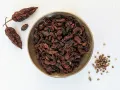
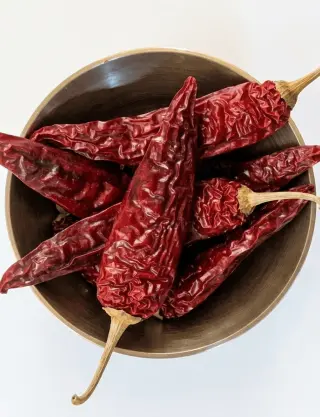
| Product form | Whole dried chilies |
| Harvest | August to October |
Northeastern India, often called the "Seven Sisters", is one of the most biodiverse regions on Earth. Wedged between the eastern Himalayas, Myanmar and Bangladesh, this area enjoys a unique humid subtropical climate that creates perfect conditions for growing extreme chilies.
The terroir that makes the difference
- Humid subtropical climate: high temperatures (30-35°C) combined with significant humidity: ideal conditions for the slow maturation of the Bhut Jolokia and the concentration of capsaicin
- Volcanic and alluvial soils: rich in minerals, well-drained, with a slightly acidic pH; the perfect substrate for Solanaceae
- Abundant monsoon: the region's generous rainfall (2,000-3,000 mm/year) ensures vigorous growth during the growing season
- Traditional agriculture: the peppers are grown in household gardens, often in polyculture alongside other vegetables, without chemical inputs, a tradition that has endured for generations
Attempts to grow the Bhut Jolokia outside its native region produce variable results. Although the plant can grow in other warm climates, the capsaicin levels and aromatic profile are generally not comparable to those of peppers cultivated in northeastern India, a genuine terroir effect.
The Bhut Jolokia is not merely a "hot" pepper: it is a complex and aromatic chili that delivers a fascinating flavour profile, provided you can handle the intensity of its heat.
Tasting notes
- Heat: extreme (1,041,427 SHU). The sensation builds gradually over 30 to 45 seconds, reaches a devastating peak, then persists for 20 to 30 minutes. This is not a flash of heat but a wave that overwhelms
- Aroma: before the heat even registers, you detect fruity notes reminiscent of passion fruit or green mango, followed by a characteristic smoky and earthy undertone
- Taste: beneath the capsaicin, the Bhut Jolokia reveals a surprising fruity sweetness, a hint of smoke and a slight floral note, a far more complex profile than most super-hot peppers
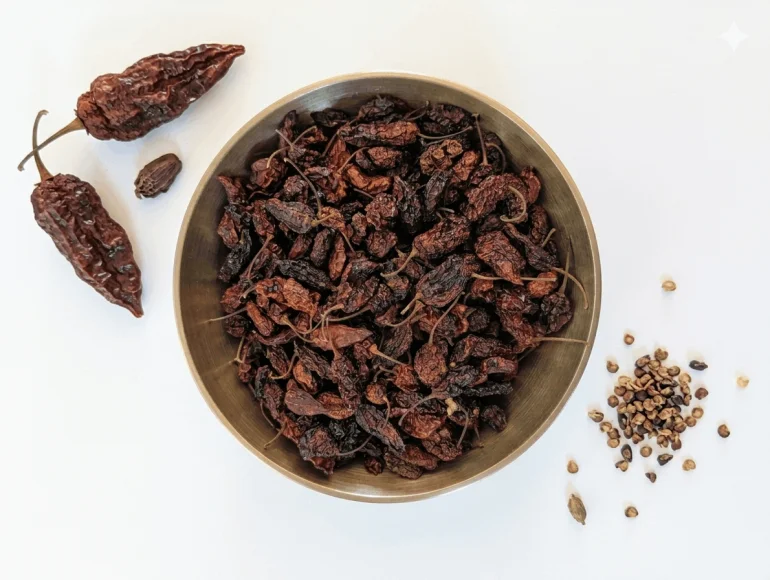
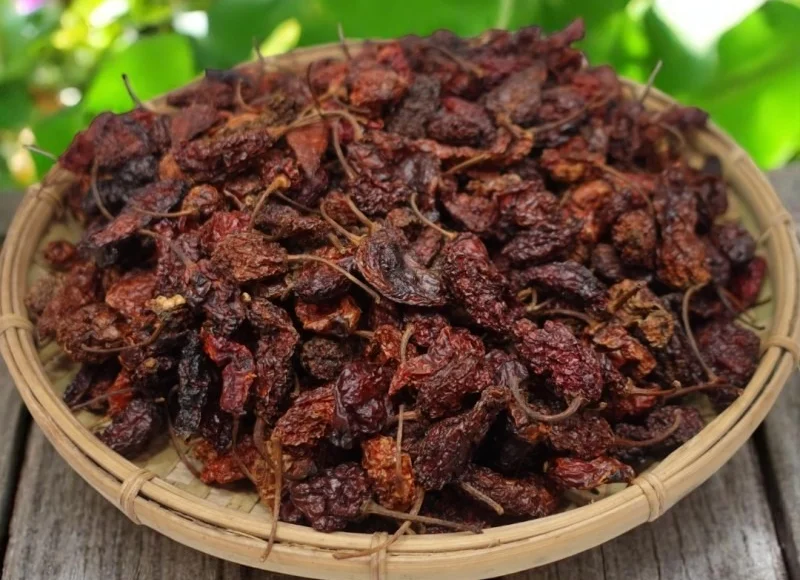
- Our whole dried chilies: drying concentrates the smoky aromas and intensifies the heat. The wrinkled texture and thin skin make them easy to crumble
Important: always handle dried Bhut Jolokia peppers with gloves. Capsaicin can cause intense burning on the skin and eyes. Wash your hands thoroughly after handling.
The Bhut Jolokia is a powerful ingredient that demands respect and precision. Used correctly, it delivers a dimension of heat and flavour that few other peppers can match.
Traditional uses
- Naga chutneys: Bhut Jolokia chutneys are a staple of Nagaland cuisine; the pepper is crushed with salt, garlic and tomatoes
- Preserves and fermentations: Naga tribes use the Bhut Jolokia in pickles and fermented condiments, where its potency also serves as a natural preservative
- Northeastern curries: added sparingly to the meat and fish stews characteristic of Naga and Assamese cuisine
How to use our whole dried chilies
- Crumble a small quantity: break off a small piece of dried chili and crumble it into your dish: start with a quarter of a pepper and adjust. The potency is considerable
- Infuse in oil: heat oil on low with half a dried pepper for 5 minutes to create an intense chili oil: remove the pepper and use the oil for seasoning
- Homemade powder: grind a dried pepper in a mortar or spice grinder for an ultra-concentrated powder: a pinch is enough for an entire dish
- Marinades: crumble into marinades for grilled meats, jerky or barbecue sauces
- Hot sauces: ideal base for homemade hot sauces combined with vinegar, garlic and fruit
Tip: the Bhut Jolokia pairs particularly well with mango, pineapple, tomato and dark chocolate: the pepper's fruity notes create surprisingly harmonious pairings with these sweet-tart flavours.
Capsaicin (the compound responsible for the Bhut Jolokia's heat) is one of the most studied bioactive compounds in nutrition and pharmacology. With its exceptional capsaicin concentration, the Bhut Jolokia amplifies the benefits associated with hot peppers.
Key documented benefits
- Metabolism boost: capsaicin activates TRPV1 receptors and increases thermogenesis: the body burns more calories to dissipate the heat. Studies show a 5 to 8% increase in basal metabolic rate after capsaicin consumption
- Endorphin release: the intense burning sensation triggers a nervous system response that releases endorphins and dopamine, creating an euphoric effect often called the "chili runner's high"
- Vitamin C: peppers of the Capsicum genus are naturally rich in vitamin C, an essential antioxidant for immunity and skin health
- Anti-inflammatory: capsaicin has documented anti-inflammatory properties, used topically in patches and creams for joint and muscle pain
- Cardiovascular health: epidemiological studies suggest that regular consumption of hot peppers is associated with reduced cardiovascular risk
- Antimicrobial effect: capsaicin has antibacterial properties, which explains the traditional use of chili as a food preservative
Caution: consuming extremely hot peppers can cause intense stomach pain in unaccustomed individuals. Start with very small amounts and increase gradually. In case of contact with eyes or mucous membranes, rinse thoroughly with water.
Handling and safety
- Wear gloves: always handle dried Bhut Jolokia peppers with disposable gloves: capsaicin can cause intense skin burning that persists for several hours
- Avoid eye contact: never touch your eyes, nose or mouth after handling the peppers, even with washed hands: capsaicin is very tenacious
- Ventilation: if grinding the peppers, work in a well-ventilated area; airborne capsaicin particles can irritate the respiratory tract
- In case of mouth burn: milk, yoghurt or bread are the best remedies; the casein in milk binds to capsaicin. Water is ineffective
Storage tips
- Store in an airtight container, away from light and moisture
- Keep in a dry, cool place: moisture is the enemy of dried chilies (risk of mould)
- Shelf life: 1 to 2 years for whole dried chilies under optimal conditions: the heat remains intense but the fruity aromas will fade over time
- For extended storage, the fridge or freezer is possible in an airtight bag
- Signs of degradation: loss of colour (from red to brown), musty smell, soft texture
Is the Bhut Jolokia really the hottest pepper in the world?
It officially held that title from 2007 to 2011. At 1,041,427 SHU, it was the first pepper to break the one-million Scoville mark. It has since been surpassed by the Trinidad Scorpion, the Carolina Reaper and Pepper X. But it remains an extremely potent pepper (roughly 400 times hotter than Tabasco) and the one that triggered the global extreme pepper race.
How can I use dried Bhut Jolokia without burning myself?
Always wear gloves. For a dish serving 4, start with a quarter of a dried pepper crumbled in and taste after 10 minutes of cooking. The heat develops during cooking. You can also steep half a pepper in warm oil for 5 minutes, remove the pepper, and use the oil for more precise control of intensity.
What does the Bhut Jolokia taste like beyond the heat?
Beneath the intense capsaicin, the Bhut Jolokia offers a surprisingly complex aromatic profile: fruity notes (passion fruit, green mango), a characteristic smoky touch and a slight floral note. Drying accentuates the smoky notes. It is this complexity that sets it apart from more recent super-hot peppers, which are often less interesting flavour-wise.
Is the Bhut Jolokia dangerous for your health?
In normal culinary quantities (a quarter to half a dried pepper per dish), the Bhut Jolokia poses no danger to a healthy person. However, capsaicin can cause stomach pain in unaccustomed individuals. People with gastric ulcers or digestive disorders should exercise caution. Handling requires gloves to avoid skin burns.
Why choose whole dried peppers over powder?
Whole dried peppers offer several advantages: longer shelf life, better dosage control (you can crumble exactly the amount needed), and a guarantee of authenticity: with a whole pepper, you can see exactly what you are buying. Additionally, the smoky and fruity aromas are better preserved in whole peppers than in powder.








 Gravy Dishes