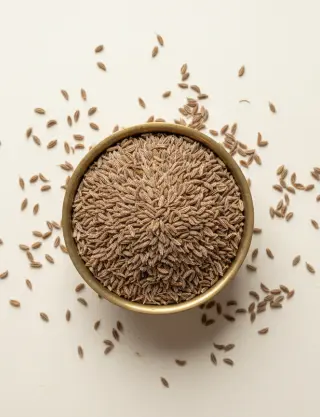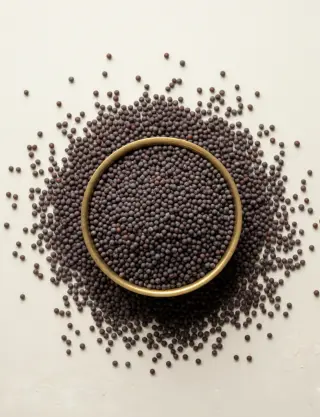




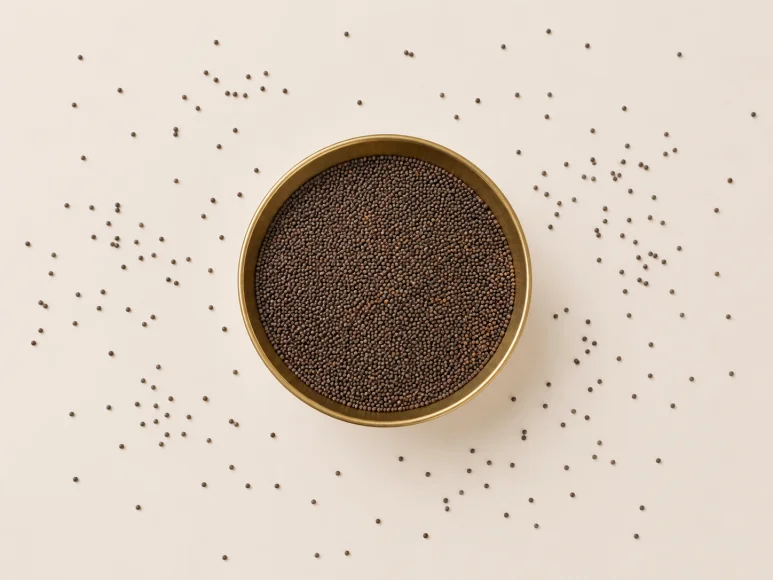
Discover our jakhiya, small wild caper seeds grown and harvested in the hills of Uttarakhand, in the Indian Himalayas. Crunchy, slightly pungent and toasted-hazelnut scented to wake up your sautéed potatoes, dals and tempered vegetables.
Ready for shipping, delivery time 3-10 business days
Delivery from €4.80 at Mondial Relay pickup points.



Jakhiya: the secret spice of pahari cuisine
Jakhiya (Cleome viscosa) is a small dark-brown seed harvested in the mountain villages of Uttarakhand, in the Indian Himalayas. Nicknamed "wild mustard" for its use close to mustard and cumin seeds, it is a quiet but essential staple of pahari cuisine, the food of the Himalayan hill communities. We source it directly from smallholder growers in the region so you can discover a spice that is still rare outside India.
Why choose whole seeds?
Like mustard or cumin, jakhiya releases its full aroma when heated whole in oil or ghee: the tempering (tadka) technique. Whole seeds keep their essential oils far longer than a powder, and their crunchy texture after cooking adds a welcome contrast to vegetable dishes and dals.
Culinary uses:
- For tempering (tadka): crackle the seeds in hot oil or ghee before adding your vegetables
- Essential for aloo jakhiya, Uttarakhand's signature potato dish
- Flavours dals and lentils with a toasted, slightly pungent note
- Enhances stir-fried vegetables (cabbage, courgette, green beans)
- Adds a crunchy touch to raita and yoghurt preparations
- Replaces or complements mustard seeds in any tempering recipe
Origin and quality:
Our jakhiya comes from the hills of Uttarakhand, where it grows on small family farms. We select our growers with care, so we can guarantee you a natural, authentic seed.
To learn all about this quiet staple of pahari cuisine, read our guide to jakhiya.
Storage:
To preserve all its aromas, store your jakhiya in a dry place, away from light and humidity, in its airtight packaging.
Rich in vitamin C
Supports digestion
Antioxidant properties
Helps fight inflammation
Supports natural defenses (antimicrobial)
Helps regulate fever (antipyretic)
Supports healthy blood circulation
Traditional mild vermifuge
| Directly selected smallholder producers | No |
| Vegetarian | Yes |
| Origin | Uttarakhand, India |
| Quality | Premium |
| Type | Whole seeds |
| Taste profile | Toasted hazelnut flavour, slightly pungent and crunchy. Releases its full aroma when it crackles in hot oil or ghee. |
| Possible traces of allergens | May contain traces of mustard and celery (packaged in a facility handling these allergens). |
Translated from German
Learn more
Jakhiya is botanically distinct from mustard, though it's often given that name by analogy of taste and use. It comes from Cleome viscosa, a plant found growing wild across much of India and Nepal, but which only the Himalayan region of Uttarakhand has turned into a proper culinary ingredient rather than just a field plant.
In Garhwali and Kumaoni cooking, jakhiya holds a place comparable to mustard or cumin elsewhere in India: it's the default tempering spice, the one thrown into hot oil first before the rest of the ingredients follow. Unlike more nationally commercialised spices, jakhiya remains largely a local matter, rarely exported and lightly documented in mainstream Indian culinary literature.
Did you know?
The English name "dog mustard", sometimes given to jakhiya, illustrates its status as a modest, local spice: long regarded as a wild plant with no commercial value, it has only recently gained culinary recognition in its own right, driven by growing interest in Himalayan regional cooking.
A local spice, without a long written history
Jakhiya does not carry the millennia-old written trail of spices like cumin or cinnamon: it has remained an essentially local plant, confined to the Garhwali and Kumaoni kitchens of Uttarakhand and the Nepalese Terai, without significant international trade. Its other English name, "dog mustard," reflects its status as a modest, little-known spice, long reserved for domestic use in mountain households rather than the spice trade.
| Feature | Detail |
|---|---|
| Latin name | Cleome viscosa L. |
| Botanical family | Cleomaceae, a family related to capers (Capparaceae), hence its "wild caper" nickname |
| Local name | Jakhya or Jakhiya (Kumaoni, Garhwali) |
| Part used | Seed, harvested from the flower's seed pod |
| Main growing region | The hills of Uttarakhand, along with some Terai areas near the India-Nepal border |
Cleome viscosa is a fast-growing annual herb, often regarded as a weed in the fields where it grows spontaneously. It's precisely these wild populations, gathered rather than intensively cultivated, that supply most of the jakhiya consumed in Uttarakhand households.
A field gathering more than a crop
- The plant grows wild in fields and wasteland during the monsoon
- The seeds, held in long, thin pods, are harvested once ripe
- Sun-dried, then threshed to release the small, dark brown seeds
- No further processing needed: the whole seed is ready for tempering
Jakhiya has a sharp, slightly bitter taste, reminiscent of milder mustard. Its true aromatic signature reveals itself in hot oil: the seeds crackle loudly, somewhat like mustard seed, releasing a warm, faintly pungent aroma that instantly perfumes the whole dish.
Used whole, never ground, jakhiya also adds a slight crunch, appreciated in the legume dishes of mountain cooking.
In Himalayan cooking
- Tempered at the very start of cooking in hot oil (tadka), before any other spice
- A key ingredient in chainsoo, a traditional dish made from roasted, ground legume flour
- Used in aloo ke gutke, a spiced potato dish emblematic of Kumaon and Garhwal
- Added to sautéed vegetables and everyday legume preparations
Did you know?
As with mustard seed, jakhiya must go into oil that's already properly hot: that contact with high heat is what triggers its characteristic crackling and fully releases its aroma. Added to oil that's too cool, it stays subdued and loses much of its aromatic interest.
Why hill cooks prefer it to cumin
Unlike cumin or mustard, which soften on cooking, jakhiya keeps its distinctive crunch even after tempering in hot oil. It is precisely this texture, paired with a sharper, nuttier aroma, that Garhwali and Kumaoni cooks look for, explaining why they stay loyal to it rather than substituting a more common spice.
A more forgiving seed than mustard
Curiously, despite the need for well-heated oil mentioned above, jakhiya actually proves more forgiving than mustard seed in everyday practice: harder to burn, it tolerates more variation in temperature during tempering, which makes it a favoured choice for the fast, high-heat tadka so characteristic of Pahadi (mountain) cooking.
Jakhiya is traditionally used in Uttarakhand folk medicine for its digestive properties, a use far less scientifically documented than more widely studied spices like cumin or mustard, owing to its largely regional spread.
What we know
- Traditional use : locally recognised as carminative, to relieve bloating and aid digestion
- Anti-parasitic properties : the Cleome viscosa plant as a whole (leaves included, not just the seed) is traditionally used in Indian folk medicine for its vermifuge properties
- Research : published scientific studies mostly focus on Cleome viscosa leaf extracts, much more rarely on the seed as eaten; results should therefore be interpreted with caution for strictly culinary use
Precautions
Consumed in normal culinary amounts, jakhiya is considered safe by the communities who have cooked with it for generations. As scientific data specific to the seed remain limited, it's advisable to stick to traditional culinary uses rather than large quantities for therapeutic purposes.
A place in Himalayan folk medicine
Beyond the kitchen, jakhiya is traditionally used in the folk medicine of the Uttarakhand hills for its anthelmintic and carminative properties, notably to ease mild digestive troubles and, according to local tradition, certain liver or respiratory complaints. These uses, passed down orally, have not been the subject of published scientific studies to date.
Quality markers
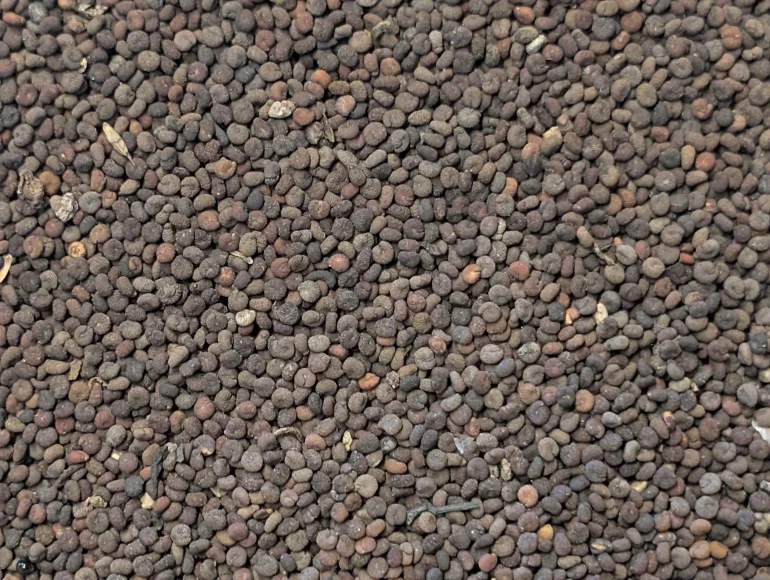
- Colour : uniform dark brown, with no pale or immature seeds
- Smell : subtle when cold, fully revealed once cooked
- Texture : small, dry seeds that flow freely without sticking
Storage tips
- In an airtight container, away from light and moisture
- Shelf life: about 2 years as whole seed
- Always used whole: no particular preparation is needed before tempering in hot oil
Is jakhiya a type of mustard?
No, despite the English nickname "wild mustard" sometimes used for it. Botanically, jakhiya (Cleome viscosa) belongs to the Cleomaceae family, related to capers, not to mustard's Brassicaceae. The resemblance mostly comes from similar tempering use and the crackling in hot oil.
How is jakhiya used in cooking?
Like mustard seed, it's tempered in properly hot oil at the very start of cooking, before the rest of the ingredients go in. It's this intense heat that triggers its crackling and releases its sharp aroma.
What are chainsoo and aloo ke gutke?
These are two traditional Uttarakhand dishes where jakhiya plays a key role: chainsoo is made from roasted, ground legume flour, and aloo ke gutke is a spiced potato dish, both emblematic of Garhwali and Kumaoni cooking.
Why is jakhiya little known outside India?
It's remained a largely regional spice, gathered rather than grown at large scale, and rarely exported. It's seen growing culinary interest in recent years, driven by a rediscovery of Himalayan regional cooking.
Should jakhiya be ground before use?
No, it's always used whole, like mustard seed. Grinding is not a traditional practice for this spice.
Why is jakhiya so little known outside India?
Because it has remained an essentially local spice, grown and consumed in the hills of Uttarakhand and the Nepalese Terai, without a significant international export trade, unlike long-established commercial spices such as cumin or cinnamon.
Can jakhiya be replaced with cumin or mustard?
You can try, but the result will differ: jakhiya keeps a distinct crunch even after tempering in hot oil, whereas cumin and mustard soften. That texture is precisely what makes it distinctive in Garhwali and Kumaoni cooking.
-
Jakhiya is botanically distinct from mustard, though it's often given that name by analogy of taste and use. It comes from Cleome viscosa, a plant found growing wild across much of India and Nepal, but which only the Himalayan region of Uttarakhand has turned into a proper culinary ingredient rather than just a field plant.
In Garhwali and Kumaoni cooking, jakhiya holds a place comparable to mustard or cumin elsewhere in India: it's the default tempering spice, the one thrown into hot oil first before the rest of the ingredients follow. Unlike more nationally commercialised spices, jakhiya remains largely a local matter, rarely exported and lightly documented in mainstream Indian culinary literature.
Did you know?
The English name "dog mustard", sometimes given to jakhiya, illustrates its status as a modest, local spice: long regarded as a wild plant with no commercial value, it has only recently gained culinary recognition in its own right, driven by growing interest in Himalayan regional cooking.
A local spice, without a long written history
Jakhiya does not carry the millennia-old written trail of spices like cumin or cinnamon: it has remained an essentially local plant, confined to the Garhwali and Kumaoni kitchens of Uttarakhand and the Nepalese Terai, without significant international trade. Its other English name, "dog mustard," reflects its status as a modest, little-known spice, long reserved for domestic use in mountain households rather than the spice trade.
-
Feature Detail Latin name Cleome viscosa L. Botanical family Cleomaceae, a family related to capers (Capparaceae), hence its "wild caper" nickname Local name Jakhya or Jakhiya (Kumaoni, Garhwali) Part used Seed, harvested from the flower's seed pod Main growing region The hills of Uttarakhand, along with some Terai areas near the India-Nepal border Cleome viscosa is a fast-growing annual herb, often regarded as a weed in the fields where it grows spontaneously. It's precisely these wild populations, gathered rather than intensively cultivated, that supply most of the jakhiya consumed in Uttarakhand households.
A field gathering more than a crop
- The plant grows wild in fields and wasteland during the monsoon
- The seeds, held in long, thin pods, are harvested once ripe
- Sun-dried, then threshed to release the small, dark brown seeds
- No further processing needed: the whole seed is ready for tempering
-
Jakhiya has a sharp, slightly bitter taste, reminiscent of milder mustard. Its true aromatic signature reveals itself in hot oil: the seeds crackle loudly, somewhat like mustard seed, releasing a warm, faintly pungent aroma that instantly perfumes the whole dish.
Used whole, never ground, jakhiya also adds a slight crunch, appreciated in the legume dishes of mountain cooking.
-
In Himalayan cooking
- Tempered at the very start of cooking in hot oil (tadka), before any other spice
- A key ingredient in chainsoo, a traditional dish made from roasted, ground legume flour
- Used in aloo ke gutke, a spiced potato dish emblematic of Kumaon and Garhwal
- Added to sautéed vegetables and everyday legume preparations
Did you know?
As with mustard seed, jakhiya must go into oil that's already properly hot: that contact with high heat is what triggers its characteristic crackling and fully releases its aroma. Added to oil that's too cool, it stays subdued and loses much of its aromatic interest.
Why hill cooks prefer it to cumin
Unlike cumin or mustard, which soften on cooking, jakhiya keeps its distinctive crunch even after tempering in hot oil. It is precisely this texture, paired with a sharper, nuttier aroma, that Garhwali and Kumaoni cooks look for, explaining why they stay loyal to it rather than substituting a more common spice.
A more forgiving seed than mustard
Curiously, despite the need for well-heated oil mentioned above, jakhiya actually proves more forgiving than mustard seed in everyday practice: harder to burn, it tolerates more variation in temperature during tempering, which makes it a favoured choice for the fast, high-heat tadka so characteristic of Pahadi (mountain) cooking.
-
Jakhiya is traditionally used in Uttarakhand folk medicine for its digestive properties, a use far less scientifically documented than more widely studied spices like cumin or mustard, owing to its largely regional spread.
What we know
- Traditional use : locally recognised as carminative, to relieve bloating and aid digestion
- Anti-parasitic properties : the Cleome viscosa plant as a whole (leaves included, not just the seed) is traditionally used in Indian folk medicine for its vermifuge properties
- Research : published scientific studies mostly focus on Cleome viscosa leaf extracts, much more rarely on the seed as eaten; results should therefore be interpreted with caution for strictly culinary use
Precautions
Consumed in normal culinary amounts, jakhiya is considered safe by the communities who have cooked with it for generations. As scientific data specific to the seed remain limited, it's advisable to stick to traditional culinary uses rather than large quantities for therapeutic purposes.
A place in Himalayan folk medicine
Beyond the kitchen, jakhiya is traditionally used in the folk medicine of the Uttarakhand hills for its anthelmintic and carminative properties, notably to ease mild digestive troubles and, according to local tradition, certain liver or respiratory complaints. These uses, passed down orally, have not been the subject of published scientific studies to date.
-
Quality markers
- Colour : uniform dark brown, with no pale or immature seeds
- Smell : subtle when cold, fully revealed once cooked
- Texture : small, dry seeds that flow freely without sticking
Storage tips
- In an airtight container, away from light and moisture
- Shelf life: about 2 years as whole seed
- Always used whole: no particular preparation is needed before tempering in hot oil
-
Is jakhiya a type of mustard?
No, despite the English nickname "wild mustard" sometimes used for it. Botanically, jakhiya (Cleome viscosa) belongs to the Cleomaceae family, related to capers, not to mustard's Brassicaceae. The resemblance mostly comes from similar tempering use and the crackling in hot oil.
How is jakhiya used in cooking?
Like mustard seed, it's tempered in properly hot oil at the very start of cooking, before the rest of the ingredients go in. It's this intense heat that triggers its crackling and releases its sharp aroma.
What are chainsoo and aloo ke gutke?
These are two traditional Uttarakhand dishes where jakhiya plays a key role: chainsoo is made from roasted, ground legume flour, and aloo ke gutke is a spiced potato dish, both emblematic of Garhwali and Kumaoni cooking.
Why is jakhiya little known outside India?
It's remained a largely regional spice, gathered rather than grown at large scale, and rarely exported. It's seen growing culinary interest in recent years, driven by a rediscovery of Himalayan regional cooking.
Should jakhiya be ground before use?
No, it's always used whole, like mustard seed. Grinding is not a traditional practice for this spice.
Why is jakhiya so little known outside India?
Because it has remained an essentially local spice, grown and consumed in the hills of Uttarakhand and the Nepalese Terai, without a significant international export trade, unlike long-established commercial spices such as cumin or cinnamon.
Can jakhiya be replaced with cumin or mustard?
You can try, but the result will differ: jakhiya keeps a distinct crunch even after tempering in hot oil, whereas cumin and mustard soften. That texture is precisely what makes it distinctive in Garhwali and Kumaoni cooking.
Why choose Jakhiya – Wild Himalayan Caper Seeds from La Table Indienne?

Exceptional freshness and quality
Our spices are imported directly from India and packaged on demand to guarantee optimal freshness. Unlike spices sold in supermarkets that can sit on shelves for months, we ensure each spice retains its full flavor and aroma.
Authenticity and traceability
Each spice comes from specific regions in India renowned for their expertise. We work directly with local producers who grow their spices traditionally.
How to best use this spice?
To reveal all the aromas, we recommend lightly toasting whole spices in a dry pan before grinding them. Store them in a dry place away from light to preserve their freshness as long as possible.

Did you know?
Whole spices are much better than ground spices
Check out our blog article to discover why whole spices retain their aromas better.
Questions & Answers
Thank you! Your question has been sent. Mihika will answer soon and you will receive an email.

Jakhiya – Wild Himalayan Caper Seeds
Discover also
Other products you might like