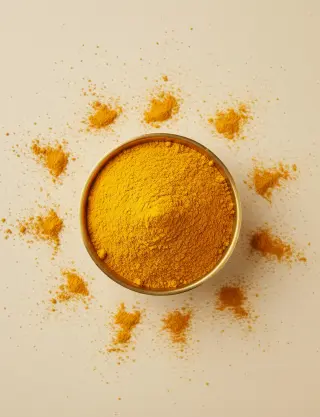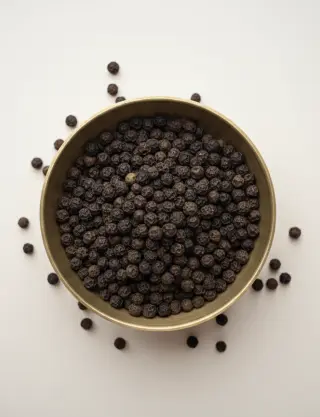




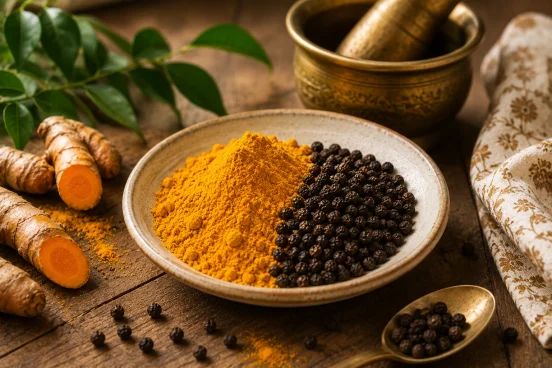
In an Indian kitchen, turmeric rarely travels alone. The moment a pinch of golden powder hits hot oil, another spice almost always joins it: black pepper. This pairing, passed down for generations long before anyone understood the chemistry behind it, is not just a matter of taste. It is a combination that makes sense, and modern research is starting to explain why.
At Table Indienne, we are often asked whether pairing turmeric with black pepper genuinely matters, and in what proportions. Here is what is worth knowing, without exaggeration or miracle claims.
Curcumin: a powerful molecule that is poorly absorbed
The most studied compound in turmeric is called curcumin. It is the polyphenol responsible for the spice's vivid yellow-orange colour, and it is also the compound scientific research has focused on for several decades. The issue is that curcumin, consumed on its own, largely passes through the digestive system without being absorbed by the body. It is quickly metabolised by the liver and intestine, then eliminated before it can circulate meaningfully in the bloodstream.
In other words, generously sprinkling turmeric on a dish does not, by itself, guarantee that the curcumin will be properly taken up. That is where the second half of the duo comes in.
Piperine in black pepper, a natural accelerator
Black pepper contains an alkaloid called piperine, responsible for its sharp bite. Several research papers, including a frequently cited study published in Planta Medica in 1998, showed that piperine slows down the breakdown of curcumin in the liver and intestine, giving it more time to reach the bloodstream.
A simple pinch of black pepper in your turmeric is not just a flavour detail: it is the gesture that helps curcumin make its way through the body more effectively.
This is precisely why Indian kitchens almost systematically pair these two spices, whether in a curry, a dal, or a simple spiced drink. It is not a culinary coincidence: it is an empirical logic passed down long before biochemistry came to confirm it.
What ratio should you use?
There is no need to overdo it: a small amount of black pepper is enough to make a difference. The most commonly recommended ratio sits around one part black pepper for nine parts turmeric, roughly 10% of the turmeric's weight.
- For one teaspoon of turmeric (about 5g), count a generous small pinch of freshly ground black pepper, roughly a tenth of the quantity.
- Choose freshly ground pepper rather than pepper that has been ground for a while: aromatic compounds and piperine hold up better in the whole peppercorn.
Fat, the third quiet ally
There is another detail traditional recipes never leave to chance: curcumin is fat-soluble, meaning it dissolves in fat rather than in water. Sautéing turmeric in a little oil or ghee at the start of cooking, or pairing it with milk, coconut cream or olive oil in a cold preparation, also helps its uptake.
This threefold habit (turmeric, a touch of black pepper, some fat) is what explains the consistency of so many Indian recipes, from a slow-simmered curry to a simple vinaigrette.
Where to pair turmeric and black pepper day to day
This duo fits naturally into many preparations without disrupting your habits:
- Golden milk: our dedicated golden milk article details the traditional Haldi Doodh recipe, where turmeric, black pepper and warm milk meet in a single cup. Follow the golden milk recipe step by step.
- Curries: the base of a good curry often starts with a tadka where turmeric and black pepper are seared together in hot oil. Try our mild vegetable curry with coconut milk.
- Soups: a vegetable soup lends itself very well to this duo, with cream or coconut milk playing the role of the fat. See our carrot and Lakadong turmeric soup.
- Vinaigrettes: olive oil provides the fat needed for curcumin uptake, right in the dressing itself. Our sunshine turmeric vinaigrette pairs exactly these two spices.
What the research actually says
It is worth being honest about the state of the evidence. The effect of piperine on curcumin absorption was first demonstrated in small human trials, with dramatic increases reported in some studies. More recent work, looking at different formulations and contexts, nuances the real scale of this effect and points out that it can vary depending on the individual, the form of turmeric used, and the amount of fat present in the meal. Curcumin remains an active area of research, and results obtained in the lab or in clinical trials do not automatically translate into guaranteed benefits for any given person. This article is intended for culinary and informational purposes, not as medical advice.
To explore spices linked to wellbeing more broadly, our complete guide to anti-inflammatory spices in Ayurveda places turmeric in a wider context.
A precaution worth knowing
As with any concentrated spice, moderation is best. In large amounts, piperine can be irritating to the digestive lining in some people, and it is also known to alter the absorption of certain medications by interfering with their metabolism. If you are on any medication or have doubts, ask a healthcare professional before significantly increasing your black pepper intake. For ordinary culinary use (a pinch in a dish) no particular precaution is needed for most people.
The choice of turmeric also matters
Not all turmeric is equal in curcumin content. Standard turmeric usually contains between 2 and 4%, while Lakadong turmeric, grown in the hills of Meghalaya in north-east India, is known for a notably higher content, around 7 to 8%. Paired with a pinch of freshly ground black pepper and a little fat, it is the most coherent combination you can put together in your own kitchen.
At Table Indienne
We offer Lakadong turmeric powder and whole Malabar black pepper, best ground at the last moment to keep its full bite. Two simple, complementary spices, made to be used together as Indian tradition intends: from our shop in Wittisheim, Alsace.