



Sabai grass bread box
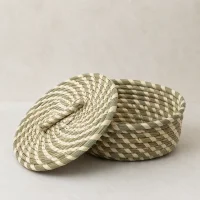
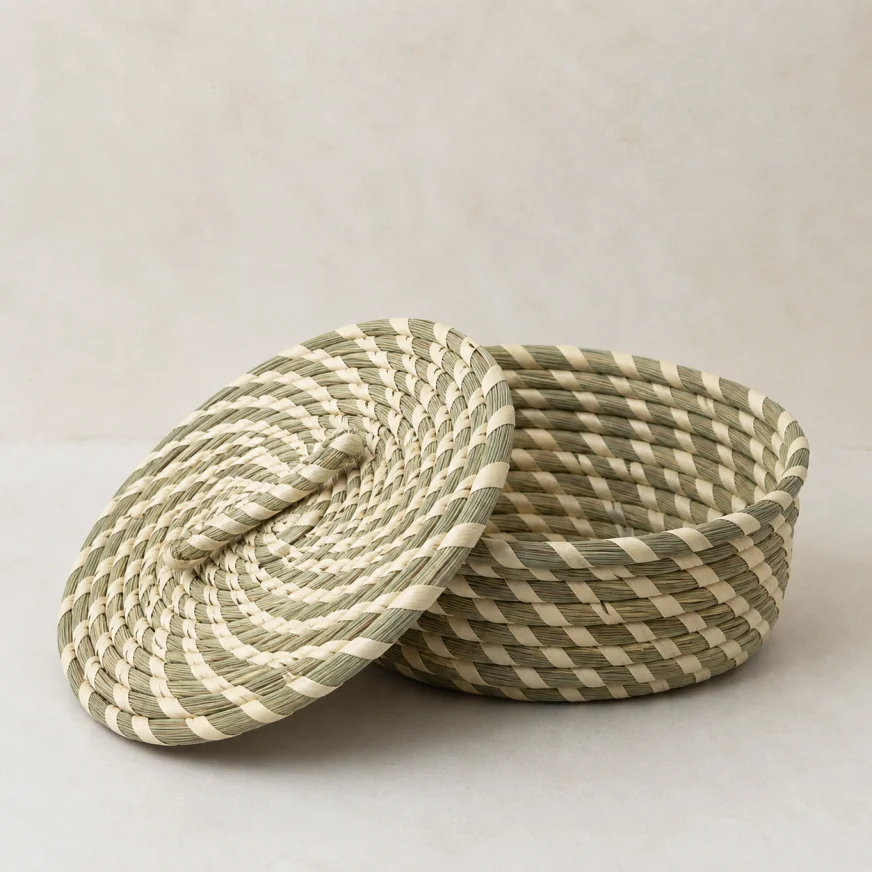
Roti and bread box in handwoven sabai grass. An eco-friendly, aesthetic and durable storage solution. Indian craftsmanship.
Ready for shipping, delivery time 3-10 business days
Delivery from €5.20 at Mondial Relay pickup points.



In the same style
This product goes well with the following products.
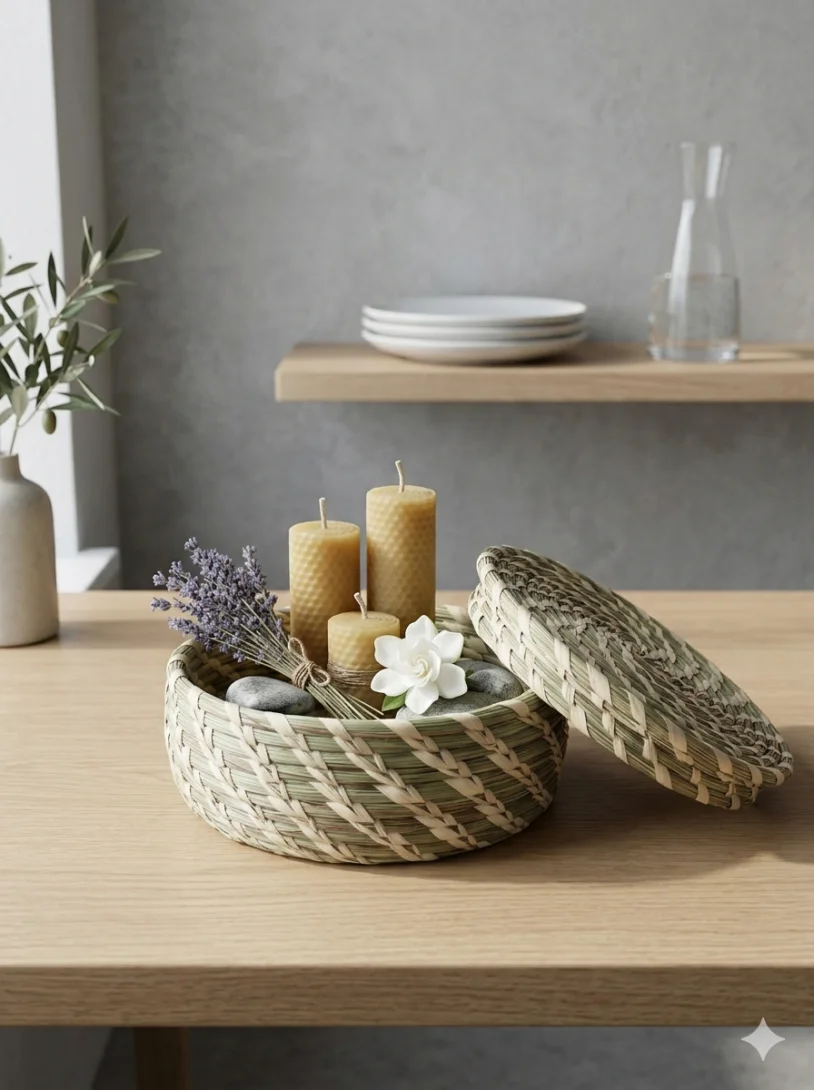
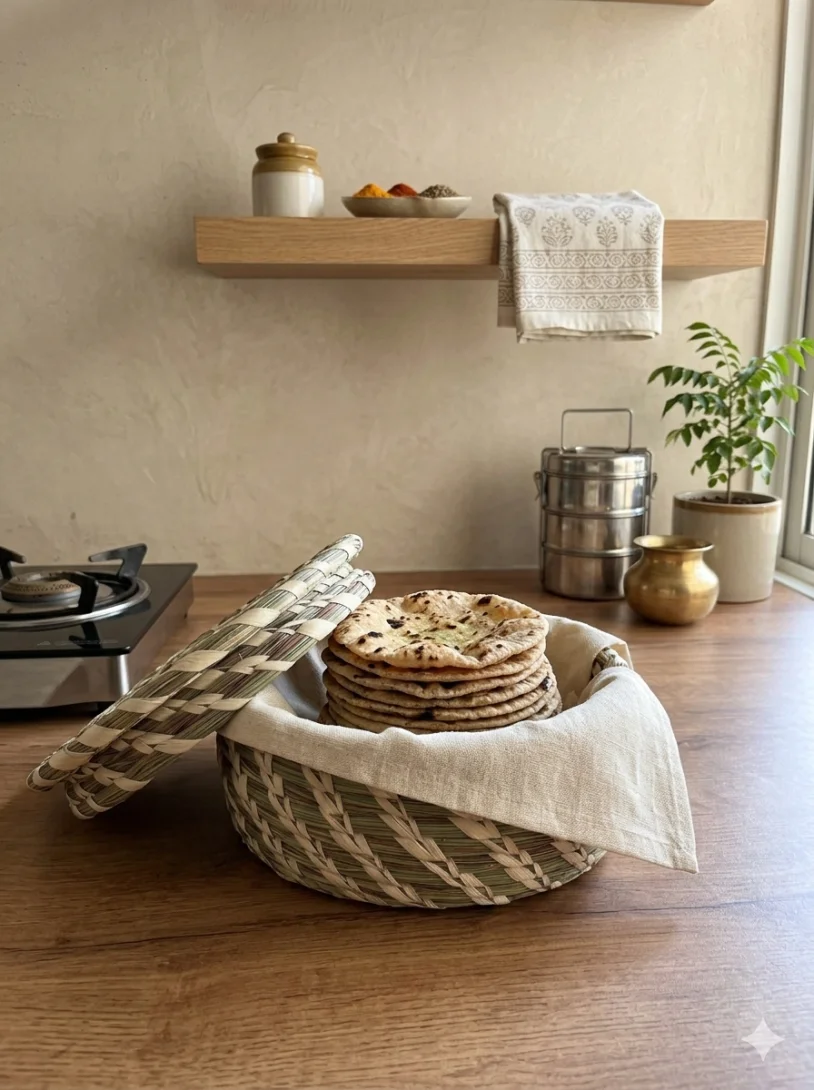
Sabai grass bread and roti box
The sabai grass bread and roti box is a great way to support sustainable and ethical practices. The use of sabai grass supports local communities, as it is a natural resource that is grown and harvested in rural areas. By purchasing this handmade roti box, you are helping to support the livelihoods of skilled artisans and preserving traditional crafting techniques.
Design : This handwoven sabai grass roti box is intended to enhance the sophistication and glitz of the home while complementing the serving manner. The box comes with a lid so that the contents of the box can be covered.
Dimension : Diameter: 23cm Height with lid: 6.5cm Height without lid: 6cm
Material : The box is made of Sabai Grass, which is a tufted perennial grass with basal sheaths woolly with whitish hairs. We can protect the environment by employing organic products, and since they decompose quickly, they are great for trash management.
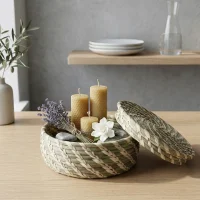
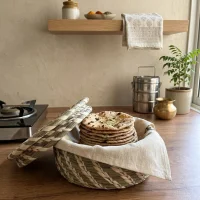
Usage : The storage box can be put to varied uses and can be utilized both at home and at events. It can be used as a snacks tray, roti / bread box or simply as a home decor solution for enhancing household aesthetics.
Care : Home washable, simple to maintain, and easily cleaned with a light brush or a damp cloth. To prolong the life of the product, sun-dry it. Place a napkin or a cloth at the base to prevent the product from being stained.
The roti and bread box is also a great way to support sustainable and ethical practices. The use of sabai grass supports local communities, as it is a natural resource that is grown and harvested in rural areas. By purchasing this handmade roti box, you are helping to support the livelihoods of skilled artisans and preserving traditional crafting techniques.
Overall, the Handmade Sabai Grass Roti and Bread Box is a beautiful and practical addition to any kitchen or dining area. Its unique and rustic charm will be sure to impress your guests while also making a positive impact on the environment and local communities.
Our article five fibres, a thousand stories traces the origins of sabai grass and the skill of the women who weave it.
| Dimensions | 30 cm |
| Weight | 545 g |
| Origin | India |
| Composition | Woven sabai grass |
| Handmade | Yes |
Learn more
Sabai grass (Eulaliopsis binata) is a perennial grass that grows wild in the forests and hills of Odisha, Jharkhand and Chhattisgarh. Its long, supple, resilient fibers make it an ideal basketry material, used for centuries by the Adivasi tribal communities of these regions.
The Adivasi artisans
Sabai craft is practiced mainly by women of the tribal communities (Kondh, Saora, Santhal and Munda) in the districts of Mayurbhanj, Keonjhar, Dhenkanal and Cuttack. This know-how is passed down from mother to daughter from a very young age. Young girls learn the basic techniques around the age of 8-10 and master the complex patterns by adolescence.
Sabai craft plays a crucial economic role for these communities, often among the most vulnerable in India. Several fair trade programs and artisan cooperatives have been set up to guarantee fair pay for the women artisans and to sustain a skill threatened by rural exodus.
Cultural recognition
Odisha's sabai grass craft has been granted Geographical Indication (GI) status in India, a recognition of its authenticity and of its inseparable link with the region. The Government of Odisha and several NGOs are working to have this craft recognized by UNESCO as intangible cultural heritage.
From harvest to finished basket
Making a sabai basket is an entirely manual process that takes 2 to 3 days for a medium-sized piece.
| Step | Description | Duration |
|---|---|---|
| 1. Harvesting | Sabai grass is cut by hand in the surrounding forests and hills, generally between October and February (dry season). Only mature stalks are selected. | 1 day |
| 2. Drying | The stalks are spread out in the sun for 3 to 5 days to remove moisture. They take on a characteristic golden color. | 3-5 days |
| 3. Dyeing | Some fibers are dyed with natural dyes: turmeric (yellow), indigo (blue), pomegranate bark (reddish brown), henna leaves (orange). Chemical dyes are avoided in traditional craft. | 1 day |
| 4. Rope twisting | The dried fibers are twisted by hand into fine, even ropes. This is the most technical step: the tension must stay constant for a uniform rope. | 2-3 hours |
| 5. Spiral coiling | The ropes are wound into a tight spiral, each row stitched to the previous one with a bone or metal needle. This is the coil weaving technique, which gives the basket its strength and shape. | 4-8 hours |
| 6. Finishing | The rim is reinforced with a last row of thicker rope. The ends are tucked in and secured for a clean finish. | 30-60 minutes |
Every basket is unique
Because they are made entirely by hand, no two sabai baskets are identical. Slight variations in color, shape and pattern are not flaws: they are the artisan's signature and proof of genuinely handmade work.
The sabai basket is a versatile object that is just as at home on the table as in your decor.
On the table
- Bread basket: ideal for serving fresh bread, sliced baguettes or rolls at a meal
- Fruit bowl: its natural ventilation (the fibers let air circulate) helps fruit stay fresh longer
- Naan and roti basket: in the Indian tradition, hot flatbreads are served in a woven basket covered with a cloth: the sabai keeps the warmth in while preventing condensation
- Appetizer serving: lined with a cloth, it makes a lovely presentation for chips, breadsticks or crudités
As decor
- Catch-all tray in the entryway for keys and mail
- Storage for balls of wool, sewing supplies or small objects
- Wall decor: sabai baskets with colorful patterns can be hung on the wall, alone or as a group
- Planter cover: place a plastic pot inside for a natural display of your plants
Sabai grass is naturally resilient, but a few simple precautions will considerably extend the life of your basket.
- Keep it dry: prolonged moisture is the main enemy of natural fibers. Never leave the basket in a damp environment (bathroom, outdoors). If the basket gets wet by accident, dry it quickly in the open air, ideally in the sun.
- Cleaning: wipe with a slightly damp cloth to remove dust. For stains, rub gently with a soft, barely damp brush. Never soak the basket in water.
- No dishwasher: the dishwasher would destroy the fibers and the natural dyes. Hand cleaning only.
- Sun protection: prolonged exposure to direct sunlight can fade the natural dyes. Store away from direct light when the basket is not in use.
- Storage: keep in a dry, airy place. Avoid stacking heavy objects on the basket so the fibers do not become deformed.
Durability
A well-maintained sabai basket easily lasts 5 to 10 years of daily use. Sabai fibers are naturally resistant to insects and mold, which explains their use over thousands of years in the humid tropical regions of India.
Is the sabai basket suitable for food contact?
Yes. Sabai grass is a natural plant fiber, not chemically treated in traditional craft. The dyes used are of natural origin (turmeric, indigo, pomegranate bark). For direct contact with food, we recommend lining the basket with a clean cloth or fabric napkin: this is, in fact, the traditional practice in India for serving naan and roti.
How do I clean the sabai basket?
Simply wipe with a slightly damp cloth. For stains, use a soft, barely damp brush. Never soak the basket in water and never put it in the dishwasher. If the basket gets wet by accident, dry it quickly in the open air or in the sun. Sabai grass is naturally resilient, but prolonged moisture shortens its life.
How long does a sabai basket last?
With proper care (kept dry, cleaned regularly), a sabai basket easily lasts 5 to 10 years of daily use. Sabai fibers are naturally resistant to insects and mold. The strength of the stitched spiral weave guarantees a durable structure even with frequent use.
-
Sabai grass (Eulaliopsis binata) is a perennial grass that grows wild in the forests and hills of Odisha, Jharkhand and Chhattisgarh. Its long, supple, resilient fibers make it an ideal basketry material, used for centuries by the Adivasi tribal communities of these regions.
The Adivasi artisans
Sabai craft is practiced mainly by women of the tribal communities (Kondh, Saora, Santhal and Munda) in the districts of Mayurbhanj, Keonjhar, Dhenkanal and Cuttack. This know-how is passed down from mother to daughter from a very young age. Young girls learn the basic techniques around the age of 8-10 and master the complex patterns by adolescence.
Sabai craft plays a crucial economic role for these communities, often among the most vulnerable in India. Several fair trade programs and artisan cooperatives have been set up to guarantee fair pay for the women artisans and to sustain a skill threatened by rural exodus.
Cultural recognition
Odisha's sabai grass craft has been granted Geographical Indication (GI) status in India, a recognition of its authenticity and of its inseparable link with the region. The Government of Odisha and several NGOs are working to have this craft recognized by UNESCO as intangible cultural heritage.
-
From harvest to finished basket
Making a sabai basket is an entirely manual process that takes 2 to 3 days for a medium-sized piece.
Step Description Duration 1. Harvesting Sabai grass is cut by hand in the surrounding forests and hills, generally between October and February (dry season). Only mature stalks are selected. 1 day 2. Drying The stalks are spread out in the sun for 3 to 5 days to remove moisture. They take on a characteristic golden color. 3-5 days 3. Dyeing Some fibers are dyed with natural dyes: turmeric (yellow), indigo (blue), pomegranate bark (reddish brown), henna leaves (orange). Chemical dyes are avoided in traditional craft. 1 day 4. Rope twisting The dried fibers are twisted by hand into fine, even ropes. This is the most technical step: the tension must stay constant for a uniform rope. 2-3 hours 5. Spiral coiling The ropes are wound into a tight spiral, each row stitched to the previous one with a bone or metal needle. This is the coil weaving technique, which gives the basket its strength and shape. 4-8 hours 6. Finishing The rim is reinforced with a last row of thicker rope. The ends are tucked in and secured for a clean finish. 30-60 minutes Every basket is unique
Because they are made entirely by hand, no two sabai baskets are identical. Slight variations in color, shape and pattern are not flaws: they are the artisan's signature and proof of genuinely handmade work.
-
The sabai basket is a versatile object that is just as at home on the table as in your decor.
On the table
- Bread basket: ideal for serving fresh bread, sliced baguettes or rolls at a meal
- Fruit bowl: its natural ventilation (the fibers let air circulate) helps fruit stay fresh longer
- Naan and roti basket: in the Indian tradition, hot flatbreads are served in a woven basket covered with a cloth: the sabai keeps the warmth in while preventing condensation
- Appetizer serving: lined with a cloth, it makes a lovely presentation for chips, breadsticks or crudités
As decor
- Catch-all tray in the entryway for keys and mail
- Storage for balls of wool, sewing supplies or small objects
- Wall decor: sabai baskets with colorful patterns can be hung on the wall, alone or as a group
- Planter cover: place a plastic pot inside for a natural display of your plants
-
Sabai grass is naturally resilient, but a few simple precautions will considerably extend the life of your basket.
- Keep it dry: prolonged moisture is the main enemy of natural fibers. Never leave the basket in a damp environment (bathroom, outdoors). If the basket gets wet by accident, dry it quickly in the open air, ideally in the sun.
- Cleaning: wipe with a slightly damp cloth to remove dust. For stains, rub gently with a soft, barely damp brush. Never soak the basket in water.
- No dishwasher: the dishwasher would destroy the fibers and the natural dyes. Hand cleaning only.
- Sun protection: prolonged exposure to direct sunlight can fade the natural dyes. Store away from direct light when the basket is not in use.
- Storage: keep in a dry, airy place. Avoid stacking heavy objects on the basket so the fibers do not become deformed.
Durability
A well-maintained sabai basket easily lasts 5 to 10 years of daily use. Sabai fibers are naturally resistant to insects and mold, which explains their use over thousands of years in the humid tropical regions of India.
-
Is the sabai basket suitable for food contact?
Yes. Sabai grass is a natural plant fiber, not chemically treated in traditional craft. The dyes used are of natural origin (turmeric, indigo, pomegranate bark). For direct contact with food, we recommend lining the basket with a clean cloth or fabric napkin: this is, in fact, the traditional practice in India for serving naan and roti.
How do I clean the sabai basket?
Simply wipe with a slightly damp cloth. For stains, use a soft, barely damp brush. Never soak the basket in water and never put it in the dishwasher. If the basket gets wet by accident, dry it quickly in the open air or in the sun. Sabai grass is naturally resilient, but prolonged moisture shortens its life.
How long does a sabai basket last?
With proper care (kept dry, cleaned regularly), a sabai basket easily lasts 5 to 10 years of daily use. Sabai fibers are naturally resistant to insects and mold. The strength of the stitched spiral weave guarantees a durable structure even with frequent use.
Questions & Answers
Thank you! Your question has been sent. Mihika will answer soon and you will receive an email.
Sabai grass bread box
You might also like
Vegtable pulao
Vegetable kadhai

Butter chicken