



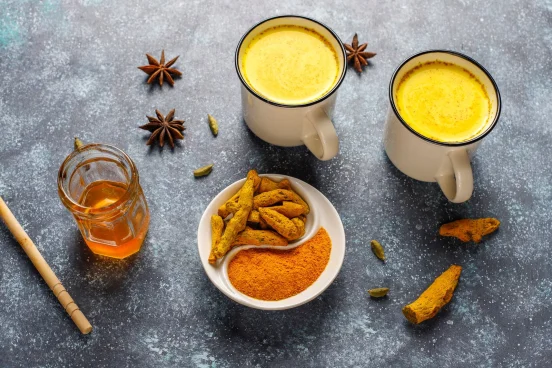
Dans la cuisine de la grand-mère de Mihika, à Alibaug, il y avait un rituel immuable chaque soir d'hiver. Dès que les températures baissaient ou que quelqu'un commençait à renifler, une petite casserole apparaissait sur le feu. Du lait chaud, une cuillère de curcuma, du gingembre, un trait de poivre noir. Ce n'était pas une recette tendance — c'était simplement ce que les mères et grands-mères indiennes préparaient depuis des générations, naturellement, sans y penser. Ce breuvage doré, les Indiens l'appellent Haldi Doodh : le lait au curcuma.
En Occident, cette boisson a pris le nom de golden milk, ou lait d'or. Elle s'est retrouvée sur les ardoises des cafés branchés, dans les magazines de bien-être, sur les comptes Instagram de chefs étoilés. Mais derrière cette hype récente se cache une tradition ayurvédique de plusieurs millénaires — une tradition qui n'a pas attendu la validation des nutritionnistes pour prouver son efficacité. Si vous avez déjà sirotée un vrai golden milk préparé avec les bonnes épices et les bonnes proportions, vous savez exactement de quoi nous parlons.
Le golden milk n'est pas une invention de café berlinois. C'est le Haldi Doodh — le lait au curcuma que les familles indiennes boivent depuis des siècles avant d'aller se coucher.
L'Ayurveda et le curcuma : une histoire de millénaires
L'Ayurveda — littéralement "science de la vie" en sanskrit — est un système médical traditionnel indien vieux de plus de 5 000 ans. L'un de ses principes fondateurs est l'idée que la santé naît de l'équilibre entre les trois doshas (forces vitales) : Vata, Pitta et Kapha. La beauté du curcuma, aux yeux des praticiens ayurvédiques, est qu'il est considéré comme l'une des rares épices capables d'équilibrer les trois doshas simultanément.
Dans les textes ayurvédiques anciens, le curcuma — appelé Haridra — est décrit comme une épice réchauffante, purifiante et fortifiante. On lui prêtait des vertus contre les inflammations, les refroidissements, les troubles digestifs, et on le conseillait pour favoriser un sommeil profond. Ces mêmes usages, transmis de génération en génération, se retrouvent aujourd'hui au cœur de la recherche scientifique moderne. Rarement une tradition millénaire et la science contemporaine ont été aussi alignées.
Le Haldi Doodh était préparé dans des moments précis de la vie familiale indienne : lors d'un rhume ou d'une grippe, avant le coucher pour calmer l'esprit, après un effort physique intense, ou simplement comme rituel de soin quotidien pendant les saisons froides. C'était la médecine du quotidien — simple, accessible, et d'une efficacité éprouvée par des siècles de pratique.
La science derrière le golden milk : pourquoi ça fonctionne
Le composé actif du curcuma s'appelle la curcumine. C'est une molécule polyphénolique qui donne au curcuma sa couleur jaune intense et concentre l'essentiel de ses propriétés thérapeutiques. Des centaines d'études scientifiques ont documenté ses effets anti-inflammatoires, antioxydants et neuroprotecteurs. Mais il y a un problème : la curcumine est très mal absorbée par le corps lorsqu'elle est consommée seule.
Et c'est précisément ici que la recette traditionnelle révèle toute sa sophistication. Deux ingrédients clés de la recette authentique agissent comme des amplificateurs naturels de l'absorption :
- Le poivre noir : la pipérine, l'alcaloïde qui donne au poivre son piquant caractéristique, augmente la biodisponibilité de la curcumine de 2 000 % selon une étude publiée dans Planta Medica en 1998. C'est un chiffre extraordinaire. Une simple pincée de poivre noir dans votre golden milk n'est pas un ajout de saveur — c'est un mécanisme biochimique essentiel.
- Le lait (ou tout corps gras) : la curcumine est liposoluble, c'est-à-dire qu'elle se dissout dans les graisses, pas dans l'eau. Sans corps gras, la majorité de la curcumine traverse le système digestif sans être absorbée. Le lait — qu'il soit de vache, de coco ou d'avoine — assure cette solubilisation et permet à la curcumine d'atteindre la circulation sanguine.
En d'autres termes, les grand-mères indiennes avaient découvert empiriquement, des siècles avant la chimie moderne, exactement comment maximiser l'efficacité du curcuma. La science ne fait que confirmer ce qu'elles savaient déjà. La recette traditionnelle du Haldi Doodh n'est pas un hasard — c'est une formule optimisée.
Pourquoi le curcuma Lakadong change tout
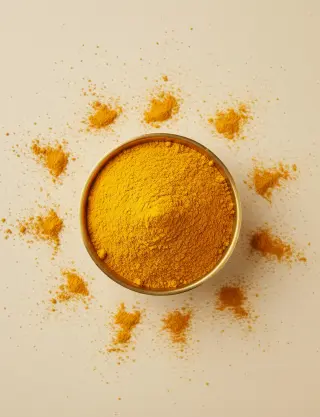
Tous les curcumas ne se valent pas. Le curcuma standard que l'on trouve en grande surface contient entre 2 et 4 % de curcumine — c'est déjà appréciable, mais loin d'être exceptionnel. Le curcuma Lakadong que nous proposons chez Table Indienne est une variété cultivée dans les collines de Meghalaya, dans le Nord-Est de l'Inde, et il contient entre 7 et 8 % de curcumine.
Ce n'est pas un argument marketing — c'est une différence mesurable et concrète. Un golden milk préparé avec du curcuma Lakadong contient deux fois plus de curcumine qu'une recette utilisant du curcuma ordinaire. La teneur exceptionnelle du Lakadong est attestée par des analyses indépendantes ; elle est le fruit d'un terroir unique, d'une variété sélectionnée sur des générations et d'un savoir-faire agricole transmis par les communautés Khasi et Jaintia du Meghalaya.
Nos fournisseurs de curcuma Lakadong sont certifiés bio. Lorsque vous préparez votre golden milk avec ce curcuma, vous bénéficiez non seulement d'une concentration en curcumine remarquable, mais aussi d'une épice cultivée sans pesticides, dans le respect des traditions agricoles locales.
7 à 8 % de curcumine contre 2 à 4 % pour un curcuma standard : votre golden milk au Lakadong est deux fois plus puissant. Ce n'est pas une impression — c'est de la chimie.
La recette authentique du golden milk
Voici la recette de base, proche de ce que l'on prépare dans les familles indiennes. Elle est simple, rapide, et profondément efficace.
- 250 ml de lait : lait de vache entier pour la tradition, ou lait de coco pour une version plus crémeuse et légèrement sucrée, ou encore lait d'avoine pour une alternative végétale douce. Chaque variante apporte son propre caractère.
- 1 cuillère à café de curcuma Lakadong en poudre : c'est le cœur de la recette. Ne lésinez pas sur la qualité — c'est ici que la différence se joue vraiment.
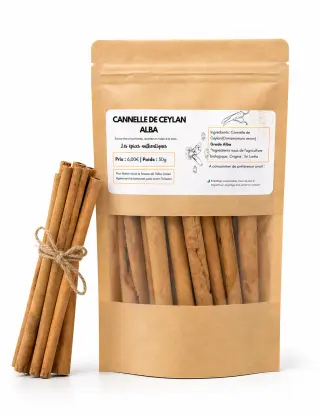
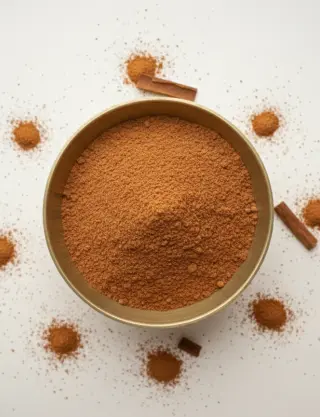
- 1/4 de cuillère à café de cannelle de Ceylan : douce, légèrement vanillée, elle apporte chaleur et rondeur. Choisissez de préférence la vraie cannelle de Ceylan plutôt que la casse — sa saveur est plus fine et sa teneur en coumarine plus faible.
- 1/4 de cuillère à café de gingembre en poudre (ou 1 cm de gingembre frais râpé) : réchauffant et légèrement piquant, le gingembre renforce les propriétés anti-inflammatoires du curcuma et apporte une note de vivacité bienvenue. Le gingembre frais donne un goût plus prononcé et une texture légèrement différente — filtrez alors votre lait avant de servir.
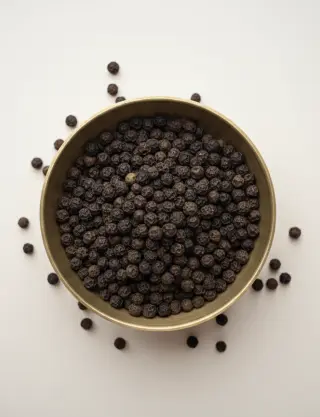
- Une pincée de poivre noir fraîchement moulu : indispensable, impératif, non négociable. Sans poivre noir, vous ne profitez que d'une fraction des bénéfices du curcuma. C'est l'ingrédient le plus important après le curcuma lui-même.
- 1 cuillère à café de miel ou de sirop d'érable (facultatif) : à ajouter hors du feu, une fois le lait légèrement refroidi, pour préserver les enzymes du miel. Le golden milk peut tout à fait se déguster sans sucrant — la cannelle apporte déjà une douceur naturelle.
Préparation : versez le lait dans une petite casserole et faites-le chauffer à feu doux. Ajoutez le curcuma, la cannelle, le gingembre et le poivre noir. Mélangez bien et laissez frémir doucement pendant 5 minutes — ne portez pas à ébullition, la chaleur excessive dénature certains composés. Si vous avez utilisé du gingembre frais, filtrez le lait à travers une passoire fine avant de servir. Versez dans une tasse et ajoutez le miel ou le sirop d'érable hors du feu. Buvez chaud, lentement, idéalement avant de vous coucher.
Les variations pour toutes les saisons
La recette de base est un point de départ — elle se décline à l'infini selon vos goûts, la saison et l'occasion.
- Golden milk glacé (version été) : préparez la recette de base, laissez refroidir, puis versez sur des glaçons. Ajoutez quelques gouttes de vanille et une touche de lait de coco pour une version estivale rafraîchissante qui ne sacrifie rien aux bienfaits.
- Golden milk latte : pour une version café, préparez votre golden milk avec seulement 150 ml de lait, puis moussez 100 ml de lait d'avoine ou d'amande séparément et versez en couche sur le dessus. La mousse dorée au curcuma est spectaculaire et la saveur est plus concentrée.
- Golden milk à l'ashwagandha : ajoutez 1/2 cuillère à café de poudre d'ashwagandha à la recette de base. Cette plante adaptogène de l'Ayurveda est réputée pour réduire le cortisol et favoriser un sommeil profond — une combinaison idéale pour la boisson du soir.
- Smoothie golden milk : mixez la recette froide avec une banane mûre et quelques morceaux de mangue congelée. Le résultat est crémeux, naturellement sucré et d'un jaune éclatant — parfait pour un petit-déjeuner anti-inflammatoire ou une collation post-entraînement.
Quand et pourquoi en boire
Le golden milk est une boisson polyvalente dont les bénéfices varient selon le moment de consommation :
- Le soir, avant le coucher : c'est le moment traditionnel du Haldi Doodh. Le lait chaud et les propriétés légèrement sédatives du curcuma et de la cannelle favorisent la détente et la transition vers le sommeil. L'ashwagandha renforce cet effet si vous le souhaitez.
- En saison froide et lors d'un rhume : les propriétés réchauffantes et immuno-stimulantes du curcuma, du gingembre et du poivre en font un allié naturel pour traverser l'hiver alsacien. À boire plusieurs fois par jour lors des premiers symptômes.
- Après l'effort physique : les propriétés anti-inflammatoires de la curcumine aident à réduire les courbatures musculaires post-entraînement. Une étude publiée dans The Journal of the International Society of Sports Nutrition a montré une réduction significative des marqueurs d'inflammation musculaire après supplementation en curcumine.
- Comme rituel quotidien de bien-être : en médecine préventive ayurvédique, le golden milk est recommandé comme soin quotidien, surtout pour les personnes soumises à un stress chronique ou à des environnements polluants. L'effet bénéfique s'accumule dans le temps.
Les épices, toutes disponibles chez Table Indienne
Toutes les épices de cette recette sont disponibles dans notre boutique de Wittisheim et sur notre site. Nous avons sélectionné chaque produit en fonction de sa qualité, de son origine et de sa concentration en principes actifs :
- Curcuma Lakadong en poudre : notre curcuma star, avec 7 à 8 % de curcumine — la meilleure teneur disponible sur le marché. Issu de fournisseurs certifiés bio, cultivé dans les collines de Meghalaya. C'est l'ingrédient qui fait la différence. Vous pouvez en apprendre davantage sur notre article dédié au curcuma Lakadong.
- Poivre noir entier de Malabar : la côte de Malabar (Kerala) est l'une des régions productrices de poivre les plus réputées au monde. Notre poivre est proposé entier pour une fraîcheur maximale — moulez-le au dernier moment pour une pipérine active optimale.
- Cannelle de Ceylan Alba : la vraie cannelle (Cinnamomum verum), douce et délicate, à distinguer de la casse (Cinnamomum cassia) vendue en grande surface sous le même nom. Sa faible teneur en coumarine la rend parfaite pour une consommation régulière.
- Gingembre en poudre : pratique pour la recette du golden milk, notre gingembre en poudre offre une concentration aromatique supérieure au gingembre frais et une conservation longue durée dans votre masala dabba.
Le secret d'un bon golden milk tient dans deux choses : la qualité du curcuma et le poivre noir. Le reste est une question de goût personnel. Commencez simple, ajustez les proportions, et faites-en votre propre rituel.
Le golden milk est peut-être la boisson la plus simple à préparer et la plus profondément bénéfique que l'on puisse intégrer à son quotidien. Pas de matériel sophistiqué, pas d'ingrédients introuvables, pas de technique complexe — juste quelques épices remarquables, du lait, et cinq minutes de votre temps. La grand-mère de Mihika le savait depuis toujours.