


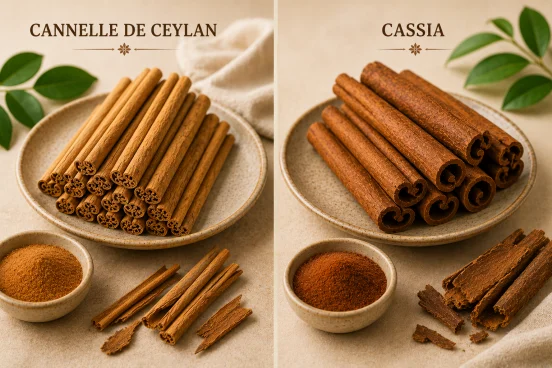
In most European supermarkets, what is sold to you as "cinnamon" is actually cassia — a related but botanically different spice from the true cinnamon used for centuries in India. The confusion is so widespread that few shoppers realise there are actually two distinct cinnamons.
Two spices, one name
True cinnamon is the bark of a tree called Cinnamomum verum (formerly Cinnamomum zeylanicum), native to Sri Lanka — the former Ceylon — and also grown in Kerala, in southern India. This is the only species that can rightfully be called "Ceylon cinnamon".
What you most often find on shelves is actually Cinnamomum cassia (also called Chinese cinnamon), native to China and Vietnam. Cheaper to produce, it now accounts for around 90% of all the "cinnamon" sold worldwide — to the point of becoming, in most people's minds, cinnamon itself.
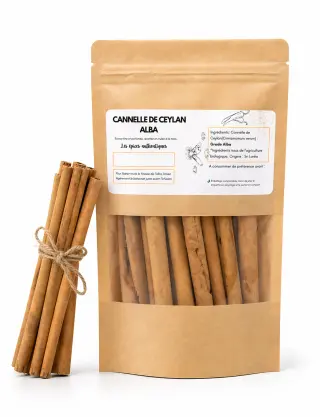
Our Ceylon Cinnamon Alba is genuine Cinnamomum verum — the only species we carry in our shop.
Coumarin: the real difference to know about
Beyond flavour, the most concrete difference between the two cinnamons is chemical. Both barks naturally contain coumarin, an aromatic compound — but in very unequal amounts. Cassia can contain up to around 1 gram per kilo, while Ceylon cinnamon contains only trace amounts, around 0.004 grams per kilo.
The European Food Safety Authority (EFSA) has set a tolerable daily intake of 0.1 mg of coumarin per kilo of body weight. For a 70 kg adult, that works out to roughly 7 mg per day. As a reference point, a single teaspoon of ground cassia (around 2 g) can on its own contain up to 2 mg of coumarin — a figure that can quickly approach the limit with daily consumption, particularly around holiday baking season. Germany's food safety agency (BfR) has previously issued warnings on exactly this point regarding traditional Christmas biscuits. With Ceylon cinnamon, this is barely a concern at all, since its coumarin content is negligible.
It is not just a matter of taste: a real chemical difference is what sets Ceylon cinnamon apart from cassia.
How to tell them apart at a glance
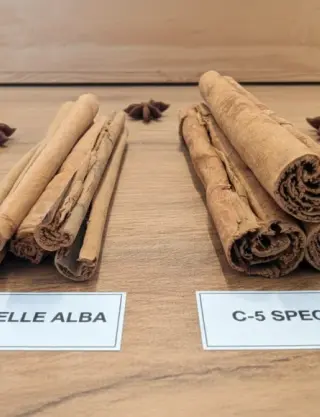
Once you know what to look for, the difference is obvious — to both the eye and the fingers. A Ceylon cinnamon stick is thin, light, and made up of several thin layers of bark rolled together, a bit like a rolled-up mille-feuille. Its texture is brittle: it can be easily snapped, or even crumbled between your fingers.
A cassia stick, by contrast, is thick, hard and dense: it is a single, thick piece of bark curled in on itself from both edges toward the centre. Its colour is darker, leaning toward reddish-brown, and you usually need a knife or a mortar to break it.
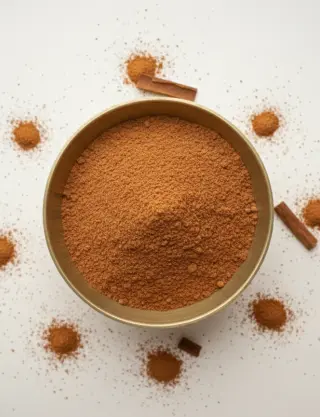
Prefer a ready-to-use powder? Our Kerala cinnamon is ground from this very same Ceylon cinnamon, right in its region of origin.
A matter of taste, too
This botanical difference carries straight through to the plate. Ceylon cinnamon has a delicate, slightly sweet flavour, with subtle floral and citrus notes. Cassia, on the other hand, is far bolder: its sharp, sometimes bitter taste tends to dominate the other spices in a dish.
It is precisely for this delicacy that Ceylon cinnamon is favoured in traditional Indian cooking, where it blends into a balance of flavours — as in a garam masala — without ever overpowering it. Not all Ceylon cinnamon grades are equal, though: the Alba grade, with its especially thin, delicate quills, is considered the finest of all. The C-5 Special grade, slightly bolder, remains an excellent alternative — our Ceylon Cinnamon C-5 Special is a fine example.
At Table Indienne
At Table Indienne, we only carry genuine Ceylon cinnamon (Cinnamomum verum) — never cassia. You will find it, among other places, in our golden milk recipe and in our masala chai recipe, where its delicacy balances the other spices without ever dominating.
Want to taste it for yourself? Find our Ceylon Cinnamon Alba sticks in our shop.