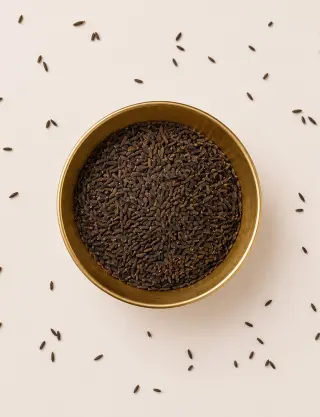
In the kitchens of the Mughal courts, a single pinch was enough to tell an everyday rice apart from one fit for an emperor. That pinch was often kala jeera, the "black cumin" of the Himalayas, also known as shahi jeera, literally "royal cumin". Fine, elongated, dark brown-black seeds with a smoky, woody, subtly sweet aroma: this is one of the most misunderstood, and most mislabelled, spices in Indian cooking.
Three spices, one name: untangling the confusion
"Black cumin" is probably the most misleading spice name there is: depending on the region and the language, it refers to three botanically distinct plants. Before you start a biryani, it is worth knowing exactly which one is in your jar.
- Kala jeera, or shahi jeera (Bunium persicum): today's hero. Fine, elongated, very dark brown seeds that grow wild at altitude in the Himalayas. A smoky, earthy, subtly sweet aroma. This is the true royal spice of Mughal biryanis.
- Nigella, or kalonji (Nigella sativa): often called "black cumin" in English or Bengali, it is botanically unrelated to kala jeera. Its seeds are small, black, triangular, with a pungent, slightly bitter taste closer to toasted onion. You will find it on naan bread, never in a royal biryani.
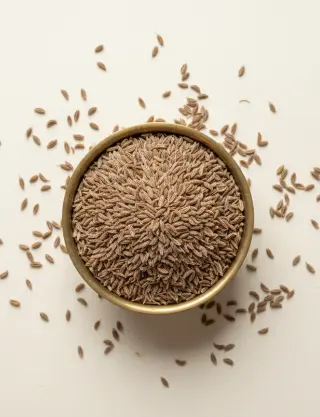
- Everyday cumin (Cuminum cyminum): the one you already use for your tadkas and dals, our cumin seeds. Light beige, with a sharper, more earthy taste and none of kala jeera's smoky, sweet notes. The everyday cousin, not the star of the feast.
If a biryani recipe calls for "shahi jeera", never substitute ground cumin: you would lose the smoky subtlety that makes the dish.
A royal aroma: smoky, woody, sweet
Kala jeera earns its nickname from a unique aromatic profile, worlds away from everyday cumin. Dry-roasted for a few seconds, it releases smoky, woody notes with an almost resinous hint of sweetness, a little like a more refined, more complex version of the cumin you already know. It is precisely this subtlety that makes it a prized ingredient for dishes where the spice needs to perfume rather than dominate: rice, braised meats, premium spice blends.
Unlike everyday cumin, kala jeera cannot be farmed at scale: it grows wild between 2,000 and 3,000 metres of altitude, in Himalayan meadows across Kashmir, Uttarakhand and Iran. This scarcity explains both its higher price and its status as a spice "reserved for special occasions" in traditional Indian cooking.
How to use it in the kitchen
Kala jeera pairs especially well with rice and slow-cooked meats. A few ideas for using it:
- Biryani and pilaf rice: add a teaspoon of whole seeds to the rice before cooking, or into hot ghee before frying the onion.
- Mughal meat dishes: lamb or chicken simmered in a korma or rogan josh gain depth from a few roasted seeds added at the end of cooking.
- Premium garam masala: some festive or ceremonial blends replace part of the everyday cumin with kala jeera, for a subtler fragrance.
- Always dry-roast first: like most whole spices, a few seconds in a hot pan is enough to wake up the full aroma. Check out our complete guide to toasting spices so you never burn them.
Gauraaj: the hands of Himalayan women
Our kala jeera comes from Gauraaj, a collective founded in 2021 in remote villages of Uttarakhand, in the Indian Himalayas, to give rural women a dignified income during the health crisis. Behind every packet lies entirely manual work: harvesting at altitude, traditional sorting and drying, carried out by these women according to knowledge passed down through generations. These small family farms grow and harvest without pesticides, following the region's ancestral practices.
Kala jeera at Table Indienne
At Table Indienne, we offer this Himalayan black cumin (kala jeera) in small quantities, in keeping with its rarity. A single pinch is enough to turn an everyday rice into a festive dish. Try it in our kala jeera pulao, a fragrant basmati rice that puts this rare spice center stage. If you enjoy discovering the Himalayas' rare spices, also take a look at our article on jakhiya, the secret Himalayan spice, another lesser-known treasure of the region.