



A dish that smells of toasted coconut and citrus, nothing like a jar of curry powder: that is the signature aroma of South India, and it comes from a handful of small, dark green leaves. Curry leaves, or kadi patta in Hindi, are one of the most misunderstood aromatics outside India, and yet one of the most essential ones at home, from Kerala to Tamil Nadu.
No, curry leaves have nothing to do with curry powder. One is a fresh leaf picked from a tree; the other is a ground spice blend invented in the West. Confusing the two means missing out on one of the most delicate flavours in Indian cooking.
Curry leaves and curry powder: two completely different things
This is the most common mix-up, and it is worth clearing up once and for all. Curry powder is a ground spice blend (turmeric, coriander, cumin, sometimes chilli) invented in the 19th century by the British as a distant nod to Indian cooking: we cover this in detail in our article on Indian cooking and curry powder. Curry leaves, on the other hand, are a real botanical ingredient: the leaf of the Murraya koenigii tree, used fresh or dried, never ground into powder. No commercial curry powder contains curry leaves, and no Indian cook would ever call curry powder "curry leaves". These two products share nothing but their English name.
Where do curry leaves come from? Kadi patta, the star of South India
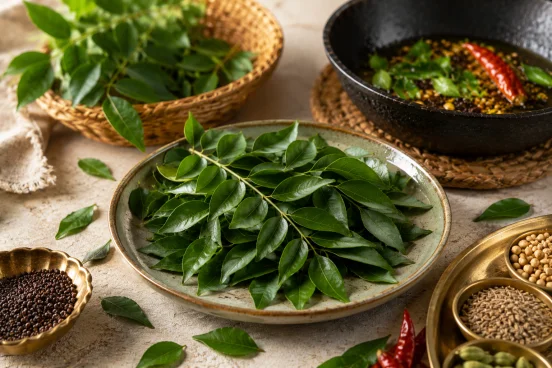
Murraya koenigii is a small tree native to the Indian subcontinent, in the same botanical family as citrus fruits (Rutaceae): which explains its slightly lemony, peppery and resinous aroma. It is known as kadi patta in Hindi, karivepaku in Telugu, karuveppilai in Tamil. It grows in nearly every garden across Kerala, Tamil Nadu, Karnataka and Andhra Pradesh, where a fresh sprig is picked daily for home cooking.
In these regions, curry leaves are not an "exotic" touch: they are as ordinary and essential as garlic or onion in French cooking. You will find them in dals, sambars, vegetable curries, chutneys, and even some savoury pastries.
The curry leaf tree, kaloupilé (Murraya koenigii), can actually be grown at home in a pot: a small tropical tree that thrives in a bright indoor spot, protected from frost (down to around 0°C at most), giving you fresh leaves within reach year-round. You do not even have to look far for a plant: Alsagarden, a nursery in our own Alsace region, sells them: a little piece of India growing close to our workshop in Wittisheim.
Tadka: sizzling curry leaves in hot oil
The right way to release their full aroma is almost never to toss them cold into a pot: it is to let them sizzle in very hot oil or ghee, either at the very start or the very end of cooking, alongside mustard seeds and cumin. This technique is called tadka (or tempering): we dedicate a whole article to it: tadka, the Indian art of spice tempering.
In practice: heat a tablespoon of neutral oil or ghee in a small pan. Once it shimmers, add a teaspoon of mustard seeds; as soon as they start popping, throw in 8 to 10 fresh curry leaves. They will crackle loudly and curl up within seconds: that is completely normal, and it is exactly the moment they release their most intense aroma. Pour this tadka immediately over your dal, rice, or steamed vegetables.
- At the start of cooking: to flavour the oil that will form the base of the whole dish (curries, stir-fried vegetables).
- At the end of cooking: as a tadka poured over an already-cooked dal or sambar, for a fresh, contrasting note.
- Watch out for splattering: fresh leaves contain water and crackle hard on contact with hot oil: keep your face back and partly cover the pan if needed.
Fresh or dried: what is the flavour difference?
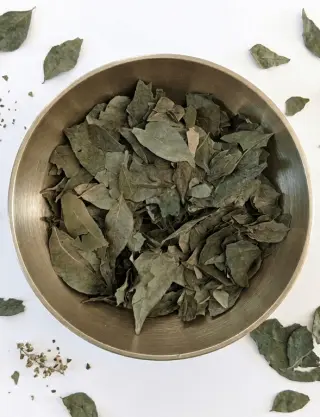
Fresh, curry leaves are vibrant, almost sharp, with distinct citrus and anise notes. Dried, they lose some of that vividness but concentrate their aroma into a more earthy, subtle form: a perfectly reasonable compromise when fresh leaves are not available, which is the case in most kitchens outside India. Our dried curry leaves from Uttarakhand are harvested and slowly dried to preserve as much of their citrus and resinous aroma as possible.
To make up for the lower intensity of dried leaves, simply use a larger quantity (about double compared to fresh leaves) and let them sizzle a little longer in hot oil, until they turn crisp.
Iconic dishes of South India
It is impossible to talk about curry leaves without mentioning the great classics of the South: sambar (a lentil and vegetable soup), rasam (a tangy tamarind broth), Kerala's coastal fish curries, and of course thoran, the grated-vegetable-and-coconut stir-fry where curry leaves play a central role in the opening tadka. Check out our step-by-step recipe for thoran, coconut vegetable stir-fry to see their traditional use in practice.
No curry leaves on hand? Possible substitutes
No single ingredient truly replicates their unique aromatic profile, but in a pinch, a few options come close to the spirit of the dish:
- Dried curry leaves: by far the closest substitute, it is the same leaf, simply dehydrated.
- Lime zest + bay leaves: a combination that, failing anything better, brings both the citrus note and a light resinous background.
- Kaffir lime leaves: botanically related (same Rutaceae family), they offer a comparable citrus aroma, though more intense.
- To avoid: curry powder never replaces curry leaves, they simply are not the same thing, botanically or flavour-wise.
How to store curry leaves
Fresh, they keep for 1 to 2 weeks in the fridge, wrapped in slightly damp paper towel and placed in a perforated bag; they can also be frozen directly on the stem without losing much aroma. Dried, keep them away from light and moisture in an airtight jar: ideally in your masala dabba: where they will hold their aroma for several months.
Curry leaves at Table Indienne
We offer dried curry leaves from Uttarakhand, harvested in northern India and carefully dried to preserve as much of their citrus and resinous aroma as possible. Everything you need to try your first tadka and bring the real taste of South India (nothing like a tin of curry powder) into your kitchen.